
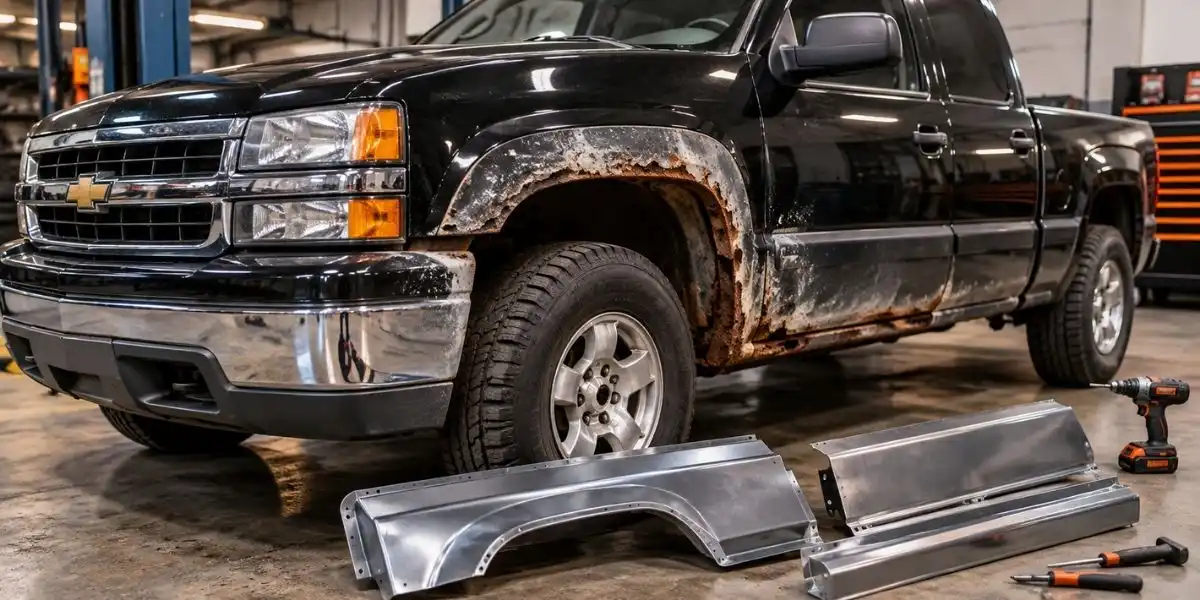
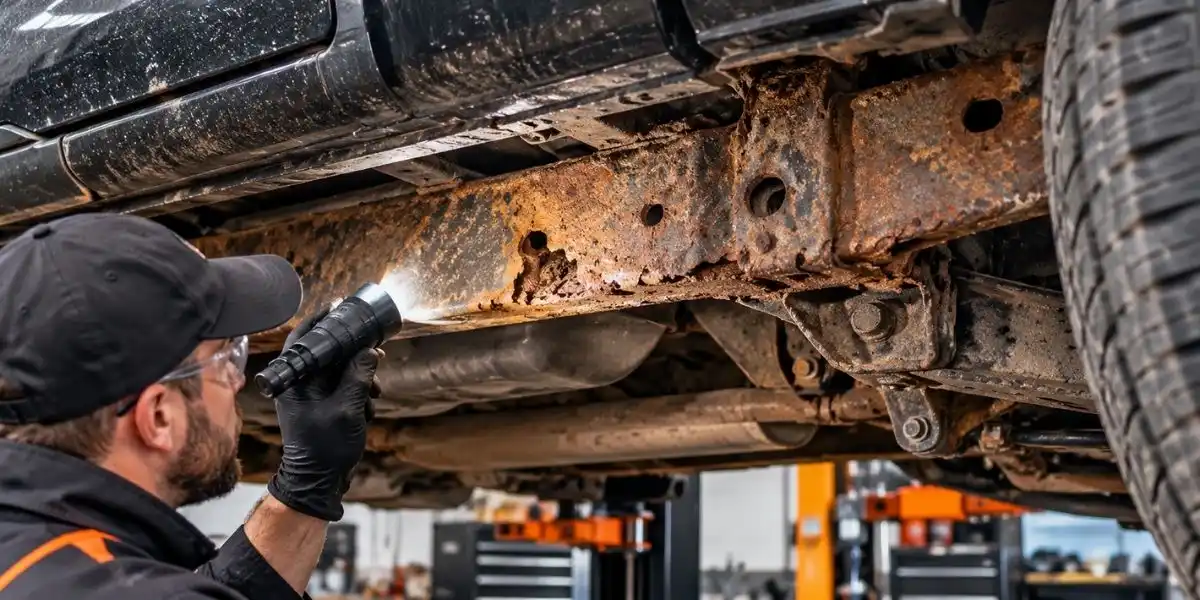
Chevy truck rust repair panels are sold for particular repair areas and vehicle applications, so the useful first step is to identify both the damaged section and the cab or bed actually on the truck. Start by comparing the relevant panel type, such as a cab-corner patch, rocker, floor section, or bedside, with the listing’s stated application and the rust boundary. This is a fitment-checking guide, not a verified list of current products: the catalog links below are places to search, but the specific part number, coverage, and availability must be confirmed with the seller.
Protecting a Chevy truck after a panel repair? See our truck undercoating and rust protection service for truck pricing by size, what is covered and booking.
Start with the repair area, not a broad truck search
“Chevy truck panel” is too broad to produce a reliable match. A useful search begins with the body area, side, and the truck’s identifying details. Panel names are not precise measurements: a listing called a cab corner might describe a small patch or a larger section, and the title alone may not show whether its edge reaches the seam where corrosion continues.
Before looking at catalogs, write down what is visible. Note whether the damage is on the driver or passenger side, which adjoining areas it approaches, and whether the truck may have had prior repairs. If you do not know the cab or bed configuration, mark it as unknown instead of guessing. That makes it easier to compare listing language without treating a broad year range as a fitment guarantee.
Use the panel category to narrow the search
These are repair-area examples, not confirmed product listings. They help describe what to search for and what to clarify with a seller:
- Cab corner: Specify the side and whether the rust is limited to the corner or reaches the rocker or another adjoining edge.
- Rocker: Ask whether the listing is for an outer rocker, an inner component, or both. Those descriptions do not necessarily mean the same piece.
- Floor section: Describe whether the damage is local or reaches a sill, brace, or attachment point. A small floor patch may not cover a larger affected area.
- Bedside: Name the side and say whether rust approaches the wheel opening, bed rail, or lower edge.
- Front body panel: Identify whether the affected part is a fender, door, or another component; nearby rust does not make those panels interchangeable.
A concise search description might read: “Chevrolet pickup, year and cab style to confirm, passenger-side cab corner, rust approaches rocker.” It is not a fitment specification. It is a way to keep the search focused and give a parts seller the relevant unknowns to resolve.
Build a shortlist without assuming a catalog result fits
Use catalogs to find candidate panel categories and part numbers, then open the individual listing. GM’s parts search is a starting point for looking up vehicle parts; LMC Truck and Classic Industries are additional catalog entry points for restoration-related searches. A catalog homepage does not verify a particular panel’s application, dimensions, stock, or current return terms, so treat each candidate as unconfirmed until its own listing or the seller answers your specific question. See GM Parts, LMC Truck, and Classic Industries.
Search with the information you have, then use the product description to identify gaps. A candidate that says “Chevrolet truck” without clarifying year range or body configuration is not enough to settle fitment. Likewise, a broad year span in a search result is not evidence that every cab, bed, or production variation is covered. If a catalog offers a vehicle selector, use it as a filter, not as a substitute for reading the item’s application notes.
Compare candidates by what the listing actually states
For each possible panel, record the part number and copy the application wording rather than relying on a search-result headline. Keep separate notes for what is stated, what is missing, and what the seller confirms. A simple comparison can prevent a common mistake: choosing a listing because its title names the right general area, then discovering that the side, panel extent, or configuration differs from what the repair requires.
| Compare | What to record |
|---|---|
| Application | Make, model, stated year range, and any cab or bed restrictions |
| Orientation | Driver side, passenger side, pair, or unspecified |
| Panel type | Patch, outer piece, inner component, or larger assembly |
| Coverage | Where the supplied panel begins and ends, based on a diagram or seller description |
| Exceptions | Production distinctions, companion pieces, and body-style exclusions |
| Order terms | Return process and what to do if the delivered part differs from the confirmed item |
If two candidates appear similar, compare their descriptions and diagrams rather than deciding from their names or photographs alone. Ask whether the image shows the complete supplied piece and whether adjoining parts are included. If the listing cannot establish the boundaries, request a diagram or written clarification tied to that part number before ordering.
Identify the body currently on the truck
A truck’s paperwork can help identify its original configuration, but older vehicles may have replacement cabs, beds, or sheet metal. Restoration work, collision repair, and prior owner modifications can make the installed body different from what a parts search assumes. Describe the vehicle you have, not only the vehicle you believe it started as.
The NHTSA VIN Decoder can be used to look up vehicle information from a VIN. Treat the result as an identification aid, not proof that the truck still has its original body parts. If decoded details and visible body features do not seem to agree, keep both facts in your notes and ask the seller which configuration their part application requires.
Separate known details from assumptions
Before sending a fitment question, make a short record with the VIN-derived information you have, the visible cab and bed features, and anything uncertain. Include the damaged side and panel area. If the cab or bed may have been changed, say so plainly. That gives the seller a chance to explain whether the listing is based on model identity, body style, or another stated distinction.
- Known: the make, the visible repair area, and the affected side.
- To verify: year or body details that are unclear from the truck or its records.
- Possible change: a replacement cab, bed, or previous sheet-metal repair.
- Evidence to share: clear photos showing the damaged area and nearby seams, plus the listing or part number.
Photos can help show where the rust lies, but they cannot establish hidden body changes or prove that a catalog part fits. If the truck has an uncertain history, prioritize a seller response tied to the item number and the configuration details you provided. Keep that response with the order information in case a mismatch needs to be resolved.
Match panel coverage to the rust boundary
Fitment and repair coverage are different decisions. Fitment asks whether the part is intended for the truck’s application. Coverage asks whether its edges reach the damaged area while leaving suitable material for the repair. A panel can be listed for the right vehicle and still be too small for corrosion that extends past its edge.
Rust visible from outside may not show the full boundary. Corrosion can continue along a seam or behind a flange, and an old patch can hide the condition of the metal beneath it. Do not use a product title as a cutting template. Compare the actual supplied shape, using a diagram or seller explanation, with the area that needs repair, and leave the final repair boundary to an inspection of the truck.
Choose a patch or larger section based on the inspected damage
A small patch may suit a localized area when surrounding metal is sound. A larger section may be needed if corrosion reaches farther, but it can also involve more panel edges and adjoining repair work. Neither size is automatically the better choice. The inspected corrosion boundary, not the listing’s label or apparent price, should guide the coverage decision.
When the area is accessible, inspect the metal and seams around the proposed repair. Swelling, perforation, thin metal, or evidence of earlier repairs can change the plan. If corrosion approaches a body mount, seat attachment, or another structural connection, do not assume a cosmetic patch resolves the structural concern; get that area assessed separately by a qualified repairer.
- Ask where each edge of the panel falls in relation to the nearby seam or opening.
- Confirm whether the listing is for a single piece, a pair, or a panel with companion parts sold separately.
- Ask the repairer whether the visible rust boundary is likely to include hidden or weakened metal.
- Pause before ordering multiple adjoining panels if the extent of corrosion has not been inspected.
For example, if a cab-corner listing appears relevant but the visible rust line continues into the rocker, the name “cab corner” does not answer whether the included metal reaches that line. Compare the part boundaries with the damaged area and have the repairer assess whether the surrounding metal is sound. This is a decision about coverage, not a claim that any particular catalog part fits a particular Chevy truck.
Confirm the open questions before ordering
Once you have a candidate, send the seller the item number and the truck details you can verify. Ask for an answer about that exact listing rather than relying on a general statement that a part fits Chevy trucks. Keep the reply and the product description together; that record makes it easier to catch a wrong side, configuration, or panel type before cutting original metal.
- “Does this part number apply to my stated year and cab or bed configuration?”
- “Is it for the driver or passenger side, and is it a single piece or a pair?”
- “Does the item include the full panel shown, and where do its edges begin and end?”
- “Are any production distinctions, exclusions, or companion parts relevant to this application?”
- “What is the return process if the delivered item differs from the application you confirmed?”
When the part arrives, compare its label and shape with the order record before cutting. If the side, application, or supplied boundaries do not match what was confirmed, pause and resolve the discrepancy with the seller. Even a correct panel does not establish how much rust is present on the truck; that depends on inspection of the vehicle.
After body repairs, corrosion protection is a separate job from choosing sheet metal. Bay State Rust Prevention provides WaxOyl rust prevention for vehicle seams, panels, joints, and cavities; see rust prevention undercoating. For assessment, rust removal, and structural restoration questions, review frame-off rust removal. For vehicle corrosion assessment or frame repair in Central Massachusetts, contact baystaterustprevention.com to discuss the services available.