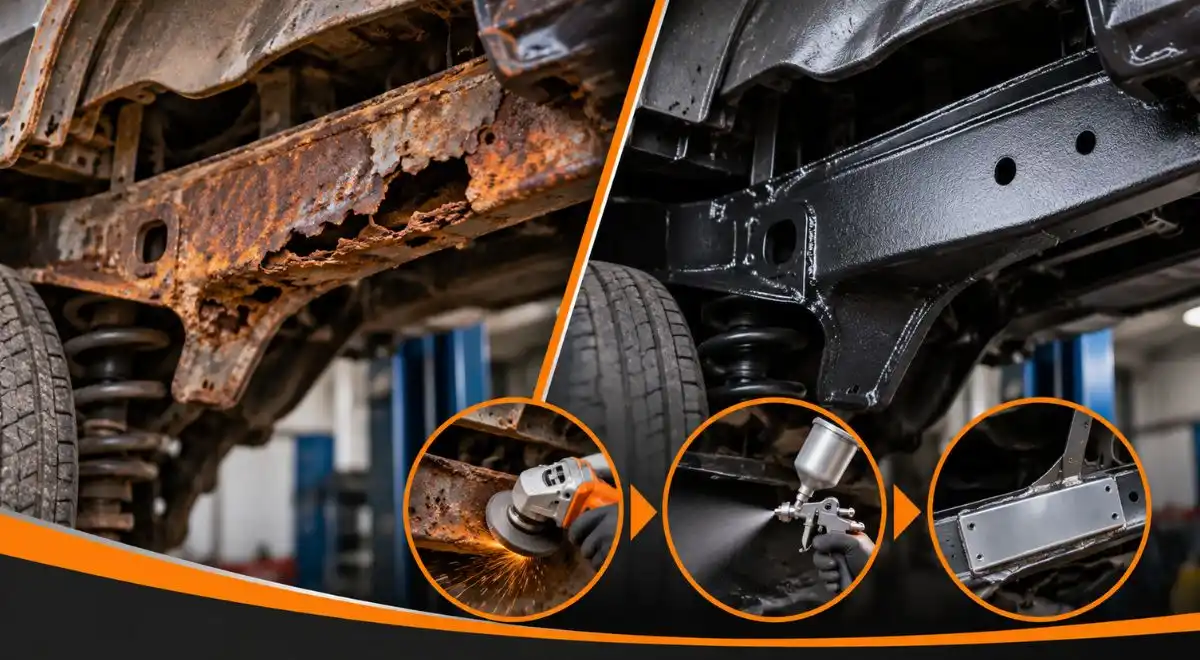
For Subaru rust prevention, first check the underside, remove road salt when washing conditions allow, and choose a treatment that matches the vehicle’s actual condition. This sequence helps owners of new, used, and leased Subarus distinguish routine prevention from rust that needs assessment or repair before any coating is applied.
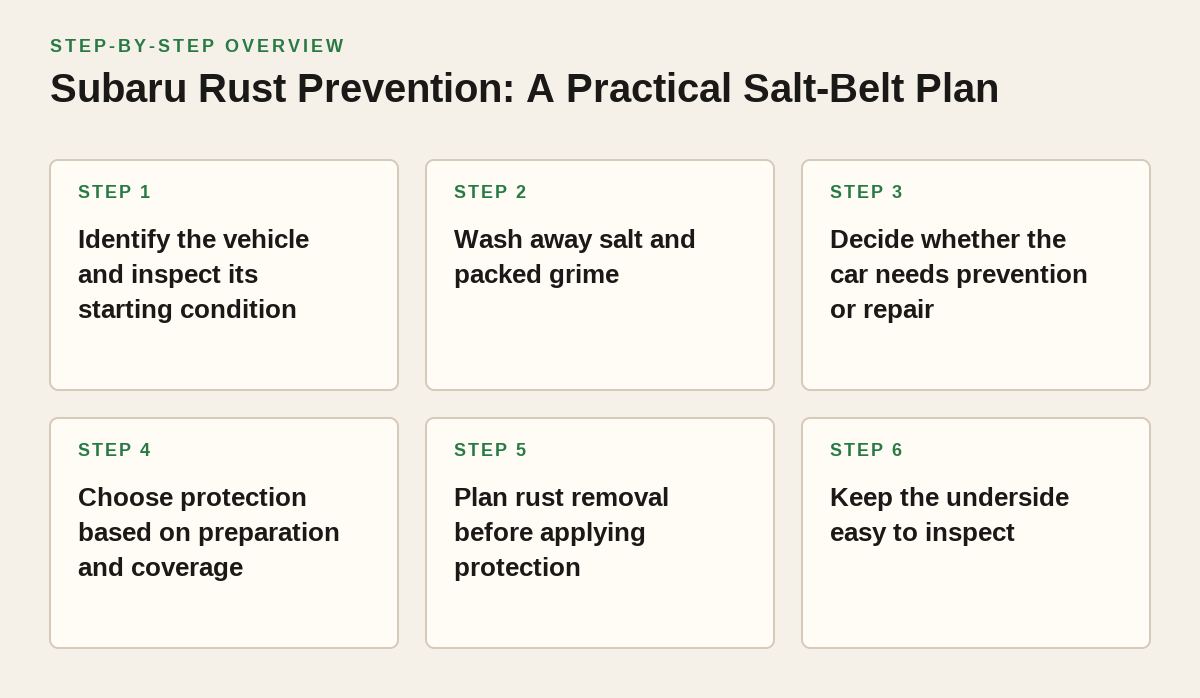
Step 1: Identify the vehicle and inspect its starting condition
Record the model year, model, prior body repairs, and any known rustproofing history. Subaru guidance can vary by vehicle, so consult the owner information for your specific car rather than assuming every model has identical care requirements. Subaru’s owner resources provide a starting point for finding vehicle information.
Inspect the underside in good light when it is dry, without putting yourself beneath a vehicle supported only by a jack. If you cannot view it safely, ask a qualified shop to inspect it. Look for chipped or lifting coatings, rust-colored trails at seams, flaky scale, holes, and damage around mounting areas. Surface staining alone does not establish that a part is structurally weakened; heavy scale, perforation, or uncertain attachment points need closer assessment.
Record what you see
Photograph accessible areas from the same positions and note prior repairs or treatments. A record helps you distinguish old damage from new changes and gives a shop a useful starting point. Classify the condition in practical terms: sound surfaces, light surface corrosion, or damage that needs professional evaluation. Do not use a new coating to conceal uncertainty about the condition of the metal.
Step 2: Wash away salt and packed grime
Road salt can contribute to vehicle corrosion, and its use also raises environmental concerns, as described by Environment and Climate Change Canada. Visible body panels do not show whether salt or grime remains in underbody areas, so include the wheel wells and accessible underside in your washing routine.
Use an underbody rinse when weather and washing conditions make it practical. Focus on the areas behind the wheels, lower body edges, and accessible suspension or underside components. A rinse can remove surface deposits, but it cannot guarantee that salt has been cleared from every enclosed cavity. Avoid directing a close-range, forceful spray at electrical connections, seals, or damaged coating.
- Choose a wash that reaches the underside as well as the exterior panels.
- Clear packed mud and salt from accessible wheel-well areas.
- After washing, look for newly exposed metal or coating that has lifted.
- Follow the vehicle’s own washing cautions where they apply.
There is no single wash schedule that suits every Subaru. As an illustrative starting policy, check and rinse after substantial exposure to treated roads when conditions permit. Adjust based on visible deposits, how often the car uses salted roads, and whether grime repeatedly collects in the same places. Buildup—not a calendar date by itself—is the reason to wash sooner.
Step 3: Decide whether the car needs prevention or repair
Protective treatment is for suitable, prepared surfaces; it does not restore metal weakened by corrosion. Applying coating over loose scale or a hole can obscure the condition without addressing it. Before treatment, have questionable frame sections, suspension attachment areas, or other potentially structural parts assessed. Ask the inspector to explain what is sound, what is corroded, and what cannot be determined without further access.
Use the findings to choose the next action
| What you find | Next action | Reason |
|---|---|---|
| Sound metal or intact existing finish | Clean and dry the underside; discuss prevention. | Protection is a preventive choice, not a repair. |
| Light surface rust with firm metal | Ask what cleaning and preparation are needed before coating. | The surface condition affects whether treatment is suitable. |
| Heavy scale, holes, distortion, or uncertain mounting points | Get a structural assessment before coating. | A coating cannot establish or restore structural strength. |
If you are buying a used Subaru, do not treat a seller’s claim of prior undercoating as proof that the metal is sound. A recall lookup at NHTSA can identify open safety recalls by VIN, but it is not a physical inspection or a rust diagnosis.
Step 4: Choose protection based on preparation and coverage
For a rust-free or properly prepared vehicle, ask what surfaces a proposed treatment covers and how the installer prepares them. Relevant areas may include seams, joints, panels, and cavities, depending on the treatment. Ask what is deliberately left uncoated and how the work will remain inspectable. A visible layer on the underside does not, by itself, tell you whether less visible areas were treated.
Bay State Rust Prevention uses WaxOyl for corrosion protection and provides professional undercoating, including treatment for seams, panels, joints, and cavities. Its rust prevention undercoating page describes the service. Compare options by surface preparation, intended coverage, and suitability for your vehicle, not just by the product name or appearance.
- Ask whether the vehicle needs to be cleaned and dried before treatment.
- Confirm how existing factory coatings and prior repairs will be handled.
- Ask how future inspections can identify new damage or corrosion.
- For a leased car, check the lease terms before authorizing added treatment.
If the car has prior bodywork or an unknown coating history, share that information before work begins. The right choice may be to inspect or prepare particular areas first, rather than apply another layer everywhere.
Step 5: Plan rust removal before applying protection
When corrosion is more than light surface staining, the next job may involve removal, repair, and bare-metal preparation—not simply covering the affected area. Frame-off disassembly and sandblasting can be appropriate when thorough access is needed, but they are not automatic requirements for every rusty Subaru. The extent and location of corrosion, the condition of surrounding parts, and the intended repair should guide the plan.
Questions to ask before authorizing restoration
- Which areas are corroded, and are any structural?
- What must be removed or disassembled to inspect and reach them?
- What preparation or repair is planned before protection is applied?
- How will the shop explain any recommendation to coat visible scale?
Bay State Rust Prevention provides frame-off vehicle disassembly, rust removal through sandblasting, bare-metal preparation, and automotive frame repair. Its frame-off rust removal page describes that work. Request an assessment if the concern involves a frame or attachment point, and ask for a repair recommendation before choosing cosmetic treatment.
Worked example: a used Subaru with a rough underside
Imagine inspecting a used Subaru and finding brown scale on a frame section. You cannot tell from a quick look whether the metal is sound. Photograph the area, ask for treatment and repair records, and arrange an inspection that can assess the metal and nearby attachments. If the structure is sound, discuss cleaning and prevention. If it is compromised or remains uncertain, get a repair assessment before deciding whether to buy. The word “undercoated” does not settle either question.
Step 6: Keep the underside easy to inspect
Protection does not replace later checks. After winter, look for fresh chips, scraped or lifted coating, packed debris, and new rust trails. Revisit any area noted during the first inspection and keep photographs and treatment or repair records together. That makes it easier for a later shop to understand what was previously addressed.
As an illustrative starting policy, check the underside after the salt season and after a scrape or repair draws attention to a particular area. Shorten the interval if deposits recur or protection is damaged; if checks repeatedly show clean, intact surfaces, continue the seasonal review rather than adding treatment without a condition-based reason. AAA’s winter car-care guidance offers seasonal context; use it alongside the instructions for your specific Subaru.
Start with a safe underside inspection
First, identify your Subaru’s model year and photograph the underside from a safe position before applying anything. If you find holes, heavy scale, or uncertain structural areas, seek an assessment before coating; if the metal is sound, compare preparation and coverage. Bay State Rust Prevention provides WaxOyl undercoating, rust removal, frame-off sandblasting, and frame repair; learn more at baystaterustprevention.com.
Authored with NotFair SEO