
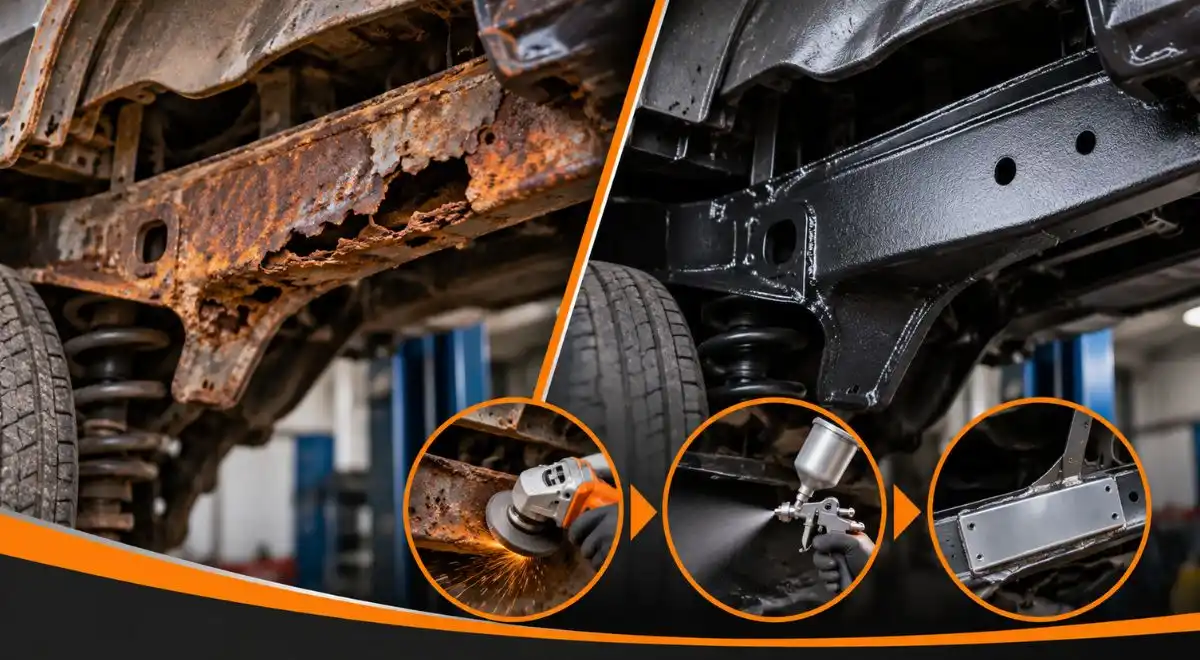
Worcester bare-metal preparation for rusted frames is a way to remove rust and existing coatings from agreed areas so the exposed frame can be assessed and the next step planned. Bay State Rust Prevention provides frame-off disassembly, sandblasting, bare-metal preparation, and automotive frame repair for vehicle owners in Worcester and Central Massachusetts. Preparation can improve visibility, but it does not replace missing metal, establish that a frame is safe to use, or decide what repair is appropriate.
What bare-metal preparation covers
“Bare-metal preparation” describes a surface-preparation stage, not a complete restoration. The work area and purpose should be clear: a shop may be asked to expose a suspected rust area for assessment, prepare a larger section for repair, or remove coatings as one part of a restoration plan. The phrase alone does not specify which surfaces will be reached, how much disassembly is included, or what happens after the metal is exposed.
Paint, undercoating, and corrosion can conceal the visible boundaries of a problem. Removing some of those layers may make surface conditions easier to see, but it does not establish the condition of areas that remain covered or inaccessible. “Bare metal” should therefore be understood as a description of prepared surfaces—not a guarantee that every part of the frame has been examined or that every contaminant has been removed.
Corrosion is an interaction between metal and its environment, rather than simply a coating defect; the Association for Materials Protection and Performance explains the basic process in its overview of corrosion. In practical terms, removing visible rust does not by itself prevent corrosion from returning if the metal is left exposed to corrosive conditions.
Separate the stages in the work description
When discussing a project, use distinct terms for distinct jobs. Inspection means assessing the vehicle’s condition. Disassembly changes access to areas that components may obscure. Preparation removes rust or coatings in an agreed work area. Repair addresses compromised structure. Protection is a later step intended to help limit future corrosion. A single project may involve several stages, but one should not be assumed to include the others.
For example, a repair shop may need specified frame areas cleaned before it can estimate structural work. That request differs from asking a shop to inspect a vehicle as it sits, and both differ from authorizing repairs. State what decision the work is meant to support: “I need the suspected area exposed so its condition can be assessed” is more useful than simply requesting “a frame sandblast.”
Choose access and preparation around the question
Frame-off disassembly can provide access that may not be available with a vehicle assembled, but it is not automatically necessary for every rust concern. The useful question is whether the proposed access is enough to inspect the areas that matter to the owner’s decision. Bay State has verified capabilities for frame-off vehicle disassembly and in-house vehicle inspection; the appropriate scope for a particular vehicle still depends on its condition and the areas needing assessment.
Match the work to the decision at hand
A used-vehicle buyer may be deciding whether suspected structural rust changes a purchase decision. A restoration owner may need coatings removed to plan work on original material. A fleet manager may need an assessment before deciding whether a vehicle can return to service. A repair or restoration business may need an exposed frame to define its own repair estimate. Those are different questions, even when the requested preparation sounds similar.
- For a purchase assessment: identify the suspected locations and ask what can be evaluated without disassembly. Treat areas that remain hidden as unresolved.
- For restoration: explain whether the aim is to assess original metal, expose prior repairs, or prepare specific sections for a repair plan.
- For a fleet vehicle: describe the concern and the decision that depends on the assessment; do not assume surface preparation alone determines return-to-service suitability.
- For an outside repair shop: ask what access and surface condition its technicians need before they can define the structural work.
Before authorizing broader access, ask what it is intended to reveal and how the findings will be communicated. A photograph can help explain visible rust, but it cannot show covered or inaccessible surfaces. An in-person assessment may identify whether more access is needed; if it cannot answer the central question without preparation, clarify what the proposed preparation is expected to add.
Agree on boundaries before work begins
Describe the included areas and ask what is excluded. If coating removal exposes damage beyond the initial request, the original scope may no longer fit. Agree on how the shop will pause and discuss a changed plan before additional work proceeds. This avoids treating an open-ended request for “rust removal” as permission for disassembly, structural repair, or corrosion protection that was never discussed.
- Which parts of the frame are included in the preparation area?
- Is disassembly proposed, and what inspection need does it address?
- Which areas will remain covered or inaccessible after the agreed work?
- How will newly exposed damage or a proposed change in scope be reviewed?
Understand what the exposed frame can—and cannot—tell you
Sandblasting is one method Bay State uses for rust removal and bare-metal preparation. The method can remove surface material and coatings in the areas treated, making some previously covered conditions easier to observe. What it reveals depends on the work area, the surface and coatings, the frame’s geometry, and access. The word “sandblasting” alone does not define the scope or tell an owner what the frame’s condition will be afterward.
Preparation may expose perforation, weakened or missing sections, or evidence of earlier repairs. These observations can help frame a repair discussion, but a cleaner surface is not a structural test. It does not establish the strength or serviceability of the whole frame, especially where relevant areas remain inaccessible. If the vehicle’s use depends on a structural decision, ask what further assessment is needed rather than treating a prepared surface as automatic clearance.
Use the findings to decide what question comes next, not to presume a particular repair. For instance, if a prepared area shows a hole, the practical issue is whether that part needs repair or replacement and what assessment supports that choice. If the surface looks intact, ask whether the inspection covered the locations that prompted the concern. If the result is unclear, identify what is still uncertain before authorizing a finish or putting the vehicle back together.
- Visible damage: ask which component is affected and whether the repair proposal addresses the compromised metal.
- Evidence of earlier work: ask whether the exposed area can be assessed sufficiently for the intended repair or restoration decision.
- No obvious damage in the prepared area: confirm that the area examined corresponds to the original concern; do not generalize beyond it.
- Unclear or inaccessible condition: ask what additional inspection or access would resolve the specific uncertainty.
Abrasive blasting also requires control of workplace hazards. OSHA’s abrasive-blasting safety guidance discusses hazards such as dust, noise, and exposure to abrasive or coating materials. Where work can generate respirable crystalline silica, the CDC’s silica information describes health risks from breathing it; OSHA’s respiratory protection standard covers workplace respirator-program requirements. These sources concern safe work practices, not which abrasive or equipment is right for an individual frame.
Plan repair and protection as separate decisions
Once the agreed areas are exposed, use the findings to determine whether structural repair is needed. If corrosion has compromised a component, removing the coating does not restore lost metal. Bay State’s verified capabilities include automotive frame repair and restoration of rust-damaged vehicle structures, but whether a particular frame is repairable—and what work it needs—depends on assessment of that vehicle.
Ask for a clear explanation of which areas are damaged, what work is proposed, and what remains outside the repair scope. If the assessment is uncertain, ask what information would make the decision more definite. A classic-vehicle owner may also need to discuss preservation goals alongside the condition of original material. A fleet operator may have a different priority: understanding whether the findings require further work before the vehicle returns to service.
Protection comes after the repair question, not in place of it. A cleaned surface should not be assumed to have lasting protection simply because the old coating and rust were removed. If the plan includes repair, ask how the proposed protection fits around that work and which surfaces are intended to receive treatment. Bay State uses WaxOyl for corrosion protection and has verified capabilities for undercoating and treating vehicle seams, panels, joints, and cavities; the treatment scope should still be confirmed for the vehicle and its completed repair.
Keep existing damage distinct from future prevention. An owner of a new or rust-free vehicle may be weighing corrosion protection, while a buyer or restoration owner facing visible frame rust first needs to understand the current condition. Learn about the separate rust prevention undercoating service when protection is the next decision. It should not be treated as a substitute for assessing or repairing damage already present.
Request an assessment with a useful scope
When contacting a shop, provide the vehicle details, explain what prompted the request, and state what decision you need to make. Mention whether the concern is visible frame rust, a purchase assessment, a restoration plan, preparation before structural repair, or a fleet vehicle’s condition. If you have photographs, use them to point out visible locations, while recognizing they cannot show what is covered. Ask what an initial inspection can establish and whether more access or coating removal is needed.
Before approving work, look for a description that distinguishes inspection, disassembly, preparation, structural repair, and corrosion protection. For a repair shop arranging outsourced preparation, confirm what area will be exposed and what information the receiving technicians need. For an owner making a purchase or use decision, ask that any unexamined areas be identified rather than implicitly treated as sound.
A useful request or work description should make these points explicit:
- The vehicle and the specific rust concern or project goal.
- The areas proposed for inspection or preparation, and the areas that will remain inaccessible.
- Whether frame-off disassembly is proposed and why that access may be needed.
- How findings that change the repair scope will be discussed before additional work.
- Whether the authorization ends at preparation or includes repair and later protection.
For Worcester and Central Massachusetts vehicle owners, the practical next step is to have the frame assessed when rust may affect it, then define preparation and repair from the findings. Bay State Rust Prevention provides inspection, frame-off sandblasting, bare-metal preparation, automotive frame repair, and WaxOyl corrosion protection; use baystaterustprevention.com to discuss which scope fits the vehicle.
Authored with NotFair SEO