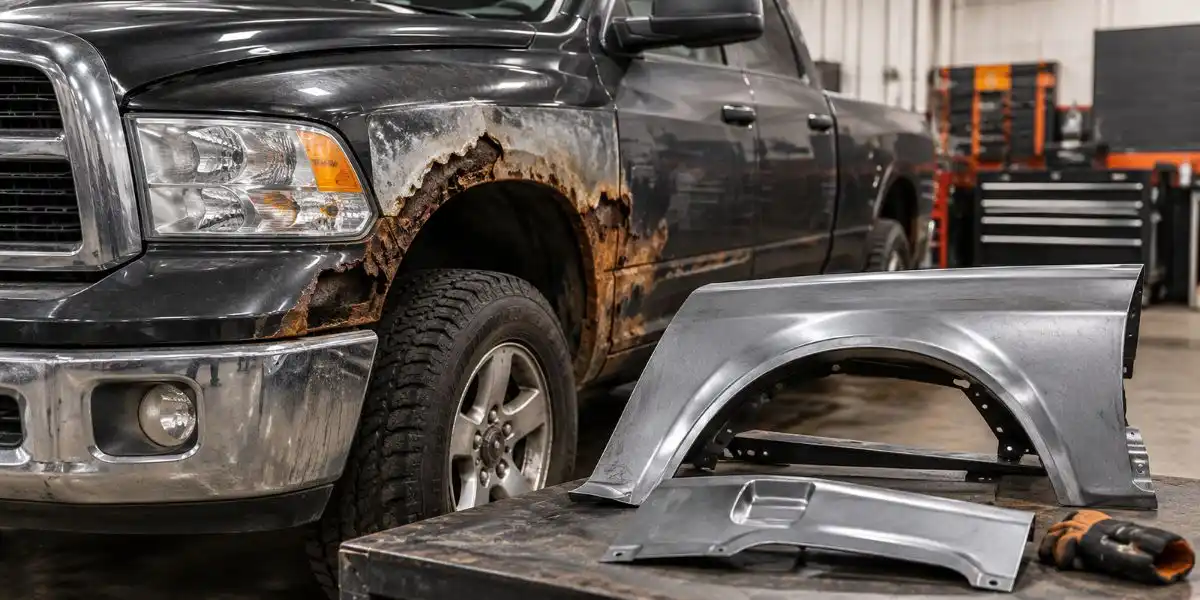
dodge truck rust repair panels are not one-size-fits-all: identify the truck’s model year, model, cab and bed configuration, then confirm that the specific panel listing matches those details. For example, a Ram 1500 regular cab and a Ram 1500 Quad Cab should not be assumed to use the same cab repair section just because both carry the Ram 1500 name. Before ordering, check the damaged area from both sides where possible; if rust reaches the frame or a mount, a body panel alone will not repair it.
Protecting a Dodge or Ram truck after a panel repair? See our truck undercoating and rust protection service for truck pricing by size, what is covered and booking.
Identify the exact Dodge truck and the damaged panel
Start with the vehicle, not the part photo. “Dodge truck” can refer to different models and body configurations, and a broad listing may leave out details that affect fit. Record the model year and model, for example, Ram 1500, Ram 2500, or Dakota, along with the cab and bed style. A VIN lookup can help verify vehicle identity; NHTSA’s decoder provides vehicle information from a VIN, but use the seller’s application details and the truck itself to confirm the panel match (NHTSA VIN Decoder).
Then name the damaged location precisely. A “cab corner” is different from a rocker, floor section, wheel arch, or bedside. Record whether the repair is on the driver or passenger side and whether it involves a small patch area or a larger section. If the truck has been modified or repaired before, photograph visible seams and compare the part shape with the actual truck; catalog information cannot establish what a previous owner changed.
Use the configuration as a fitment check
For a Dodge-specific comparison, consider two trucks described as Ram 1500s: one regular cab and one Quad Cab. Their model name alone is not enough to confirm that a cab-side panel fits both. Likewise, a bedside listing must be checked against the truck’s bed style and side, rather than selected from a picture that merely looks similar. These examples illustrate what to verify; they do not identify a guaranteed interchange or part number.
When you contact a supplier, give them a compact identification sheet:
- Vehicle identity: model year, model name, and VIN when available.
- Body configuration: cab style, bed style or length as identified on the truck, and the affected side.
- Repair location: the named panel area and a photograph showing nearby seams, trim, and body lines.
- Prior changes: known collision repairs, replacement panels, or modifications that could affect the original fit.
- Part scope: whether you need a small repair section, a larger panel skin, or a complete assembly.
Mopar’s parts catalog is a starting place for checking original parts information, while the truck’s actual configuration and the seller’s application notes still need to agree (Mopar parts catalog). If a catalog or seller cannot confirm the application from the information you provide, pause and ask what detail is missing instead of treating a broad “Dodge pickup” label as a fitment guarantee.
Compare panel types and sources before buying
Once you know what area is damaged, compare the kind of part being offered. A repair patch covers a limited section; a larger skin replaces more of the panel face; a complete assembly may include additional edges or attached pieces. Listings do not always use those terms consistently, so ask what metal is physically included and request a clear view of its boundaries. A part that appears similar in a catalog image may stop short of a corroded flange or extend farther than the repair requires.
What to verify in an OEM, aftermarket, or used-part listing
Different sources answer different questions. An OEM catalog can help identify original parts information. An aftermarket listing may offer a repair section or replacement panel for a stated application. A used part may preserve an original shape, but its condition and hidden corrosion need careful checking. None of those labels, on its own, confirms that a panel is right for the truck or suitable for the repair.
- Application range: compare the stated year range and model with your truck; ask whether cab, bed, side, or trim differences narrow that range.
- Panel boundaries: establish whether the piece includes the wheel opening, lower flange, seam edge, or other area that must meet the existing metal.
- Material and condition: ask what the part is made of and, for a used panel, whether there is rust, distortion, damage, or previous repair.
- Photo and return terms: request photos of the actual part when condition matters, and confirm the seller’s return policy before purchase.
- Joining requirements: check whether the intended repair method and the truck’s repair information support the part and its edges.
For example, suppose a listing describes a lower cab repair section for a particular Ram model-year range. Before ordering, confirm that it is the correct side and cab application, then compare its upper and lower edges with the area that must be removed. This is a way to check a listing, not evidence that a particular year range or part number fits every Ram in that range.
Save the listing details, seller’s fitment confirmation, and photographs with the repair notes. If the part arrives with a different flange, shape, or boundary than expected, compare it to the truck before cutting away original metal. Agreeing on fit before disassembly reduces the risk of having an open repair and a panel that does not match the opening.
Choose a patch or larger replacement from the rust boundary
The visible hole is not necessarily the full repair area. Rust can continue under paint, seam sealer, an overlap, or a previous patch. The right part is therefore determined by the sound metal left around the damage, not just the stain or opening visible from outside. A small section can be appropriate when the surrounding metal is solid and the repairer can make a sound joint. A larger panel may be considered when corrosion is widespread or the edges needed for a smaller patch have deteriorated.
When a smaller repair section may work
A localized patch can preserve more original material when corrosion is confined and the cut can end on sound metal. Before choosing one, ask the repairer where the cut lines would fall and how they will inspect the back of the joint. If preparation reveals soft, layered, or perforated metal beyond the planned cut, the repair boundary may need to expand. Ordering the smallest-looking patch before inspecting that boundary risks buying a piece that does not cover the actual damage.
When to consider a larger panel
A wider replacement may make sense if several perforations run together, a lower edge has lost its shape, or rust extends along a seam. It can also mean more disassembly, more joining work, and more surface to finish. The choice is not simply “small part versus large part”; it is whether the selected piece lets the repair remove compromised metal while retaining a sound, properly joined result.
Use these questions to discuss the scope with a repairer:
- Where will the cut end, and how will the shop confirm the remaining edge is solid?
- Does the replacement piece reach beyond the corrosion, including affected flanges or seams?
- Can the back of the joint be accessed for inspection and protection after joining?
- Could opening the panel reveal rust in an adjoining panel, reinforcement, or mount?
Manufacturer repair information matters when a repair involves cutting or joining. Mopar TechAuthority is a route to manufacturer service information; check the applicable instructions for the specific truck and repair rather than relying on a procedure from a different model (Mopar TechAuthority). I-CAR’s Repairability Technical Support is another repair-information resource for collision professionals; it can help frame repair questions, but the applicable vehicle-specific procedure still needs to be established (I-CAR Repairability Technical Support).
Separate body-panel rust from frame and mount damage
A cab corner, bedside, or floor panel is body sheet metal. The frame and its attachment points are different parts of the vehicle and need a separate assessment. A new bedside does not restore a weakened frame rail; replacing a cab corner does not repair a corroded cab mount. Before buying body panels, look for rust that may change the job from sheet-metal replacement to structural repair.
Where it is safe and practical to inspect, check the inside face of the damaged area and nearby structures. Look for:
- Swelling at seams: corrosion between overlapping panels can push the seam outward.
- Flaking or holes behind the exterior: damage on the inner face may extend beyond the visible opening.
- Corrosion near mounts: check the surrounding area where the cab or bed attaches to the frame.
- Signs of earlier work: filler, a fresh coating, or old patch edges may conceal the original damage.
These clues help define what needs inspection; they do not establish structural safety. If corrosion reaches a frame rail, crossmember, or mount, have the affected structure assessed before treating a body-panel order as the repair plan. Bay State Rust Prevention lists in-house vehicle inspection, corrosion assessment, rust removal, and automotive frame repair among its capabilities. A practical next step is to request an assessment of the affected structure rather than assume a replacement panel resolves it.
Plan the repair and corrosion protection together
New metal does not protect the repair by itself. Cut edges, joined seams, and concealed surfaces need an appropriate protection and finishing plan. Ask how the repairer will prepare and protect surfaces that become inaccessible once the panel is joined, and how exposed seams and finished surfaces will be treated. The exact products and process depend on the repair and vehicle-specific instructions; do not assume that an exterior coating can reach or protect a closed cavity.
For a Dodge truck with sound body metal that needs broader corrosion protection, review the site’s rust prevention undercoating information. If the job also involves rust removal from a frame or another component, the frame-off rust removal page describes that separate service. Neither undercoating nor rust removal is a substitute for replacing perforated body metal or repairing a compromised structure.
If cutting or welding is planned, include work-area hazards in the decision about who performs the repair. OSHA identifies welding, cutting, and brazing as operations with hazards requiring appropriate precautions; the controls depend on the work and setting (OSHA: Welding, Cutting, and Brazing). That guidance is not a vehicle repair procedure, but it is a reason not to treat extensive panel work as a simple bolt-on task.
Make the order conditional on a confirmed match
Before ordering, send the supplier the model year, model, VIN if available, cab and bed details, side, panel location, and photographs. Ask the supplier to confirm the specific listing against those details and clarify what the piece includes. Compare the part’s edges with the intended repair boundary, then inspect the truck closely enough to know whether the rust stops at the body panel or extends into a seam, mount, or frame.
If the vehicle has previous body work or the corrosion boundary is unclear, have the damaged area assessed before cutting or committing to a larger part. For frame or component corrosion, Bay State Rust Prevention provides rust removal, frame-off sandblasting, corrosion assessment, and automotive frame repair; contact baystaterustprevention.com to discuss whether an assessment or restoration service fits the condition of your truck.