
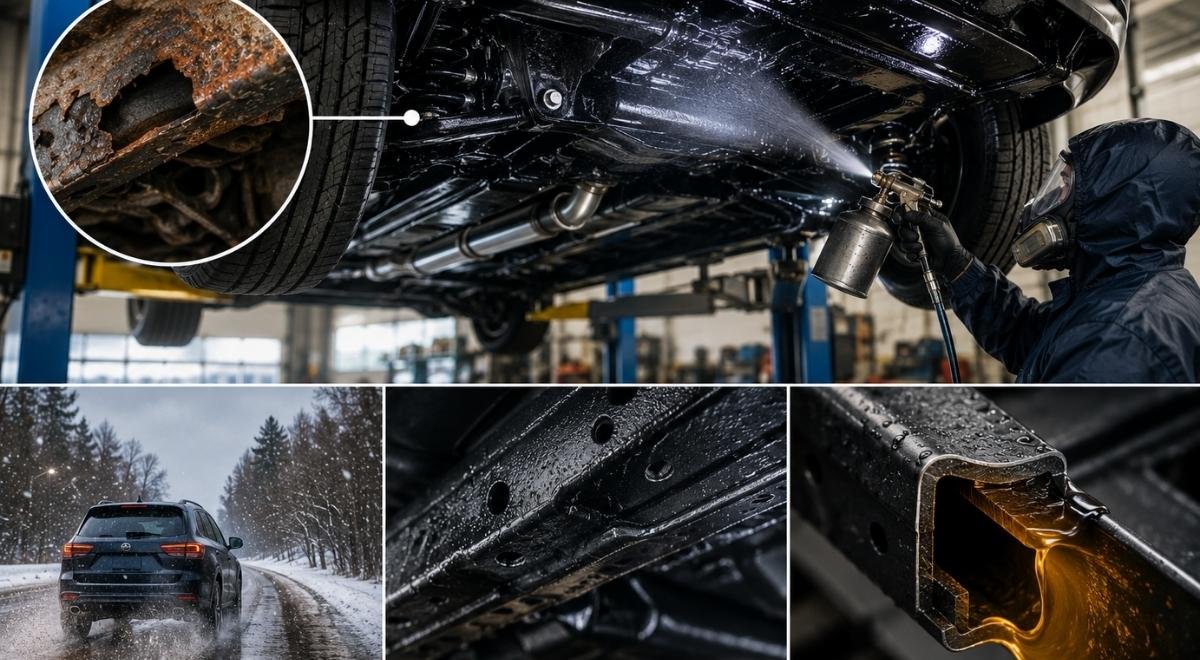
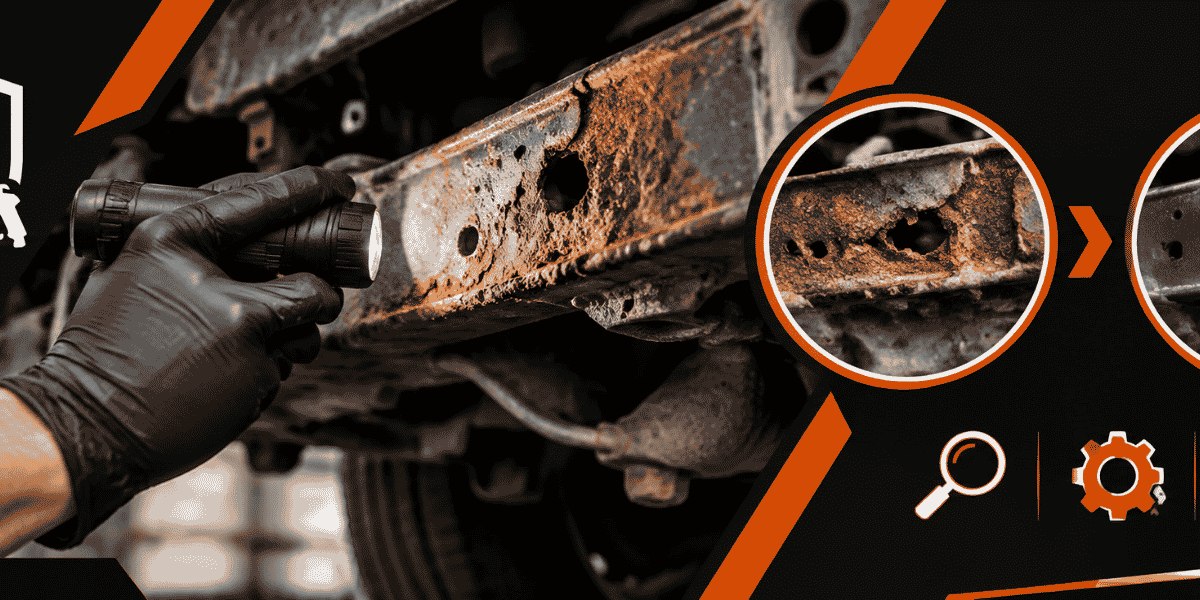
Vehicle undercoating is a protective layer applied to a vehicle’s underside, frame, wheel wells, or other exposed components to reduce contact with water, oxygen, and road contaminants that drive corrosion. It is not a substitute for removing active rust, repairing weakened metal, or washing salt from hidden cavities. For a Central Massachusetts vehicle owner, the useful question is not simply whether a coating is “good.” The question is whether the metal is clean and sound enough for a coating to protect it, and whether the selected material can remain intact through salt, abrasion, drainage, and seasonal movement.
What Vehicle Undercoating is—and what it is not
Undercoating is a corrosion-control treatment for surfaces that face spray and contamination from below. Depending on the vehicle and the material, it may cover frame rails, crossmembers, floor pans, wheel housings, suspension mounting areas, brackets, seams, and selected inner cavities. The coating works by separating vulnerable metal from some of the ingredients required for corrosion: moisture, dissolved salts, and oxygen.
That description matters because “undercoating” can refer to very different jobs. A thin cavity treatment is designed to creep into seams and displace moisture. A thicker protective film may remain flexible on a frame or floor pan. A hard coating may resist minor abrasion but can become a problem if it bridges over rust or cracks. A restoration coating may be applied only after abrasive cleaning and metal repair, when the objective is a clean, inspectable finish rather than simply slowing an existing corrosion cell.
The three jobs commonly confused with undercoating
- Rust prevention: applying protection to clean or lightly weathered metal before corrosion has compromised the structure.
- Rust removal: taking corrosion products, scale, old coatings, and contamination off the surface so the condition of the metal can be evaluated.
- Frame repair: restoring structural strength by cutting out weakened material, fabricating replacement sections, or using an appropriate repair method before protective finishing.
A coating can slow corrosion on sound metal, but it cannot turn flaky steel back into structural steel. Nor can it reliably seal a dirty, salt-laden surface. If a frame rail is swollen at a seam, perforated, sharply reduced in thickness, or separating around a suspension mount, the right sequence is inspection, repair planning, metal preparation, and then corrosion protection.
For a new truck, leased vehicle, or daily driver, the objective is usually prevention with access preserved for future inspections. For a classic vehicle, the objective may be conservation of original metal and a finish that does not hide defects. For a fleet, the priority may be repeatable inspection and service access across many vehicles. Those are different applications even when the invoice uses the same word.
Why Central Massachusetts changes the decision
Road salt is not merely dry grit. Sodium chloride and other deicing materials dissolve in water, allowing an electrically conductive film to remain on steel. The United States Environmental Protection Agency describes road salt as a source of chloride pollution affecting water and infrastructure; its overview is useful context for understanding why winter contamination persists beyond the visible snow season: EPA’s road-salt overview. On a vehicle, that salty film can collect inside seams, behind shields, above brackets, and along overlapping sheets where a hose cannot easily reach.
That is why a Central Massachusetts treatment must account for hidden salt retention, not just the visible frame surface. A vehicle driven through slush, parked in a heated garage, and then driven again can experience repeated wet-dry cycles. Warmth evaporates water but leaves dissolved contaminants behind. The remaining residue can pull moisture back toward the steel under humid conditions.
Why corrosion protection matters to owners, buyers, and fleets
Rust begins as a surface problem but does not necessarily remain one. Paint damage, a stone chip, or a thin seam can expose steel. Once moisture and electrolyte reach that area, corrosion can spread laterally beneath coatings and along layered joints. The visible spot may be smaller than the area where the metal has lost section.
Surface rust, scale, and structural corrosion are different decisions
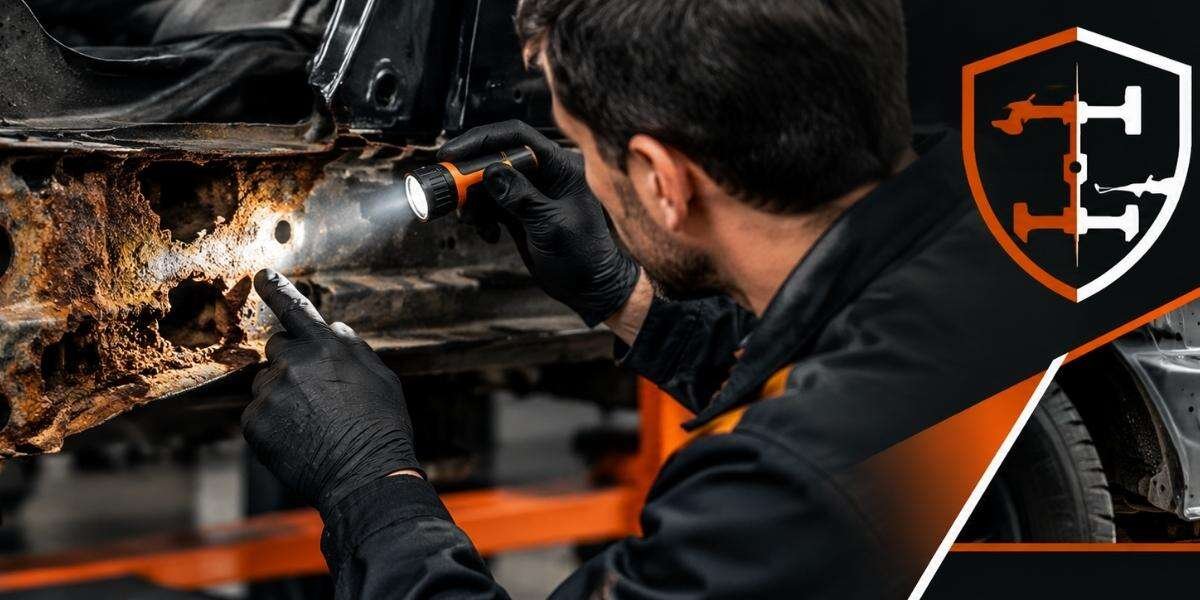
Surface rust is usually a thin oxidation layer with the original shape of the metal still present. It may be cleaned and protected after inspection. Scale is more advanced: corrosion products have expanded, become layered, and may conceal pitting underneath. Structural corrosion involves meaningful loss of load-carrying material, perforation, a weakened weld area, or deterioration near a mount that transfers suspension, steering, drivetrain, or body loads.
For a used-car buyer, the location matters as much as the amount. Rust on a removable exhaust shield is not equivalent to rust around a control-arm mount. For a fleet manager, a recurring issue around step brackets or body mounts may justify a scheduled inspection program. For a restoration shop, a frame that looks acceptable under old black coating may require removal of that coating before the repair scope can be trusted.
- Low consequence example: light orange oxidation on a nonstructural bracket with intact edges and no swelling.
- Inspection-required example: layered scale along a boxed frame seam, especially where drainage is poor.
- Repair-first example: a hole, split seam, softened mount, or visibly reduced section near suspension or body attachment points.
- Restoration example: a classic frame with old paint, grease, and corrosion whose original dimensions cannot be confirmed without comprehensive cleaning.
Corrosion affects more than appearance
Rust can seize fasteners, restrict movement at joints, damage brake and fuel-line clips, and make routine service more destructive. It can also hide water paths. A blocked drain hole may keep a cavity wet; a missing splash shield may direct salt toward a crossmember; a cracked coating may retain contamination at its edge.
There is a safety reason to treat structural rust as an engineering issue rather than a cosmetic one. The National Highway Traffic Safety Administration explains that vehicle safety recalls address safety defects and provides the official VIN lookup for open recalls at NHTSA’s recall page. A coating does not replace checking recall information, following manufacturer repair procedures, or having questionable structural areas assessed by a qualified professional.
Owners also need to distinguish a corrosion treatment from a warranty promise. A product may be intended to protect a surface, but the result depends on preparation, film continuity, impact exposure, drainage, inspection, and maintenance. Asking what will be cleaned, what will be masked, what will remain visible, and how future inspections will be handled is more useful than asking only how thick the coating is.
How a protective coating interrupts corrosion
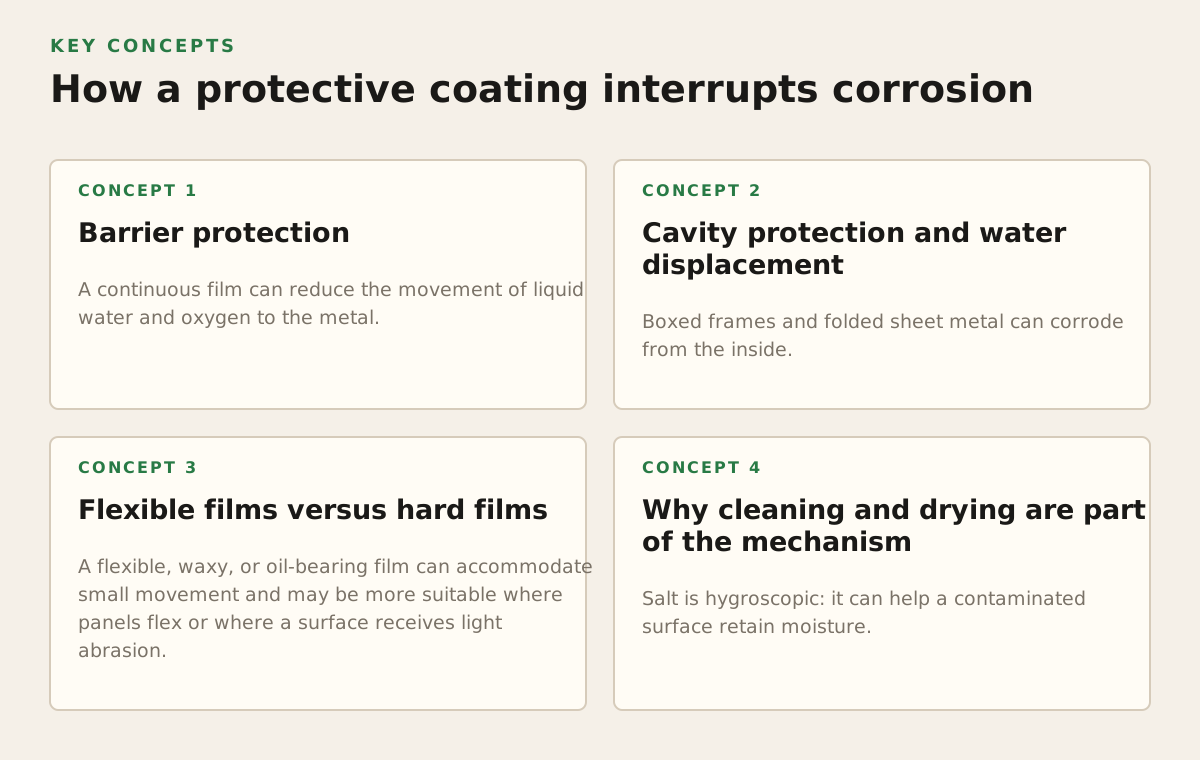
Steel corrosion is an electrochemical process. A vulnerable area of steel gives up electrons, while another area consumes them in a reaction involving oxygen and water. Dissolved salt increases the conductivity of the moisture film, making it easier for the corrosion cell to operate. Undercoating does not change the steel into a different metal; it seeks to interrupt the environment that allows the reaction to continue.
Barrier protection
A continuous film can reduce the movement of liquid water and oxygen to the metal. This is the simplest mechanism and the one most people imagine when they hear undercoating. It only works well when the film adheres to a reasonably clean substrate and remains continuous. A coating applied over loose scale has a weak foundation. A film cut by stones, jacks, tools, or a sharp seam can create an entry point.
Adhesion is more important than appearance. A uniform-looking black surface may still be poorly bonded if oil, wax, salt, loose rust, or incompatible old material lies underneath. Preparation must be selected for the condition: washing, degreasing, mechanical cleaning, abrasive blasting, drying, and selective removal of failed coatings each have a role. Not every vehicle needs the same degree of stripping, but every vehicle needs enough preparation to support the intended protection.
Cavity protection and water displacement
Boxed frames and folded sheet metal can corrode from the inside. Their openings may be small, while the internal surfaces are large and difficult to inspect. A cavity product is therefore applied differently from a thick exterior coating. It must reach seams and internal faces without blocking designed drainage paths.
The practical limitation is access. A lance cannot protect a cavity it cannot enter, and a treatment cannot compensate for mud packed into an opening. Drain holes should not be sealed. Existing plugs, inspection openings, and factory access points need to be identified before application. If a cavity already contains heavy scale, the technician must avoid assuming that an internal film has restored the lost section.
Flexible films versus hard films
A flexible, waxy, or oil-bearing film can accommodate small movement and may be more suitable where panels flex or where a surface receives light abrasion. A harder film may provide a durable outer barrier on an appropriately prepared surface but can crack, chip, or conceal changes if the substrate moves or continues to corrode underneath.
WaxOyl is the corrosion-protection material used by Bay State Rust Prevention. Product selection and application still have to follow the condition of the particular vehicle; a named material is not a reason to skip cleaning, cavity access, drying, or inspection. The official product site provides manufacturer information at WaxOyl’s official website, but the important shop-floor question remains where the material is appropriate and where a repair or different preparation step must come first.
Why cleaning and drying are part of the mechanism
Salt is hygroscopic: it can help a contaminated surface retain moisture. Even without relying on a precise laboratory threshold, the practical consequence is clear: a vehicle that is visibly wet or carrying winter residue is not ready for a dependable protective film. Water trapped in a seam can continue attacking the metal after the exterior appears dry.
- Illustrative preparation example: identify the frame, body mounts, drain paths, brake and fuel lines, exhaust, suspension components, and heat-sensitive areas before washing.
- Remove packed mud and salt residue, then degrease areas where oil would interfere with adhesion.
- Use mechanical cleaning or abrasive methods where scale or failed coating prevents inspection; the required extent depends on the metal’s condition.
- Allow cavities and overlaps to dry, while avoiding compressed-air practices that drive contamination deeper into a boxed section.
- Apply the selected protection in a controlled pattern, keeping drains, service points, labels, and components requiring movement or heat clearance usable.
- Document damaged areas, excluded areas, and locations that should be reinspected rather than representing the coating as a repair.
Where undercoating breaks down
The most common failure is not that the chemistry suddenly stops working. It is that the coating is asked to solve a problem it cannot solve: loose rust, trapped moisture, contaminated metal, poor access, repeated impact, or structural loss. A professional recommendation should identify the failure mode rather than promise permanent protection.
Applying over active scale
Heavy scale can detach from the steel beneath it. If a coating bonds to the outer rust layer, the film may lift when that layer moves. The protected-looking surface can then hide corrosion that is still progressing between the coating and the metal. On a frame, this is particularly concerning around seams, brackets, and mounts where visual access is already limited.
For a lightly rusted daily driver, limited cleaning followed by preventive protection may be sensible. For a restoration project or a frame with deep scale, broader removal is often required to determine whether the original steel remains usable. The correct answer cannot be selected from a photograph of the vehicle’s exterior alone.
Sealing in contamination
Grease, mud, salt, and moisture reduce adhesion and create a contaminated interface. A coating may remain attached at the edges while separating over the center. This is why a quick spray over a dirty underside can create false confidence. Washing is not the same as degreasing, and degreasing is not the same as removing scale.
There is also a balance: aggressive cleaning can remove sound factory protection or expose thin metal, while insufficient cleaning leaves the technician unable to evaluate what is underneath. The preparation method should be proportionate to the job. A new vehicle receiving preventive treatment is not handled like a forty-year-old frame headed for restoration.
Ignoring abrasion, heat, and movement
- Abrasion: tires, stones, packed snow, and road debris can wear the film at wheel wells and leading edges.
- Heat: exhaust components and nearby shields may exceed the service range of a general-purpose coating.
- Movement: body mounts, flexible panels, and suspension-adjacent areas can open cracks if the film is too rigid.
- Service work: jacks, stands, sockets, and replacement parts can scrape protection away.
- Drainage: plugging a designed drain can retain water and reverse the purpose of the treatment.
These limitations do not make undercoating ineffective. They define the maintenance plan. The underside should be inspected after work that disturbs the frame, after significant off-road use, and periodically when the vehicle’s environment justifies it. A damaged patch should be cleaned and restored instead of simply sprayed over.
Blasting without controlling the process
Abrasive blasting can expose the true condition of a frame, but it creates its own hazards and preparation requirements. OSHA identifies abrasive blasting hazards that include dust, noise, flying particles, and exposure to hazardous materials; its safety guidance is available at OSHA’s abrasive-blasting page. That is why frame-off work needs containment, suitable media and pressure choices, personal protective equipment, and a plan for removing abrasive from seams and cavities.
Blasting is not automatically the best answer for every underside. It may be unnecessary for a newer vehicle with sound factory coatings and light surface oxidation. It may be appropriate when old layers prevent inspection, when a classic frame is being restored, or when repairs require clean edges and known metal thickness. The decision should be made after examining the frame, not as a default upsell.
How practitioners apply it to real vehicle decisions
A useful workflow starts with condition and intended use, then chooses preparation and protection. The same sequence works for a commuter car, a pickup used for work, a specialty vehicle, or a commercial fleet, but the inspection emphasis changes.
For a new or relatively clean vehicle
Start by documenting the underside before any material is applied. Look for factory coatings, exposed seams, drain holes, wiring, brake and fuel lines, exhaust heat zones, and areas already showing impact damage. The aim is preventive coverage without hiding inspection points.
A reasonable starting policy—not a universal benchmark—is to inspect the vehicle at the end of its first winter and again whenever major underside service is performed. If the film is intact and the metal remains clean, maintenance may be limited to washing, visual checks, and localized renewal. If salt, mud, or impact has removed protection, the repair should be localized and prepared rather than layered over contamination.
For a used vehicle being evaluated
Ask for access to the frame and mounting areas, not just a view of the exterior rocker panels. Look for fresh material that appears to cover older scale, inconsistent edges, blocked drain openings, and areas where the coating stops just short of a likely problem. Fresh undercoating is not proof that corrosion was addressed correctly.
- Check frame rails from multiple angles, including the top and inner faces where accessible.
- Examine suspension mounts, steering attachment areas, body mounts, and crossmember connections.
- Look for swelling, layered scale, perforation, split seams, and repairs that change the original shape.
- Compare the condition on both sides; significant asymmetry can indicate a localized leak, impact, or drainage problem.
- Confirm whether a coating is preventive, cosmetic, or part of documented structural repair.
If the seller will not permit a qualified inspection, treat that as a purchasing risk rather than assuming the dark underside is protected. A coating can make a vehicle look cared for while reducing visibility of the very rust a buyer needs to evaluate.
For a rust-damaged frame
The order is more important than the product name. First identify whether corrosion is cosmetic or structural. Then remove enough coating and scale to establish the boundaries of sound metal. If the frame requires fabrication or reinforcement, complete that work according to an appropriate repair plan. Only after the repair is inspected should the surrounding metal receive final corrosion protection.
When extensive cleaning is required, frame-off rust removal can give a restoration project better access to rails, brackets, crossmembers, and hidden surfaces. It is not automatically required for every repair, and it should be weighed against the vehicle’s design, the extent of corrosion, the need to preserve original material, and the cost of disassembly and reassembly.
After cleaning or blasting, bare steel should not be left indefinitely in a damp shop environment. The next steps should be coordinated so that residue is removed, the surface is dry, repairs are completed, and the chosen protective system is applied in a compatible sequence. A restoration finish should also leave critical welds, repaired sections, and inspection areas understandable to the next technician.
For fleets and repair shops
Fleet work benefits from a written inspection routine. Record vehicle identification, corrosion locations, photos, excluded components, repairs recommended, and the date of treatment. The goal is not bureaucracy; it is preventing a vehicle from receiving the same surface spray repeatedly while a structural issue develops underneath.
An illustrative fleet policy might divide vehicles into three groups: preventive treatment, localized correction, and repair hold. Vehicles in the first group receive cleaning and protection. Vehicles in the second receive localized rust removal and coating renewal. Vehicles in the third remain out of the treatment queue until frame or component repairs are evaluated. That classification is a starting policy, not a universal service interval or safety standard.
Repair shops outsourcing rust removal should also specify the handoff condition. Agree whether the returned component will be bare metal, primed, coated, masked at mounting faces, or ready for assembly. Clarify how abrasive residue, threaded holes, drain passages, bushings, seals, and heat-sensitive parts will be handled. A vague request for “blasting and undercoating” can produce avoidable rework if the intended finish and inspection standard are not defined.
A practical recommendation for Massachusetts owners
Choose protection based on the vehicle’s metal condition, not its age or the darkness of its current coating. A new truck or leased vehicle generally benefits from early inspection and preventive treatment before salt has established itself in seams. A used vehicle deserves an independent corrosion inspection before purchase. A classic or specialty vehicle may need comprehensive disassembly and cleaning so that preservation does not conceal weakened original metal. A fleet needs documented repeatability and clear repair hold points.
For Central Massachusetts vehicles exposed to winter salt, the most defensible approach is inspect, clean, repair, protect, and reinspect. Bay State Rust Prevention provides rust prevention undercoating, rust removal, frame-off sandblasting, and frame repair for vehicle owners, restoration projects, repair shops, and fleets across Worcester and Central Massachusetts. Review the available services at baystaterustprevention.com.