

Truck frame rust treatment starts with determining whether corrosion is superficial or has weakened the structure. Inspect and document the frame, have suspected structural damage assessed before coating, then clean and protect metal that is sound or has been properly repaired. This sequence helps you choose between prevention and restoration, and avoids covering a defect that still needs attention.
Make a safe, useful inspection
Park on firm, level ground and let hot components cool before looking underneath. Use a flashlight, eye protection, gloves, and a camera. If inspecting the underside requires lifting the truck, follow the vehicle maker’s lifting and support instructions; never work under a vehicle supported only by a jack. If you cannot support it safely, have a repair professional inspect it.
Look beyond the most visible patch
Check both frame rails, crossmembers, and areas around suspension and body mounts. Look where overlapping metal, seams, and brackets can retain wet dirt and road debris. A clean-looking outer face does not establish that a boxed section or joint is sound. Avoid aggressive scraping, drilling, or grinding simply to test the metal: that can damage what remains or make an already weak area worse.
- Photograph each suspect area from more than one angle and note its location.
- Look for flaking layers, deep pits, swelling at seams, holes, cracks, or distortion.
- Compare similar locations on the opposite side, but do not assume they have the same condition.
- Stop before coating if you see perforation, cracking, severe scaling, or damage near a structural attachment.
Corrosion is metal deterioration caused by reactions with its surroundings; moisture and salts can contribute to damaging conditions. AMPP’s corrosion overview explains the process, while the EPA describes road salt’s effects on water quality in its road salt and water quality overview. For an owner, the practical point is to pay attention to places where salt-bearing grime can remain trapped, not just exposed surfaces.
Decide whether the issue is surface rust or structural damage
Color alone cannot tell you whether a frame is safe. Light discoloration on apparently sound metal may call for cleaning and protection, but deep pitting, holes, cracks, distortion, and heavy scale warrant a closer structural assessment. Be especially cautious around suspension, steering, and body attachment points: damage there may affect how the structure carries loads.
A coating does not restore metal that has been lost. If corrosion is extensive, or you cannot tell whether a suspect area is merely scaled or perforated, ask for an assessment before removal or undercoating. The result may change once dirt or old coating is removed, so an exterior inspection has limits.
Use records to explain the concern
For a used-truck buyer, ask to see the frame rather than relying on a seller’s description of an undercoating. A dark finish does not establish what condition the metal was in before it was applied. Keep your photos and notes so a repair professional can focus on the locations you identified. If you are checking for an open safety recall, use the vehicle’s VIN with the official NHTSA recall lookup; a recall search is separate from evaluating rust damage.
Match the next step to what the inspection shows
Use this table to organize the decision, not to diagnose hidden damage. If the surface cannot be seen clearly or the frame’s condition is uncertain, get an in-person assessment before choosing a treatment.
| What you see | Reasonable next step | Avoid |
|---|---|---|
| Dirt or loose contamination on apparently sound metal | Clean and dry the area, then inspect it again before considering protection. | Coating over mud, moisture, or loose debris. |
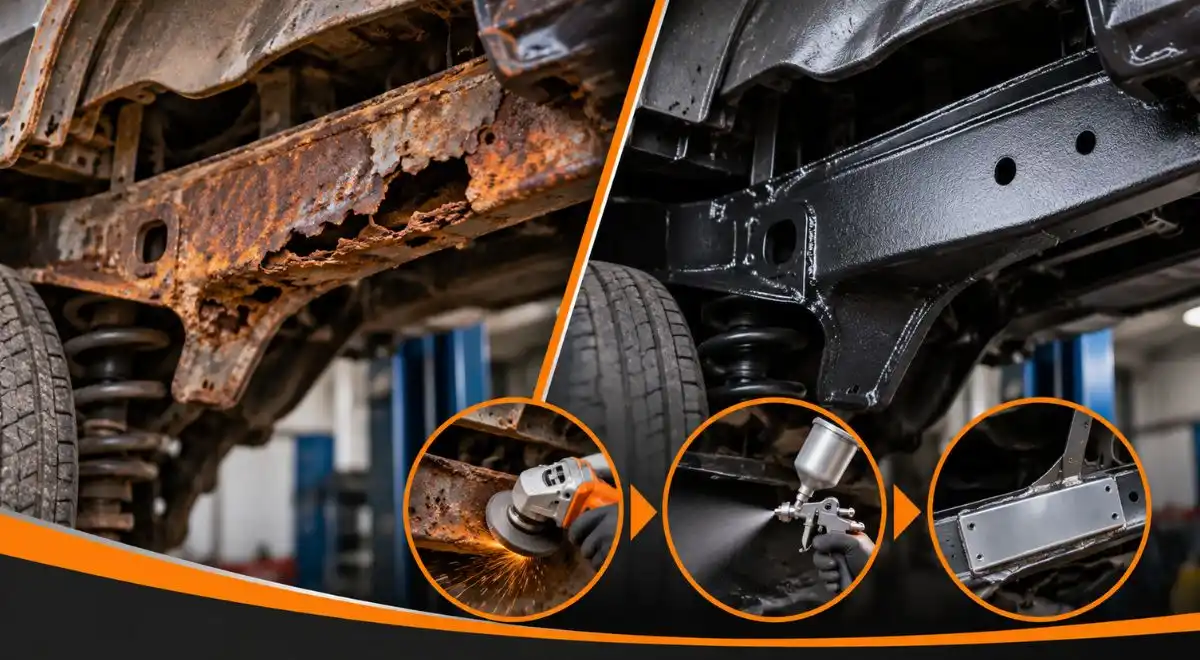
| Surface rust without visible holes or distortion | Remove corrosion to a suitable prepared surface, then protect it with a compatible system. | Assuming one quick brush pass clears every pit or seam. |
| Heavy scale, deep pitting, cracks, holes, or damaged mounts | Request a structural assessment and repair plan before coating. | Filling, sealing, or covering the defect without determining whether metal is compromised. |
| Rust at an inaccessible joint or inside a boxed section | Ask how the area can be inspected, cleaned, dried, and treated. | Assuming an exterior coating reaches hidden surfaces. |
Cleaning and repair are different jobs. Cleaning can expose metal for inspection; it does not establish that a structurally damaged frame is repairable by a particular method. A shop’s proposed scope should explain what will be inspected, what happens if more damage is exposed, and whether repair must precede protection.
Choose a cleaning method that allows inspection
On sound metal, appropriate mechanical preparation can remove loose corrosion and help reveal the surface. Extensive corrosion, complex shapes, and cavities may call for more access than an exterior cleaning provides. Frame-off disassembly and blasting can be considered when the condition and repair plan justify that work; it is not simply a shortcut to a fresh-looking coating.
Plan for what cleaning may uncover
Before work begins, agree on how the shop will document newly exposed damage and pause for a repair decision if necessary. Ask how abrasive material and debris will be kept away from components and openings. Do not assume that blasting or grinding can be performed indiscriminately around brake lines, wiring, fuel-system parts, seals, or other components that need protection.
Repair procedures can depend on the vehicle and the area being repaired. I-CAR describes its Repairability Technical Support resource as a source for vehicle repair information and procedures. For a rusted frame that needs more extensive cleaning, review what frame-off rust removal involves and ask whether the proposed process provides access to the areas that need inspection and preparation.
Repair compromised metal before protecting it
If the assessment identifies structural damage, the work needs to address the damaged metal, not just its appearance. The appropriate repair depends on the condition and the vehicle; have the repair professional explain the proposed scope and how it relates to the affected structure. Do not coat over a structural defect or treat filler, a converter, or thick undercoating as a substitute for repairing lost or damaged metal.
Prepare for the selected protection
Once any necessary repair is complete, the surfaces need preparation suited to the repair process and chosen product. That generally means dealing with contamination and loose corrosion and ensuring the area is dry as required by the product instructions. Keep coatings away from brakes, exhaust surfaces, moving parts, and other areas where the product or vehicle instructions prohibit application. Toyota provides owner manuals through its owner resources page; consult the appropriate vehicle guidance as well as the coating label.
For sound or properly prepared metal, WaxOyl can be part of a corrosion-protection plan. Ask which areas are included: rails are not the whole vehicle, and seams, joints, panels, and cavities may need different access and application methods. Bay State Rust Prevention’s rust prevention undercoating page covers the relevant service category. Confirm the proposed preparation and coverage for your truck rather than assuming every treatment includes the same areas.
Check the work and track changes
Before accepting a treatment, ask what was inspected, cleaned, repaired, and coated, and which areas were intentionally left untreated. If cleaning exposed new damage, confirm how that changed the repair plan. Photos of key areas, particularly where work uncovered defects, make it easier to compare condition later than relying on the appearance of a dark finish.
- Confirm the agreed coverage and ask whether seams, joints, or cavities were included.
- Check that any newly exposed damage was discussed before protection was applied.
- Ask which surfaces or components needed to remain free of coating.
- Keep photos and work notes with the vehicle’s maintenance records.
As an illustrative starting policyreview the same documented areas after each winter season. This is not a universal maintenance interval. Inspect sooner if the truck regularly encounters salted roads, stores outdoors, accumulates debris, or has chipped or damaged coating; a change in use or visible condition is a reason to adjust the schedule. Fleet owners can use the same records to identify which vehicles or locations need closer attention without assuming every truck has identical exposure.
Start by documenting the frame before treatment
First, photograph the rails, crossmembers, and attachment areas, and note any scaling, pits, holes, cracks, or distortion without scraping or coating over them. Use that record to request an assessment that separates cleaning and prevention from structural repair. Bay State Rust Prevention provides vehicle corrosion assessment, rust removal through sandblasting, frame repair, and WaxOyl undercoating for vehicle owners across Worcester and Central Massachusetts. To discuss whether a truck’s condition calls for protection, restoration, or both, visit baystaterustprevention.com.