

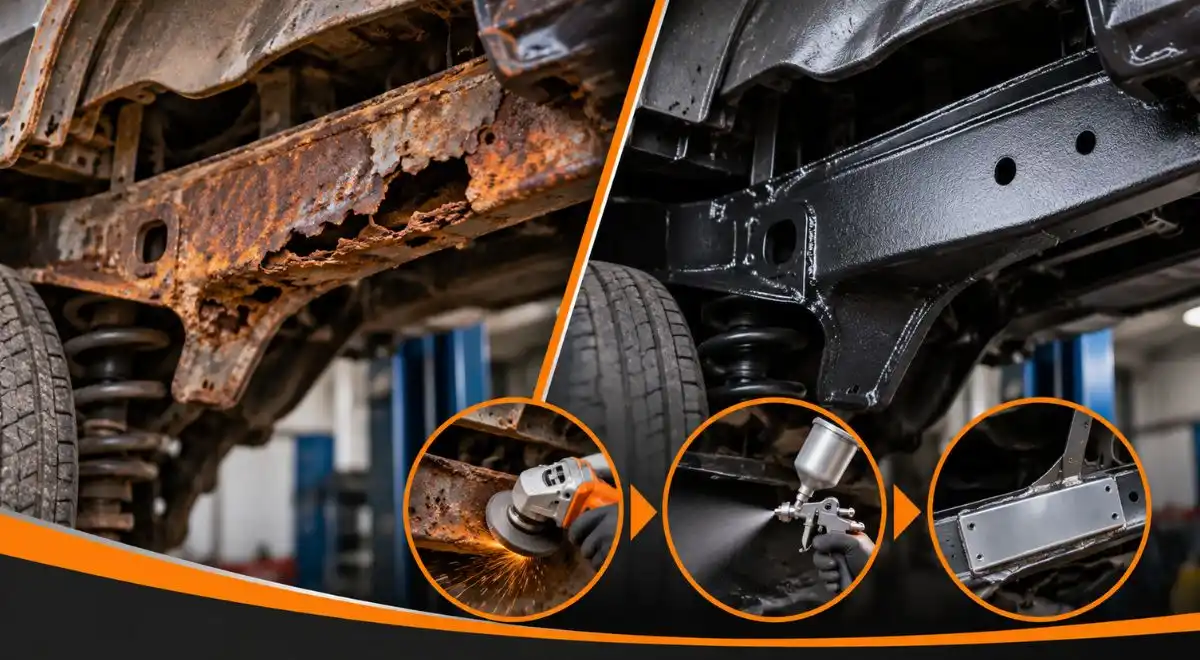
Rust removal and undercoating do different jobs: assess the vehicle first, remove corrosion when needed to inspect or prepare metal, repair weakened structure, then protect suitable surfaces. If the vehicle is sound, prevention may be the right starting point; if rust has caused thinning or holes, a coating is not a substitute for repair. The useful decision is not simply which product to apply, but which work the vehicle’s condition actually calls for.
Decide whether the job is prevention, removal, or repair
These are related but distinct scopes. Prevention applies a protective treatment to appropriate surfaces. Removal clears corrosion or old material to expose and prepare a surface. Repair addresses metal that is damaged or no longer suitable for its intended structural role. A vehicle may need one of these stages or several, but the terms should not be treated as interchangeable in a quote.
Road-salt exposure is one reason owners consider corrosion protection. Transport Canada discusses the connection between road salts and vehicle corrosion in its road salts and vehicle corrosion information. That context can help an owner of a winter-driven car or fleet truck think about exposure; it does not establish that every vehicle needs the same product, coverage, or schedule. Environment and Climate Change Canada also describes the use and environmental effects of road salts in its road salts overview.
Choose by observed condition and intended outcome. A newer vehicle with no visible damage may call for a prevention discussion. A used vehicle with an unknown treatment history may need an assessment before a new layer is applied. A restoration project with scale or suspected structural damage needs a different scope from either: access and removal may be needed before repair can be planned.
- Sound metal, prevention goal: confirm which surfaces the proposed treatment will cover and what preparation is included.
- Accessible surface corrosion: determine whether cleaning or removal is needed to assess and prepare the metal.
- Flaking scale, swelling, or perforation: ask for a closer condition assessment before choosing a finish.
- Corrosion near a frame or mounting point: prioritize evaluation of the affected structure over appearance or coating.
These are decision prompts, not a diagnosis. Road grime, seams, shields, and existing coatings may limit what can be seen. A photograph or quick look from outside may not resolve whether a suspicious area is surface discoloration or metal loss. When access is limited, ask what inspection would clarify the condition and what remains uncertain before approving a treatment.
Assess the condition and agree on the inspection scope
Location matters as much as appearance
Rust color alone does not show how much metal remains. A small, accessible patch on a non-structural area poses a different question from corrosion at a frame connection, suspension mounting point, or other load-bearing location. Loose flakes and layered scale warrant attention because the visible surface may not tell the whole story; a hole or swelling seam may also prompt a closer look. Ask where the corrosion is and what role that area servesrather than judging the vehicle by the amount of rust visible overall.
The UK’s MOT inspection manual assesses corrosion in relation to vehicle structure and safety. Its rules apply to UK inspections, not to a Massachusetts inspection decision, but the manual illustrates why the location and effect of corrosion matter. For a used-car buyer, the useful question is whether a concern affects a structural area, not only whether rust appears in a listing photo.
Make uncertainty part of the scope
A useful inspection explanation separates what was observed from what could not yet be assessed. Ask whether the inspection reached the area of concern, whether existing material obscures it, and whether more access is needed. If the answer depends on disassembly or removal, treat that as a separate decision with a clear purpose, not as proof that the metal is either sound or damaged.
- Which areas were inspected closely, and which were only viewed from outside?
- Is the proposed work intended to prevent corrosion, remove material, or repair damage?
- What would need to be opened, cleaned, or removed to assess the uncertain area?
- What findings would change the plan, such as newly visible thinning or a hole?
- Which surfaces or cavities will remain inaccessible under the proposed scope?
For a shop or fleet coordinator, record the areas to assess and the decision-maker for any newly exposed damage. For an owner, request the same distinction in plain language. A quote that says only “rust work” may leave unclear whether it includes inspection, removal, structural repair, or protective treatment.
Compare removal methods by access and purpose
Removal is useful when corrosion or other material prevents a meaningful assessment or suitable surface preparation. Its purpose is not automatically to restore damaged metal. Once material is removed, the condition may be easier to evaluate; if the metal is weakened or perforated, the next decision may be repair rather than a coating. Define what removal is expected to reveal or prepare before comparing methods.
In-place work versus frame-off access
Work in place avoids taking the vehicle apart, but access to some surfaces may be limited. Frame-off work involves disassembly to reach areas that may not be accessible with the vehicle assembled. It can be relevant to an extensive restoration or a project where the required assessment, removal, or repair depends on access to the frame and related components. It is not automatically the right scope for every rusty vehicle.
Ask what the proposed disassembly will make accessible and what decisions follow once those areas are exposed. If the work is intended to prepare a frame for repair, clarify how newly visible damage will be documented and who will approve the repair scope. If the vehicle needs only treatment of accessible, sound surfaces, extensive disassembly may not serve the same purpose.
Blasting is a process, not a diagnosis
Sandblasting is a removal method, not a finding that the component is structurally sound afterward. The process can expose the condition of a prepared area, but an assessment of any loss or damage remains important. OSHA’s abrasive blasting guidance describes hazards and protective measures for blasting work. For a vehicle project, ask how the work area, components, and openings will be managed, and which parts are included in the agreed scope.
Use these distinctions when comparing proposals:
- Cleaning: clarify whether the work removes dirt and loose material only, or also addresses corrosion.
- Blasting: identify the components or areas to be blasted and what must be protected or excluded.
- Disassembly: ask what access it provides and how the exposed parts will be assessed.
- Preparation: establish which surfaces are expected to be ready for a later repair or treatment.
The meaningful comparison is what each scope reaches and what decision it enables. A proposal that uses a more intensive method is not automatically more complete if it leaves the area of concern inaccessible or does not explain how findings will affect the next stage.
Separate structural repair from protective treatment
A coating does not replace metal that has been lost. If removal exposes a hole, thinning, or damage at a structural connection, ask for a repair assessment before treating that surface as ready for protection. The visible edge of a corroded area may not show the full extent of the concern, so the assessment may require additional access. Keep repair and coating as separate decisions: first establish what needs restoration, then determine which surfaces are appropriate to protect.
This sequence matters in restoration and in ordinary ownership. A classic vehicle may require access and removal to determine what can be retained, followed by repair and preparation. A winter-driven car with sound metal may have no structural repair scope at all. For a repair shop handing a vehicle to another provider, the handoff should say whether the next task is to inspect, remove corrosion, repair metal, prepare a surface, or apply protection.
Before authorizing work, agree how the plan changes if removal reveals damage. For example, if cleaning a frame section exposes a hole, that finding may require a pause and a repair decision. It does not make a further coating a substitute for restoring the damaged area. Ask whether newly visible conditions will be documented and whether additional work requires separate approval.
- Before access work: identify the area and why access is needed.
- After removal: review any newly visible damage before deciding on a finish.
- Before repair: clarify which component or structural area the repair addresses.
- Before protection: confirm which surfaces are ready and what the treatment will cover.
The business information supplied for this article lists Bay State Rust Prevention’s capabilities as frame-off vehicle disassembly, sandblasting for rust removal, bare-metal preparation, and automotive frame repair. The appropriate scope depends on the vehicle’s condition and assessment. For projects where access and removal are under consideration, see frame-off rust removal.
Choose a prevention scope that fits the vehicle
When the relevant metal is suitable for treatment, undercoating can be part of a corrosion-prevention plan. Confirm coverage rather than relying on the label: “undercoating” does not by itself specify which panels, seams, joints, or cavities are included. Ask what the proposed treatment reaches, how existing material affects preparation, and which areas will be left untreated or inaccessible.
The business information supplied for this article lists full-vehicle WaxOyl rust prevention undercoating and rustproofing for seams, panels, joints, and cavities among Bay State Rust Prevention’s capabilities. Those descriptions do not determine the exact scope for an individual vehicle. Ask which areas are included in the proposed work and how the vehicle’s condition and history affect preparation. For details about the site’s prevention service, see rust prevention undercoating.
Account for prior treatment and vehicle use
Previous treatment is relevant to inspection and preparation, but it does not prove that hidden metal is sound. If the vehicle’s history is unclear, say so and ask what can be assessed before a new application. For a fleet, consistency in the written scope can help distinguish vehicles that need assessment from those being considered for prevention; it does not remove the need to evaluate a vehicle with visible damage.
Owners of new or leased vehicles should check applicable manufacturer instructions and lease terms before authorizing an added coating. The evidence here does not establish what a particular manufacturer or contract permits. Verify those conditions directly with the manufacturer or leasing company, then compare the permitted treatment with the proposed coverage.
For a practical plan, match the work to the job:
- New or visibly sound vehicle: ask what prevention covers and check relevant manufacturer or lease requirements.
- Used vehicle with unknown history: clarify what can be inspected and whether existing material affects preparation.
- Vehicle with visible scale: establish what removal is meant to expose before selecting a protective finish.
- Restoration or frame project: define access, removal, repair, and protection as distinct stages.
- Fleet or shop handoff: document the areas to assess and who approves additional repair if damage is found.
Bay State Rust Prevention provides rust prevention undercoating, rust removal, frame-off sandblasting, and frame repair for vehicle owners across Worcester and Central Massachusetts, according to the supplied business information. To discuss which scope fits a vehicle’s condition, start at baystaterustprevention.com.