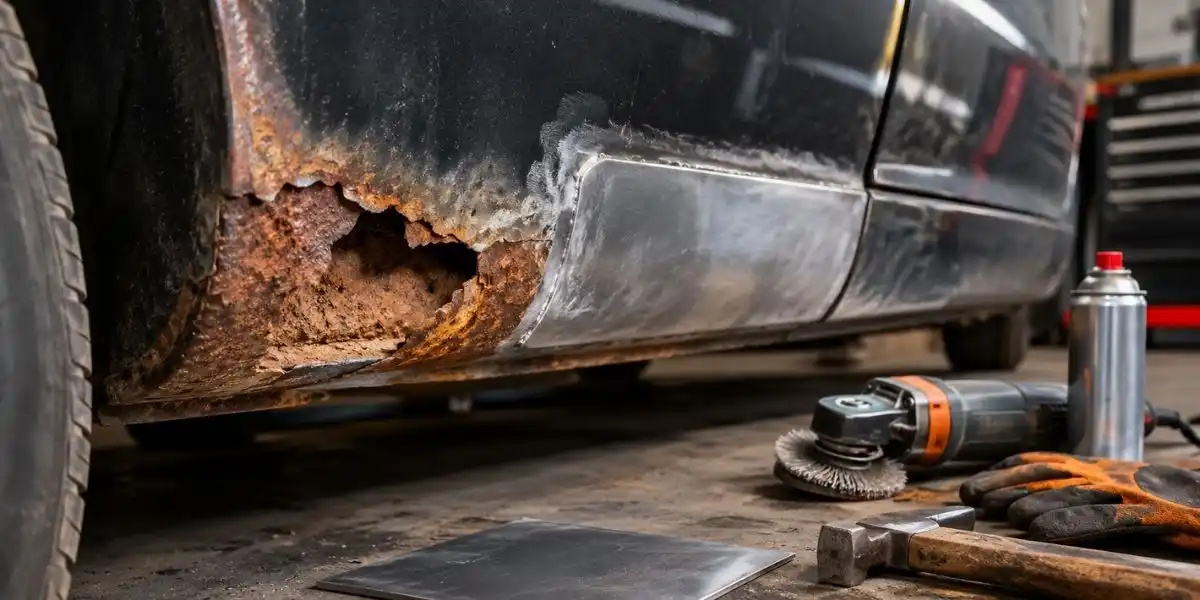
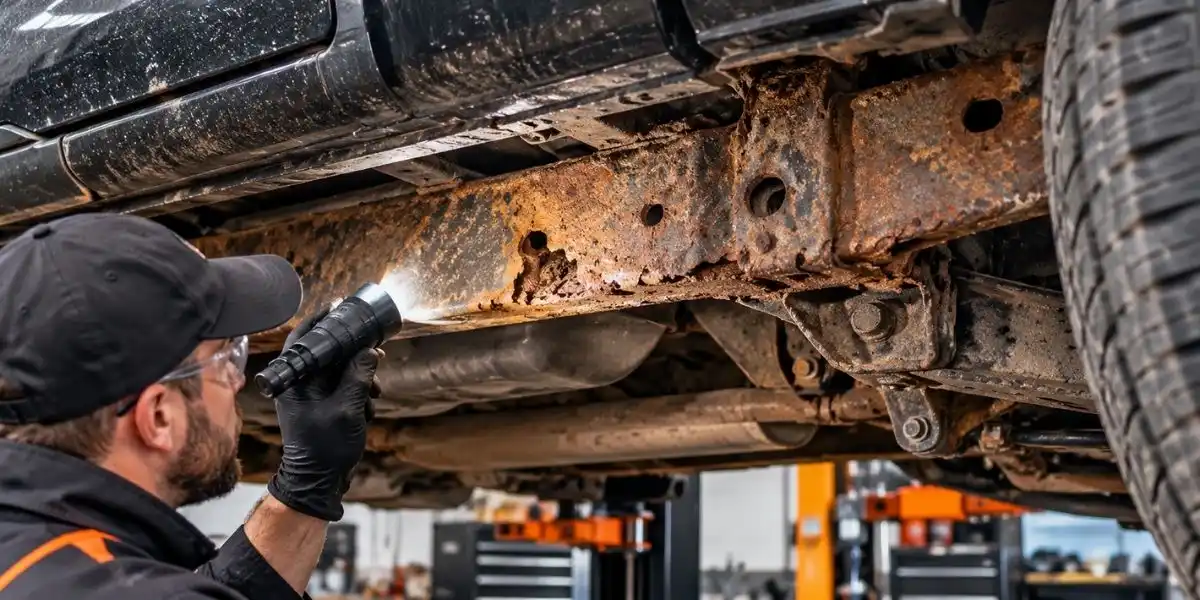
Rust hole repair depends on where the opening is and whether sound metal remains around it. A localized hole in an outer body panel may be suitable for a fitted metal patch after the damaged metal is removed. A hole in a frame, suspension mount, rocker, or other structural area needs an assessment of the surrounding structure and the vehicle-specific repair requirements before anyone chooses a fix. Covering corrosion with filler, paint, or undercoating does not replace missing metal.
Rust holes in the frame or underbody? See our rust removal and sandblasting service for how the work is done, starting prices and booking.
Identify the part before choosing a repair
The opening alone does not tell you how serious the damage is. An outer fender skin and a frame rail have different jobs, even if the visible holes look similar. Some parts mainly enclose or shape the vehicle; others support loads, hold components in place, or form part of the vehicle’s protective structure. A repair decision should start with the part’s function, not the apparent size of the hole.
Separate body-panel damage from possible structural damage
Look at what is near the rust, not just what is visible through it. A perforation close to a mounting point, reinforcement, structural seam, or load-bearing member deserves closer assessment. The concern is not that every nearby hole automatically makes the vehicle unsafe; it is that corrosion may have weakened a connection or spread behind overlapping metal where a surface view cannot establish its extent.
- Outer body skin: A local metal patch may be considered if the corrosion is confined and the surrounding metal can support the repair.
- Seam, pinch weld, or rocker: Overlapping panels can trap corrosion, so the visible opening may not show how far the damage continues.
- Frame rail or crossmember: The decision must account for the member’s condition and function, not simply whether the hole can be closed.
- Suspension, steering, body, or seat-belt mounting area: Have the surrounding structure and applicable repair information assessed before treating the damage as cosmetic.
For collision and structural repair, the vehicle maker’s information can matter because methods may depend on the part, material, and location. I-CAR’s Repairability Technical Support is a resource for repair-related information; its existence is not a substitute for the applicable vehicle-specific procedure or an inspection of the vehicle in question.
If the vehicle is subject to a safety inspection, check the rules that apply where it is registered. For example, Massachusetts’ automotive inspection regulation includes criteria concerning vehicle condition and structural components. Inspection requirements are not a repair plan, and passing an inspection should not be treated as proof that hidden corrosion has been evaluated for every intended use.
Find the corrosion boundary before estimating the work
Rust develops where moisture and contaminants can remain against metal, including seams, overlaps, cavities, and damaged coatings. A small opening can be the visible end of corrosion that has spread under paint or into a closed section. On the other hand, a hole does not by itself establish that an entire panel or frame must be replaced. The practical question is how much sound metal remains, where it is, and whether the affected surfaces can be reached and repaired.
What an inspection should clarify
A useful assessment distinguishes what can be seen from what remains uncertain. Ask what area was examined, whether the back side is accessible, and whether trim, coating, or adjacent parts must be removed to assess the metal. If the damage is boxed in or lies at a joint, a quick look at the outer surface may not settle the repair boundary. Bay State Rust Prevention’s verified capabilities include in-house vehicle inspection and corrosion assessment; the findings and proposed scope for a particular vehicle still need to be confirmed directly.
- Part and location: What component has the hole, and what does it support or connect?
- Extent: Does corrosion appear limited to the opening, or does it continue into nearby seams, layers, or cavities?
- Remaining metal: Is there sound material around the proposed repair area, or is the surrounding metal thin, flaky, or perforated?
- Access: Can the back side be inspected, cleaned, joined, and protected? If not, what additional access is needed?
- Repair basis: Does the vehicle maker provide instructions or restrictions relevant to this part and material?
These details help distinguish a localized perforation from wider metal loss. They also matter when buying a used vehicle: a neat coating or smooth filler surface does not establish what lies underneath. If the condition of a critical area cannot be determined without removing a covering or adjacent component, ask whether that inspection step is needed before approving a cosmetic finish.
Understand what a metal patch requires
When patching is appropriate, the job is more than closing an opening. Corroded metal must be removed back to material that can support the repair. Replacement metal must suit the part and be joined using a method appropriate to the vehicle and repair location. The finished area then needs suitable sealing and corrosion protection, including on accessible reverse surfaces. If rust is left at the edge or bare metal is left exposed, finishing the visible face alone does not address those weaknesses.
Typical stages and the decisions behind them
- Expose the area: Remove enough finish or covering to examine the corrosion boundary. The visible edge may not match the full extent beneath a coating or adjoining layer.
- Set the repair boundary: Decide how much compromised metal must come out. There is no fixed cut-out margin that can be assumed to fit every panel, material, or vehicle.
- Fit and join replacement material: Choose the material and joining approach for the specific part, its construction, and applicable repair information. Filler is not a substitute for missing metal where the part requires a metal repair.
- Finish and protect: Seal and refinish the repaired area as appropriate, and protect accessible seams or cavities rather than leaving exposed or heat-affected surfaces untreated.
Ask the repairer to explain the proposed boundary and method in terms you can follow. A clear estimate or work discussion should identify what is being removed, what is being replaced or repaired, and which surfaces can be protected afterward. For a structural section, it should also explain why the remaining material is considered suitable for the proposed repair. These questions are more useful than judging the job by how smooth the finished surface looks.
Welding and abrasive preparation require controls for their specific hazards. OSHA’s guidance on welding, cutting, and brazing addresses workplace risks such as fumes and fire, while its abrasive blasting guidance covers hazards associated with blasting operations. These are safety resources, not vehicle repair instructions. They are a reminder that welding or blasting a vehicle involves more than the visible rust, including nearby wiring, fuel, trim, and enclosed spaces.
For a classic or specialty vehicle, say whether preserving original construction or appearance is a priority before work begins. A visually tidy finish does not, by itself, demonstrate structural suitability; conversely, appropriate metalwork may require refinishing that changes the untouched appearance. Agree on the intended outcome and what will be inspected before the work is authorized.
Know when a small patch is the wrong fix
A small patch is a poor choice when it would attach to badly thinned metal, bridge corrosion that remains active, or conceal damage without restoring the part’s function. This is especially important in structural areas, where the visible opening may be only one sign of a larger problem. Depending on the inspection and vehicle-specific requirements, the repair may need broader metal removal, replacement, or structural work rather than a small patch.
Frame condition can be difficult to judge from the outside if a section is boxed or has layers. Rust removal may help expose the metal for assessment, but removing surface corrosion is not proof that a damaged frame is repairable. Bay State Rust Prevention’s verified capabilities include frame-off vehicle disassembly, sandblasting for rust removal, bare-metal preparation, and automotive frame repair. Whether a particular frame needs those steps, or can be repaired in a proposed way, depends on its condition and requires assessment.
- Question a surface-only fix if the proposal closes the opening without explaining how compromised metal is removed.
- Ask for a structural explanation when the rust is on a frame, mount, or other load-bearing part.
- Clarify hidden areas if seams, cavities, the opposite side, or joined panels have not been inspected.
- Ask what preparation involves if broader rust removal or disassembly is proposed, and what the work is intended to establish.
- Separate repair from coating so protective material is not presented as a substitute for restoring missing metal.
Filler, paint, and undercoating can hide a hole, but they do not replace steel or show that weakened structure is sound. A converter or coating may have a role in a suitable corrosion-protection plan, but it should not be treated as a replacement for metalwork where perforated or structurally compromised metal needs repair.
Protect the repair and choose a practical next step
Keep metal repair and corrosion prevention distinct
Metal repair addresses existing damage; corrosion protection aims to reduce future exposure. A sound finishing plan considers accessible surfaces on both sides of the repair and the seams or cavities where moisture and debris can collect. Ask what was cleaned, sealed, or coated, which areas could not be reached, and whether the surface was ready for the protection being applied. A coating over damp contamination, active rust, or unfinished metal can obscure a problem rather than resolve it.
For a vehicle without a current metal-repair need, a separate prevention plan may be relevant. Bay State Rust Prevention offers full-vehicle WaxOyl rust prevention undercoating and treatment for seams, panels, joints, and cavities. The service details are on the rust prevention undercoating page. Confirm directly whether that treatment fits the vehicle and whether any existing rust must be addressed first.
For extensive frame corrosion, rust removal and bare-metal preparation may be considered as part of assessment and repair planning. Frame-off work has a different scope from treating an intact vehicle, so ask what disassembly and preparation are proposed and how the result will be evaluated. Bay State Rust Prevention describes its related work on the frame-off rust removal page; that page should not be taken to mean every rusted frame needs frame-off treatment.
- Outer-panel hole: Ask whether corrosion is localized and whether the surrounding metal can support a patch.
- Hole near a structural joint or mount: Prioritize inspection of the affected part and adjacent structure before choosing a cosmetic repair.
- Frame perforation or widespread scale: Ask what can be established about the frame’s condition, whether broader access or rust removal is needed, and what repair options follow from the assessment.
- Restoration project: State whether original appearance, continued use, or structural restoration is the priority so the proposed scope addresses the right outcome.
After the repair, keep an eye on the finished area during routine cleaning and maintenance. New bubbling, a cracked coating, debris trapped at a seam, or a fresh opening at an edge are reasons to request another inspection, not reliable evidence about hidden structural condition. If the rust hole is in a frame or mounting area, or the surrounding metal cannot be assessed from the outside, ask for an in-person evaluation before authorizing a cover-up. Bay State Rust Prevention offers corrosion assessment, rust removal, frame-off preparation, and automotive frame repair; contact baystaterustprevention.com to ask whether the vehicle’s location and condition fit those capabilities and what information is needed to assess the next step.