
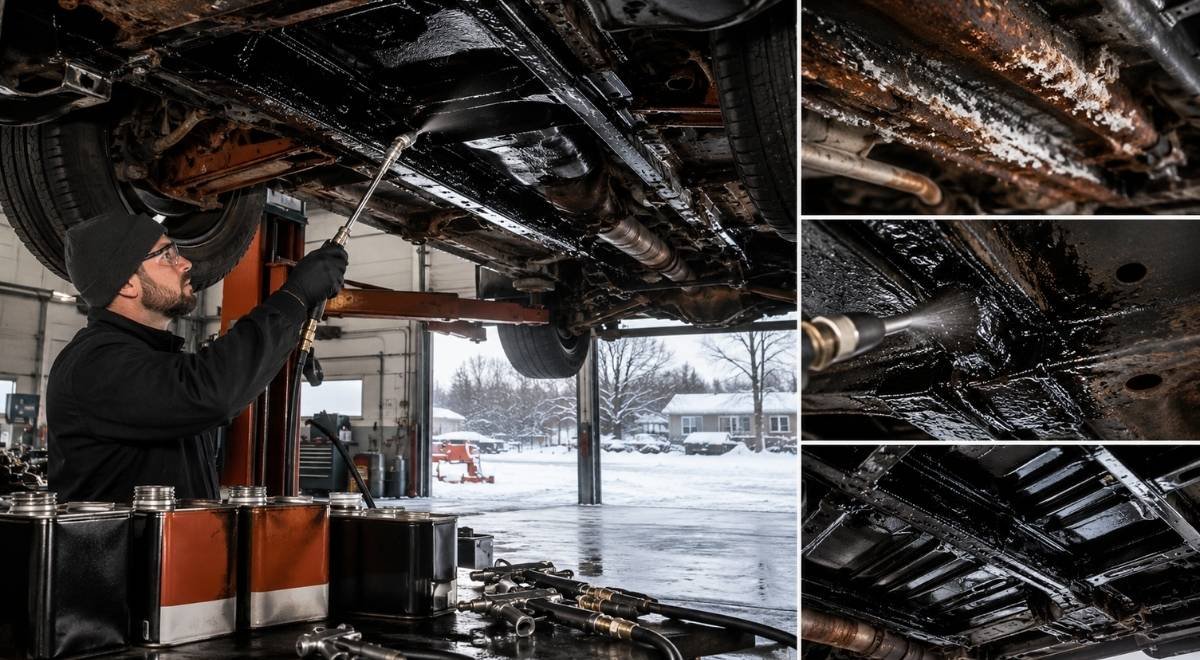
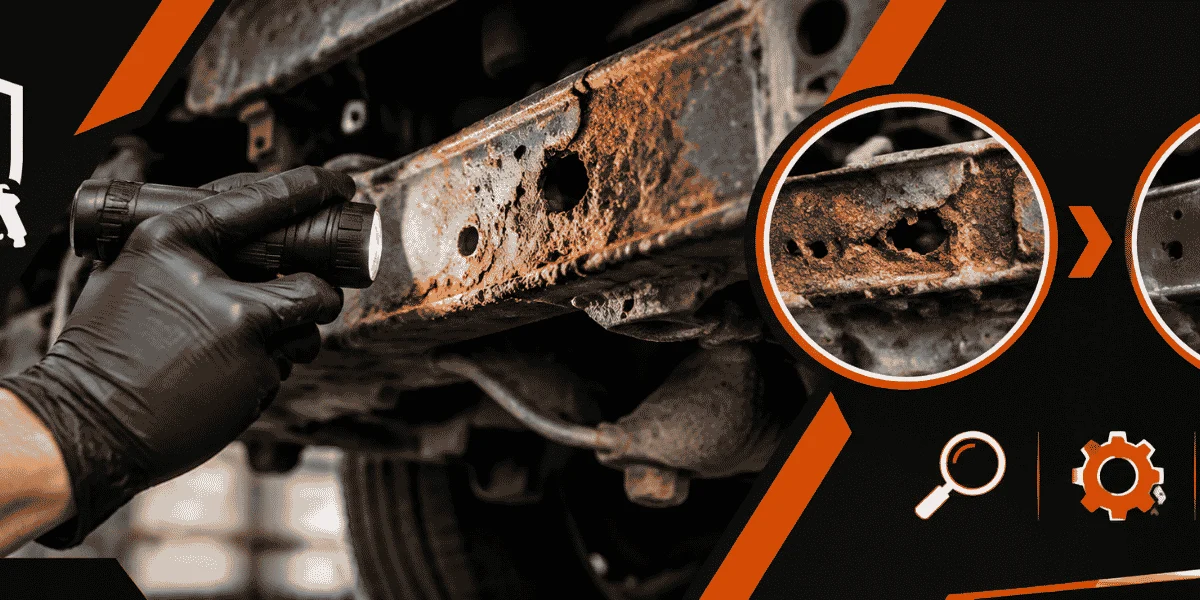
Oil-based undercoating for vehicles is a corrosion-control coating that leaves a water-displacing, flexible film on exposed metal, seams, fasteners, and cavities. Unlike a hard paint-like barrier, it is intended to creep into small gaps and remain serviceable when a vehicle flexes, vibrates, or picks up road spray. For a Central Massachusetts owner, the important question is not simply whether an undercoating is “oil based.” The useful question is whether the product, preparation, access, and reapplication plan match the vehicle’s actual rust risk.
That distinction matters for a new pickup, a leased crossover, a work van, and a classic car in different ways. A clean frame may need a preventive film. A frame with layered scale may need cleaning or structural evaluation first. An underbody covered in wet dirt may need washing and drying before any coating is applied. The coating is one part of a corrosion-control system, not a substitute for inspecting metal.
What oil-based undercoating is—and what it is not
An oil-based undercoating is a fluid or semi-fluid corrosion protectant carried by an oil-like vehicle. After application, it leaves a film that helps separate steel from water, dissolved salts, and oxygen. The film may remain slightly mobile rather than curing into a rigid shell. That mobility is useful around seams and overlapping panels, where a brittle coating can crack or detach.
It is different from several products that are often grouped together under the word “undercoating”:
- Oil-based or wax-oil films are selected for penetration, water displacement, and flexibility.
- Rubberized or asphaltic coatings form a thicker, more fixed layer and are often used for sound reduction or impact protection as well as corrosion control.
- Paint or epoxy systems depend heavily on preparation, adhesion, and a clean substrate; they are not automatically suitable for spraying over active scale.
- Greases and assembly lubricants may protect a fastener or hinge but are not necessarily designed for broad underbody coverage.
- Rust converters chemically react with certain iron oxides; they do not replace removal of loose scale or inspection of weakened steel.
The best choice depends on the surface and the job. A flexible oil film can be sensible for a daily-driven vehicle whose frame is intact but exposed to salt spray. It is not a repair for a perforated crossmember. Nor should it be used to conceal a brake line, drain hole, cracked weld, or unsafe section of frame.
The film is a barrier, not a structural material
Corrosion consumes steel when moisture, oxygen, and contaminants remain in contact with the metal. Road salt makes that environment more aggressive by helping water conduct electrical current across the surface. The coating interrupts that contact, but it does not restore the thickness or strength of steel already lost.
That is why a responsible inspection distinguishes between:
- surface discoloration with solid metal underneath;
- scaly rust that may shed during cleaning;
- pitting that reduces local thickness;
- perforation through a bracket, pan, or boxed section; and
- cracks, buckling, separation, or poorly repaired frame areas.
For owners who need the broader service rather than a coating alone, Bay State Rust Prevention describes its rust prevention undercoating work as part of a vehicle-specific corrosion-prevention process. The useful takeaway is to match the treatment to the metal’s condition before choosing a product.
Why road salt makes the decision important in Massachusetts
Winter corrosion is not caused by cold weather alone. A vehicle repeatedly exposed to brine can carry a conductive residue into seams, folded edges, spring mounts, brake-line clips, and the inside of boxed frame sections. Massachusetts publishes information about its winter snow-and-ice operations and the materials used to maintain roads; local exposure varies with route, storm conditions, parking, and how often the vehicle is washed. See the Massachusetts snow and ice control information for the state’s official context.
The practical implication is that a vehicle can look clean from above while corrosion progresses underneath. Saltwater does not need to pool visibly to matter. It can be held by compacted mud, trapped behind a shield, or drawn into a lap seam by capillary action. A film that reaches those locations can be more useful than a thick coating applied only to broad, easy-to-see surfaces.
Different vehicles carry different corrosion decisions
- New trucks and SUVs: prevention is easier before scale develops, especially around frame welds, body mounts, rear suspension brackets, and exposed fasteners.
- Leased vehicles: an owner may want a documented, reversible maintenance approach that avoids drilling, permanent alterations, or coating over defects.
- Daily commuters: repeated winter mileage creates more opportunities for salt to enter seams than occasional use on dry roads.
- Fleet vans and work trucks: the downtime required for cleaning and inspection may be more important than the material cost, so a repeatable service schedule matters.
- Classic and specialty vehicles: originality, access, storage humidity, and the risk of trapping contamination can outweigh the convenience of a fast application.
- Older vehicles with visible rust: the first decision is whether the steel remains serviceable, not which coating has the strongest marketing description.
For a used-car buyer, undercoating should prompt questions rather than automatic reassurance. Ask when it was applied, whether the vehicle was cleaned first, whether drain holes remain open, and whether photographs or inspection notes show the metal before treatment. A fresh dark film can make a frame look uniform without proving that the frame is sound.
As an illustrative inspection policy—not a universal benchmark—a buyer might request clear views of both frame rails, crossmembers, body mounts, brake and fuel-line areas, and suspension attachment points before purchase. If those areas cannot be seen, an independent inspection is more valuable than assuming the coating indicates good condition.
How a flexible oil film protects metal
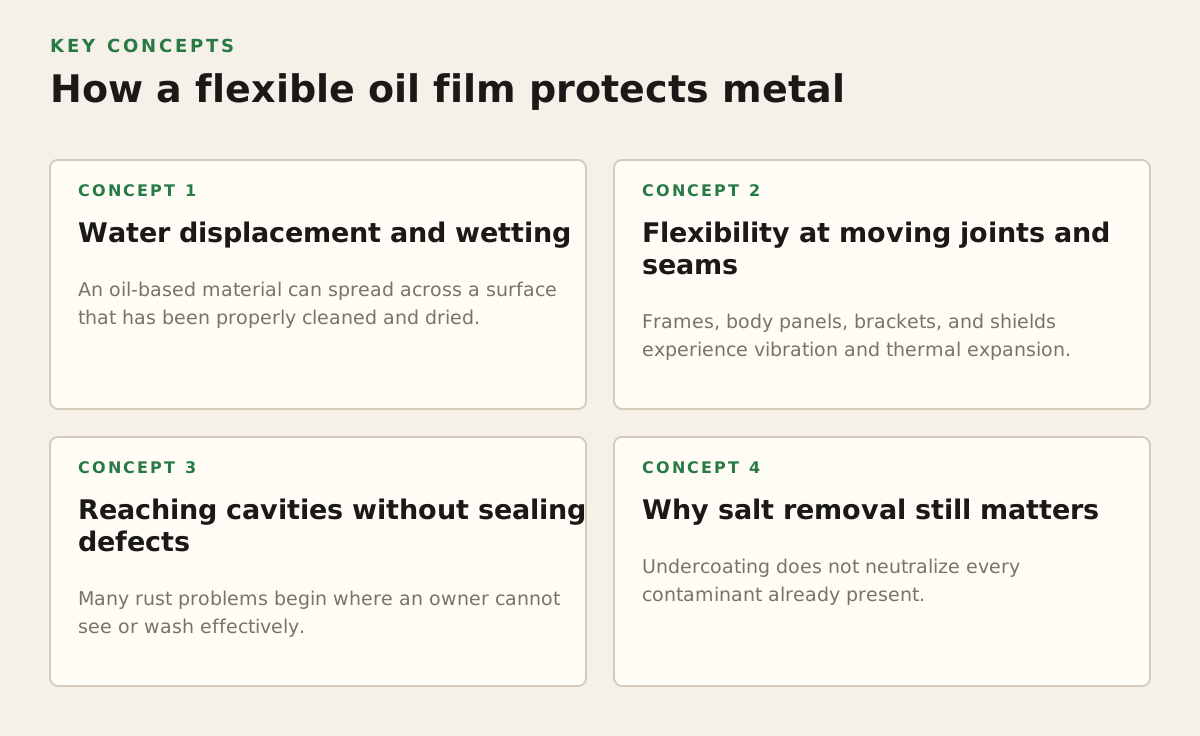
The mechanism is straightforward but depends on application quality. The product must contact the steel, remain in the vulnerable area, and avoid creating new problems such as blocked drainage or hidden inspection points.
Water displacement and wetting
An oil-based material can spread across a surface that has been properly cleaned and dried. Its film occupies microscopic irregularities and helps prevent water from maintaining direct contact with the steel. It may also move into seams and around fasteners where a high-viscosity coating cannot reach.
This does not mean an applicator should spray over dripping water, mud, or thick loose scale. Contamination can separate the film from the metal, while trapped moisture can continue the corrosion process underneath. Preparation determines whether the coating is touching steel or merely covering debris.
Flexibility at moving joints and seams
Frames, body panels, brackets, and shields experience vibration and thermal expansion. A rigid coating can develop a crack or lose adhesion at an edge. A flexible film is better suited to locations where small movement is expected, although flexibility also means it can be washed away, displaced, or worn thin at impact points.
Coverage therefore needs to be intentional. The technician should identify both broad exposed areas and high-risk details:
- frame rail flanges and weld transitions;
- inside faces of boxed sections where access permits;
- body mounts and hardware shoulders;
- spring hangers, control-arm brackets, and crossmember edges;
- seams behind wheel liners and splash shields;
- exposed brake-line and fuel-line clips; and
- overlapping panels that collect salt but still require drainage.
Reaching cavities without sealing defects
Many rust problems begin where an owner cannot see or wash effectively. A cavity application can help if it reaches the intended surfaces, but access must be controlled. Drain holes, inspection openings, wiring connectors, exhaust components, friction surfaces, and heat-sensitive parts should not be treated as though they were all the same.
Good work is therefore partly a mapping exercise. Before spraying, the applicator identifies where the material should go, where it must not go, and how the vehicle will be inspected afterward. Overspray on a brake rotor is not a minor cosmetic issue; it can compromise braking friction. Material on a hot exhaust component may smoke or degrade. Coating a drain path can retain the very water the treatment is meant to exclude.
Why salt removal still matters
Undercoating does not neutralize every contaminant already present. Washing removes soluble salt and loose soil; drying prevents the new film from being diluted or separated. The Federal Highway Administration discusses the relationship between winter maintenance chemicals and corrosion in its official road-salt corrosion research. That research context supports a practical rule: reducing contamination before protection is more defensible than simply adding material over an existing residue.
| Condition before application | Likely decision | Reason |
|---|---|---|
| Clean, intact metal | Apply preventive film after drying | The coating can contact the substrate and protect exposed areas. |
| Light surface rust | Clean, inspect, then treat if metal is sound | Loose residue should not become a hidden separation layer. |
| Heavy scale or packed mud | Remove contamination before deciding | The actual condition may be concealed. |
| Perforation, cracking, or distortion | Repair or replace affected structure first | A coating cannot restore lost strength. |
| Wet cavity or blocked drain | Dry and restore drainage | Trapping moisture defeats the intended protection. |
Where oil-based undercoating breaks down
A flexible film has useful limitations. Treating those limitations as part of the maintenance plan is better than promising permanent protection.
Impact and abrasion
Gravel, packed snow, brush, and road debris can remove coating from the front edges of frame rails and wheel-well areas. Jacking points and service contact points may also be scraped during repairs. These are normal losses, not proof that the entire treatment failed. They are reasons to inspect and touch up exposed metal when appropriate.
Heat and incompatible surfaces
Exhaust pipes, catalytic converters, mufflers, brake friction surfaces, tire tread, belts, and electrical connectors require careful exclusion. Heat can change the material, while contamination of a friction or moving surface can create an immediate safety problem. Product instructions and the vehicle manufacturer’s service information should control uncertain applications.
Compatibility also matters when a vehicle already has another coating. A new oil film may soften, swell, or loosen an older product. It may also make later welding, grinding, or refinishing more difficult. Before restoration work, the shop should document what has been applied and remove contamination from areas that will be repaired.
Hidden corrosion and false confidence
Dark, uniform coverage can hide visual clues. That is particularly concerning on boxed rails and layered brackets, where corrosion may progress from the inside or between overlapping pieces. A coating can slow access to the metal for later inspection, so service records and photographs are valuable.
When rust has advanced, a cleaning and structural assessment comes first. Abrasive blasting is not a magic cure: it removes corrosion and coatings so the remaining metal can be evaluated, but it can also expose pinholes and thin sections that require repair. The Occupational Safety and Health Administration’s abrasive-blasting guidance addresses hazards such as dust, ventilation, respiratory protection, and abrasive materials. Those controls are part of competent restoration work, not optional shop decoration.
Maintenance after application
Owners should not treat a one-time application as a lifetime guarantee. An illustrative starting policy might include an inspection after the first winter, a check after major suspension or frame work, and additional attention when the film is visibly thin or missing. Those intervals are planning examples, not a universal service schedule; driving exposure and product instructions should determine the actual timing.
- Look for bare bright steel, fresh orange corrosion, or coating washed from edges.
- Check whether mud or salt remains packed above shields and inside wheel wells.
- Confirm that drain holes and access openings remain clear.
- Inspect around repaired welds, replacement brackets, and newly disturbed fasteners.
- Record photographs and areas treated so the next inspection is comparable.
How practitioners apply it to real vehicles
A sound process begins with a decision about the vehicle, not with a spray wand. The same material may be appropriate for a clean fleet chassis and inappropriate for a heavily scaled restoration project.
1. Establish the vehicle’s baseline
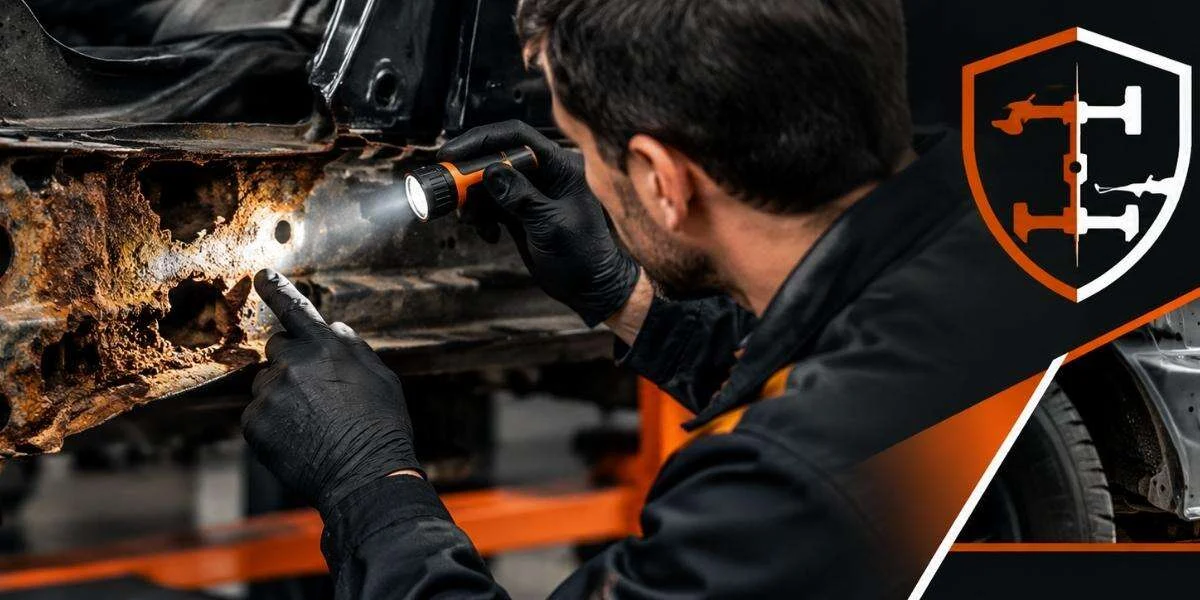
The inspection should cover the frame rails, crossmembers, suspension mounts, body mounts, floor edges, wheel wells, brake and fuel lines, and visible cavities. For a fleet, the baseline can be a repeatable checklist. For a classic vehicle, it may include photographs, measurements, and notes about original finishes. For a used-car buyer, it should answer whether the metal is structurally sound before any coating obscures it.
Warning signs that deserve repair evaluation include a screwdriver or probe entering a section, holes around mounting points, separated welds, buckled rails, visibly reduced bracket thickness, and corrosion adjacent to a previous patch. A coating decision should pause until those conditions are understood.
2. Clean according to the substrate
Cleaning can range from washing and drying to mechanical rust removal or abrasive blasting. The method must remove loose scale without needlessly damaging solid metal. The shop must also protect bearings, seals, wiring, glass, painted bodywork, and components that can be harmed by water, abrasives, or pressure.
For a severely rusted classic frame or a component being restored off the vehicle, frame-off rust removal may be more appropriate than attempting to coat over the assembly. Removing the frame or component from the vehicle can improve access and reveal damage that an underbody application would leave hidden. The consequence is more labor and disassembly, but the inspection is correspondingly more meaningful.
3. Repair before preservation
Structural repair may involve cutting out weakened steel, fabricating replacement sections, restoring correct geometry, and welding according to the vehicle and shop’s repair procedures. The repair area then needs a compatible corrosion-protection plan. Applying oil film before welding or refinishing can create smoke, contamination, and a safety hazard; those areas must be clean and suitable for the next operation.
For a daily driver, the right outcome may be limited cleaning and monitoring if the metal is sound. For a restoration, it may be a more extensive disassembly, blasting, repair, primer, finish system, and cavity protection plan. “More coating” is not automatically the more professional answer.
4. Apply selectively and document the work
Application should follow the product’s technical instructions for surface condition, equipment, ventilation, temperature, and prohibited areas. The operator should use controlled coverage rather than trying to make every component look equally wet. A written record can identify the product, date, areas reached, excluded components, and issues deferred for repair.
Concrete illustrative examples show how the decision changes:
- Three-year-old commuter crossover: if the frame is intact and the main concern is winter salt, clean, dry, inspect, and apply a flexible film to exposed frame and cavity areas while preserving drains and service points.
- Ten-year-old work pickup: if scale is concentrated around rear spring mounts, remove enough contamination to assess thickness; repair any weakened mount before treating the surrounding sound metal.
- Classic body-off project: if the frame is already removed, use the access to document every surface, remove corrosion, complete structural work, and choose a finish and cavity plan that will not interfere with future welding or inspection.
- Five-vehicle service fleet: create one inspection checklist covering rails, mounts, lines, drains, and abrasion points, then schedule follow-up based on route severity and observed loss rather than applying an arbitrary identical interval.
- Recently purchased used truck: do not interpret a fresh black coating as proof of a clean frame; request inspection access and look for concealed scale, blocked drains, and patched structural areas.
5. Keep the protection serviceable
After treatment, the owner still has useful work to do. Rinsing salt from accessible underbody areas, repairing damaged splash shields, avoiding prolonged storage with wet packed mud, and reporting new corrosion early all extend the value of the application. A shop servicing the vehicle should know that an oil film is present before heating, grinding, welding, or refinishing nearby components.
For a Central Massachusetts owner, the most defensible recommendation is to use an oil-based film on clean, inspected, structurally sound metal, with cavity access and drainage treated as design constraints. Do not use it to conceal active structural rust, and do not judge success by how dark or thick the underbody looks. Bay State Rust Prevention can help owners evaluate rust, perform undercoating, remove corrosion, sandblast restoration components, and address rust-damaged frames; visit baystaterustprevention.com when the vehicle needs a condition-based plan rather than a coating applied blindly.