
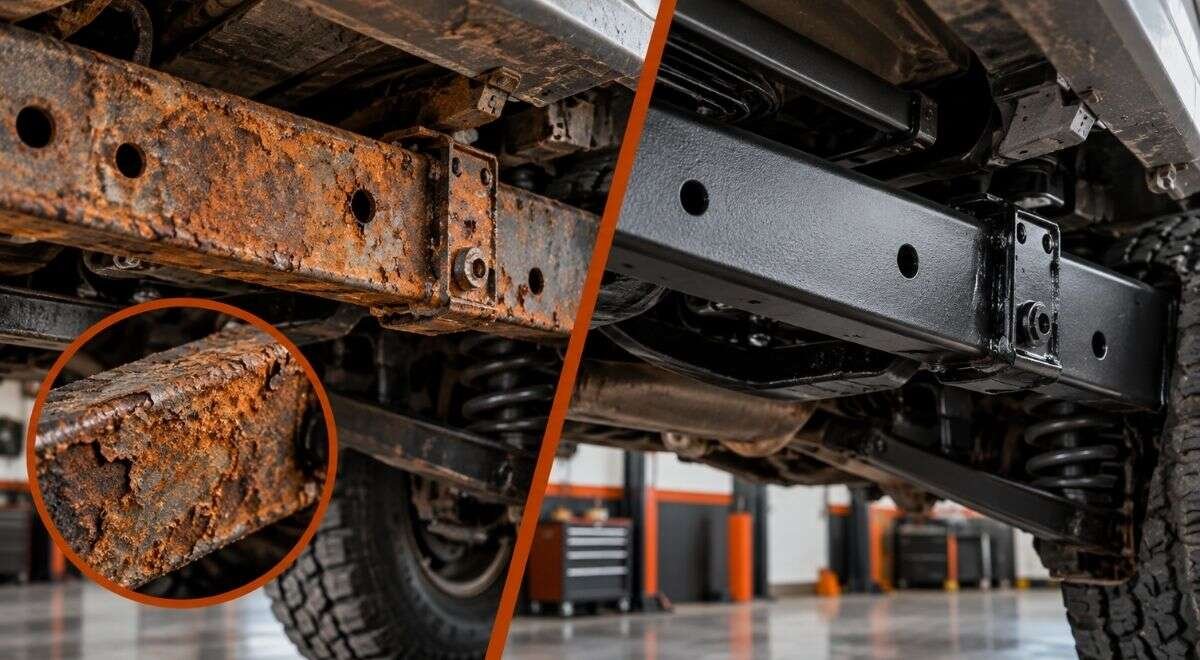
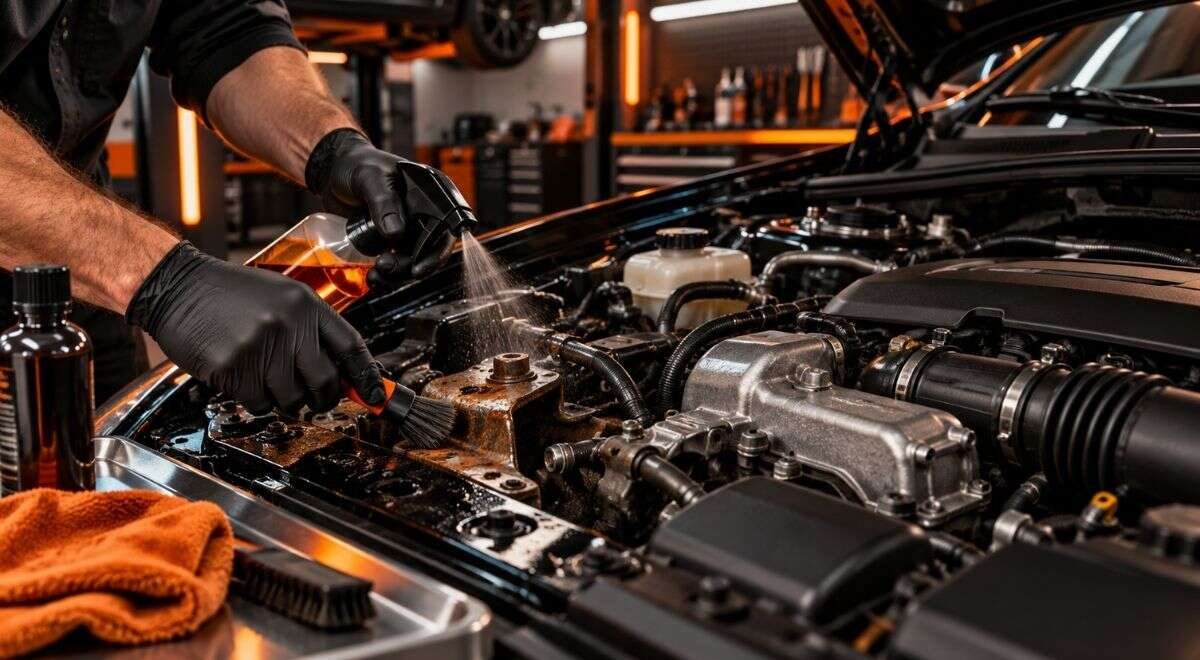
Frame surface rust is early corrosion on exposed steel that has not yet caused meaningful section loss, holes, or weakened load-bearing areas. It can often be cleaned, converted or sealed, then protected with a suitable coating—but a frame that is flaking, deeply pitted, cracked, or soft under inspection may need professional repair or replacement rather than a cosmetic spray. For drivers in Central Massachusetts, the practical job is to determine which condition exists before covering it with undercoating.
What Frame Surface Rust actually means
Rust is the visible result of steel reacting with oxygen and water. Road salt does not create a separate kind of rust, but it makes the corrosion process easier to sustain by helping moisture remain conductive on the metal. The Federal Highway Administration describes deicing materials as useful for winter safety while also recognizing their corrosive effects on vehicles and infrastructure; that trade-off is especially relevant to trucks and cars exposed to Massachusetts winter roads. See the Federal Highway Administration’s discussion of road salt and deicing materials.
The word surface is the important limitation. Surface rust may appear as orange staining, a thin brown film, rough scale, or small raised spots around welds and fasteners. It is not automatically harmless, however. Rust occupies more volume than the original steel and can lift paint, seam sealer, or an existing coating. Once moisture gets under that lifted layer, corrosion can continue out of sight.
Surface rust versus structural corrosion
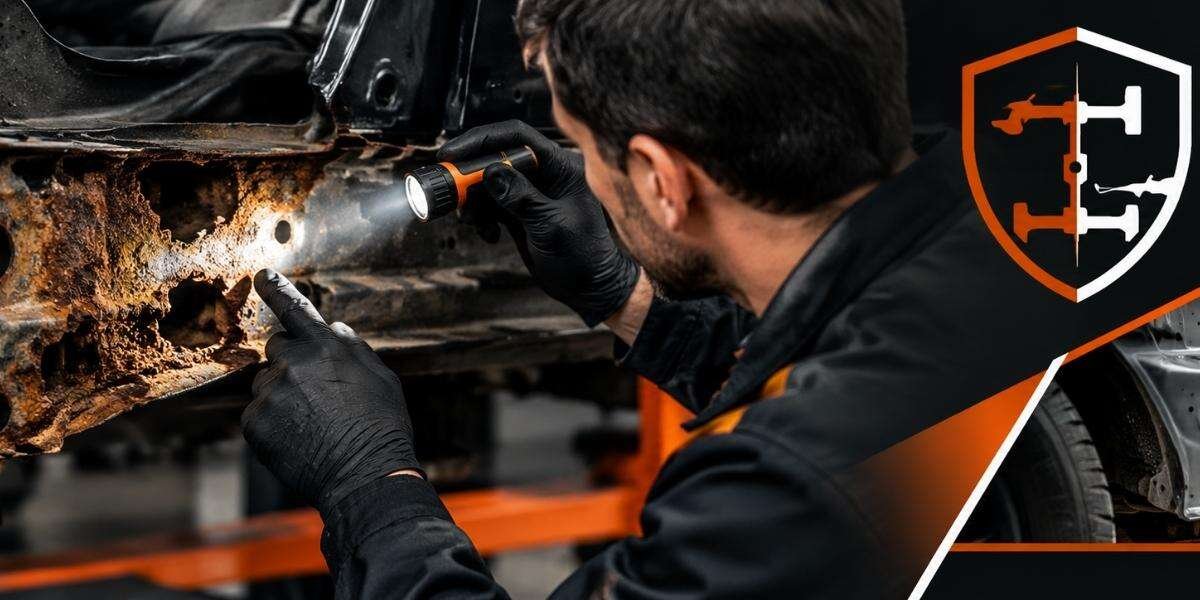
A sound-looking frame can hide more advanced damage inside a boxed rail, crossmember, suspension mount, or overlapping seam. The useful question is not “Is the frame rusty?” but “Has corrosion reduced the steel’s thickness, continuity, or attachment strength?” Look for:
- Loose scale that breaks away when lightly probed with an inspection tool.
- Deep pits with sharp edges, especially around drain holes, welds, and brackets.
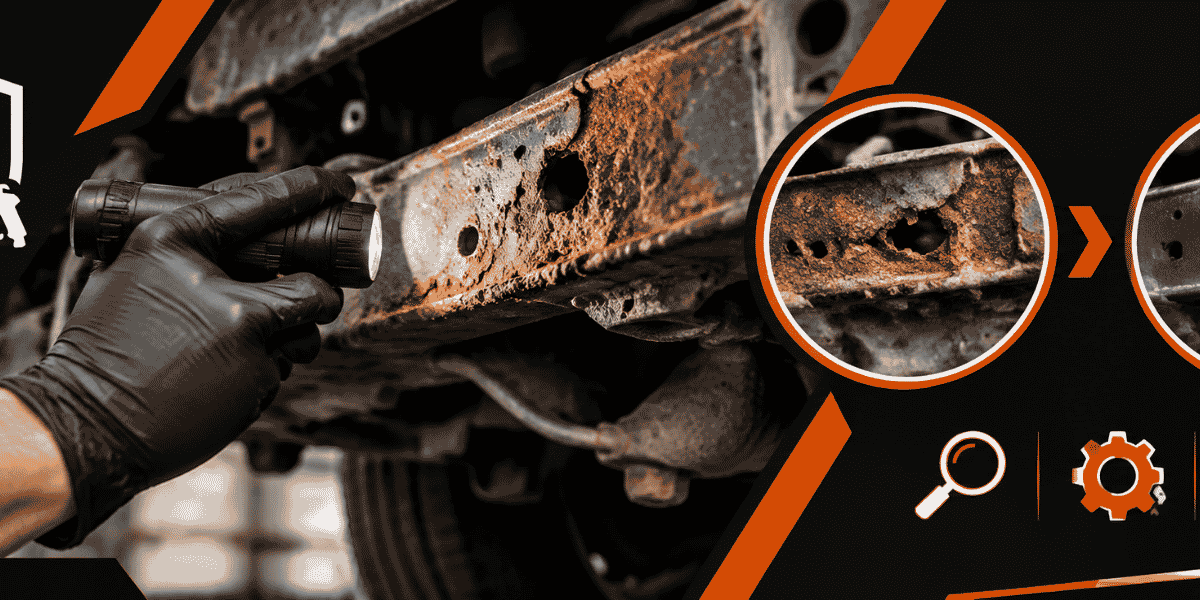
- Perforation, including pinholes or daylight through a boxed section.
- Cracks or separated seams near suspension, steering, body, or powertrain mounts.
- Swelling between layers, which can indicate corrosion trapped inside a lap joint.
A coating can hide orange color, but it cannot restore missing steel. If a probe enters a hole, the metal flexes unusually, or a mount appears distorted, stop treating the job as routine rustproofing and arrange a structural inspection.
Why frame corrosion matters in Massachusetts
Frames are exposed to a difficult combination: wet pavement, salt solution, mud, stones, heat from the exhaust, and areas that do not dry quickly. The underside also receives repeated impact from spray and grit. A vehicle that looks clean above the beltline may have corrosion concentrated along the bottom flange of a frame rail or inside a crossmember.
Salt residue is particularly troublesome because a visual rinse may remove loose dirt without removing all soluble residue from seams and cavities. Applying oil, wax, or rubberized material over contaminated steel can trap the problem rather than stop it. That is why cleaning and drying come before coating.
Why boxed frames need extra care
Open channel sections are easier to see and clean. Boxed rails are more deceptive: water and salt can enter through drain holes, cracks, fastener openings, or damaged seams, then remain against the inner wall. The outside may show only a small rust bubble while the inside has broader scale.
Pay special attention to:
- Drain holes that are blocked by mud, rust scale, or undercoating.
- Crossmember ends where several layers of steel meet.
- Body and cab mounts, including their brackets and captive nuts.
- Suspension and steering mounts, where a small loss of section can have an outsized consequence.
- Rear frame kick-ups and areas above the rear axle that collect wet debris.
Do not drill new holes in a frame simply to inspect or drain it without a qualified repair decision. A hole can remove material, weaken a section, or create a new path for water. Existing openings should be kept clear according to the vehicle’s design and repair requirements.
How to inspect Frame Surface Rust without hiding the evidence
An inspection should begin with the vehicle safely supported and the underside accessible. A driveway look beneath a parked vehicle is useful for screening, but it is not an adequate structural examination. Never rely on a jack alone, and never place any part of your body beneath a vehicle supported by an unsafe arrangement.
A practical inspection sequence
- Wash first. Remove mud and salt residue with appropriate pressure and allow the underside to dry fully.
- Map the affected areas. Photograph the frame rails, crossmembers, mounts, brake-line brackets, and seams before disturbing the rust.
- Remove loose scale carefully. Use a hand tool or suitable mechanical method to expose solid metal without grinding away evidence.
- Probe suspicious spots. Compare questionable areas with nearby clean-looking steel and check whether the surface is firm.
- Inspect the inside of cavities where possible. A borescope can reveal scale that an outside visual check misses.
- Separate cosmetic from structural findings. Mark areas needing cleaning, coating, welding evaluation, or immediate repair.
These steps are an illustrative inspection workflow, not a universal safety standard or a substitute for the manufacturer’s repair information. If the corrosion is near a suspension attachment, steering component, seat-belt anchorage, or body mount, obtain a qualified structural opinion before applying a permanent coating.
Massachusetts vehicle inspections involve safety and equipment requirements that can affect whether a rust-damaged vehicle is roadworthy. Because inspection rules and enforcement guidance can change, check the current information from the Massachusetts Registry of Motor Vehicles rather than assuming that a coated frame will pass or that a visible rust spot will fail.
Questions a used-car buyer should ask
For a used truck or older car, ask whether the underside was recently coated and request photographs from before the coating was applied. Fresh black material over heavy scale is not proof of repair. A seller should be able to explain:
- Whether the frame was washed and mechanically cleaned before coating.
- Whether any welding, patching, or replacement of brackets was performed.
- Which sections were inspected internally, if the frame is boxed.
- Whether drain holes and access points remain open.
Look for a consistent finish that follows the frame’s contours rather than thick material concentrated over suspicious areas. If you cannot see the steel and the history is unclear, pay for an independent inspection before purchase.
How rust removal and protection work
There is no single product that makes every rusted frame sound. The treatment has to match the condition of the steel and the intended use of the vehicle. A daily driver exposed to salt needs a maintainable barrier and regular inspection; a restored classic may need a more extensive strip-and-repair process so the original metal and welds can be documented.
Cleaning and preparation
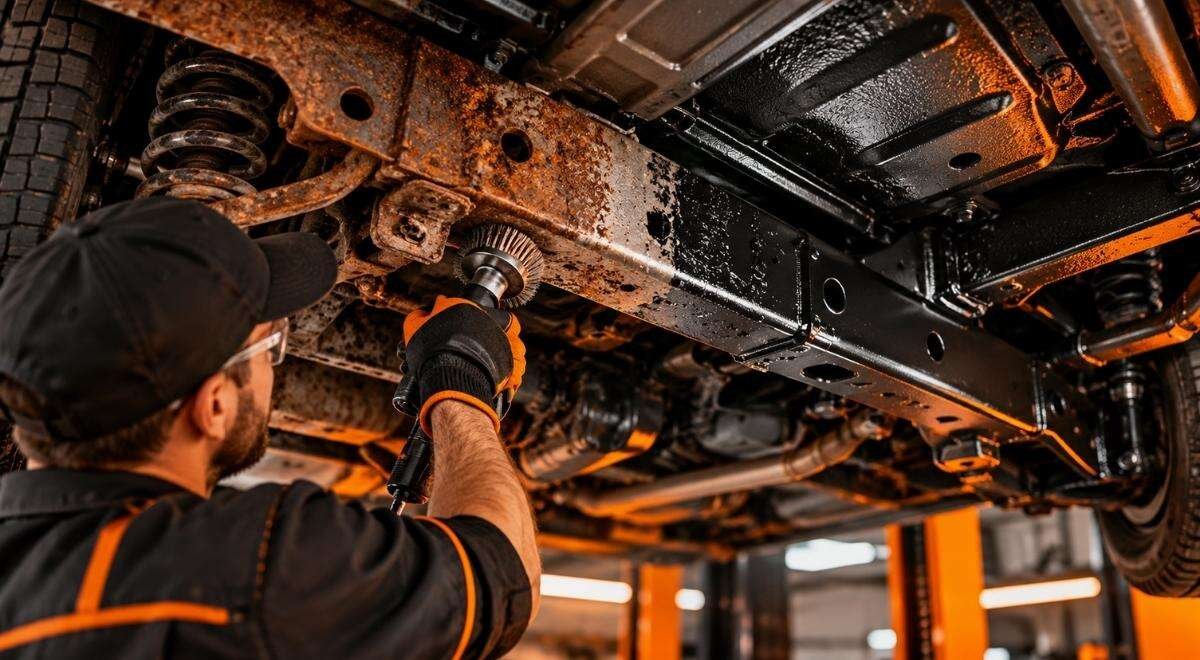
Loose scale, dirt, salt, grease, and failed coatings all interfere with adhesion. Preparation may include washing, scraping, wire work, abrasive blasting, or localized removal. The objective is not always to make every square inch shiny; it is to remove unstable material and expose enough sound steel to judge the next step.
Abrasive blasting is a removal method, not a structural repair. It can reveal pinholes, thin edges, old welds, and cracks that were obscured by scale. It can also damage thin metal, drive abrasive into cavities, or create a large cleanup problem if performed without containment. The Occupational Safety and Health Administration discusses respiratory, containment, and abrasive-blasting hazards in its abrasive blasting safety guidance.
After cleaning, the frame must be dry and free of blasting dust or residue. Coating over damp steel or trapped abrasive shortens the useful life of the treatment. Openings, seams, and cavities should be assessed separately rather than flooded indiscriminately.
Choosing the treatment
For light, stable corrosion, a rust-compatible primer or corrosion-inhibiting coating may be appropriate after preparation. For an intact frame that needs ongoing seasonal protection, a waxy or oily cavity product can help displace moisture and slow new corrosion when applied to clean, accessible surfaces. Bay State Rust Prevention uses WaxOyl for corrosion protection, but the product is not a substitute for removing loose scale or repairing weakened steel.
Hard coatings and flexible cavity protectants have different jobs:
- Hard primers and topcoats can protect prepared exterior steel but may fail if applied over movement, scale, or contamination.
- Waxy or oily films can creep into seams and remain serviceable as a maintenance layer, but they may need inspection and renewal.
- Seam sealers can block water at an appropriate joint, but sealing over active rust or wet contamination can conceal continued corrosion.
- Rubberized coatings can resist splash and noise in suitable applications, yet a damaged edge can allow water to travel behind the film.
The best system is often layered: remove unstable rust, repair the metal, prime compatible surfaces, seal appropriate seams, and protect cavities. The exact products and order depend on substrate condition, access, curing requirements, and the manufacturer’s instructions.
Where frame-rust treatments break down
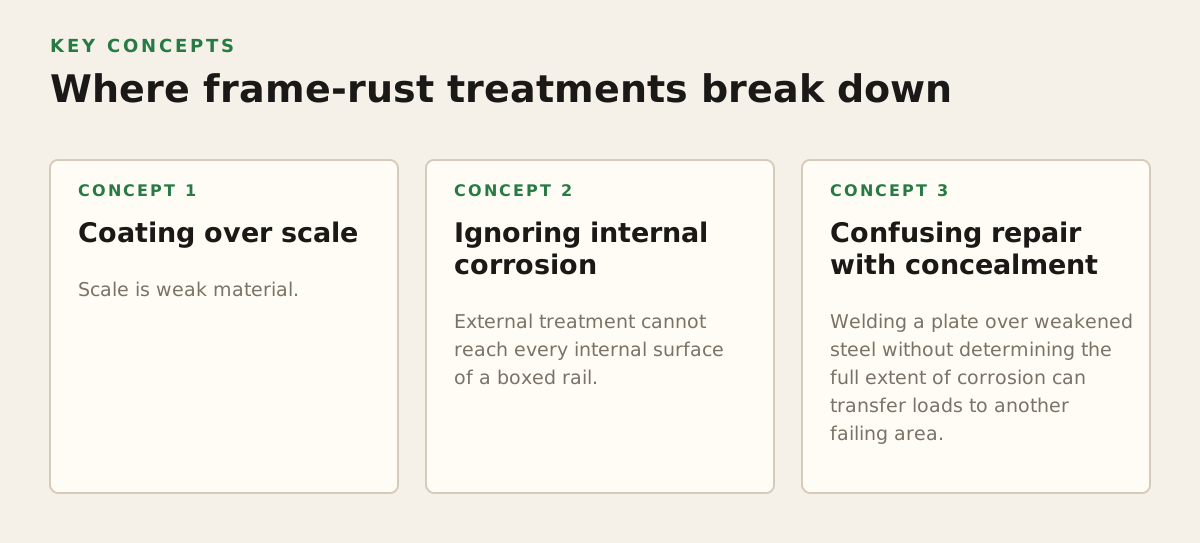
Most disappointing results come from a mismatch between the visible symptom and the actual failure. A coating may appear successful for a short time while corrosion continues underneath. The following limitations should be part of the decision before work begins.
Coating over scale
Scale is weak material. If it remains attached only by friction, a new film bonds to the scale rather than to steel. Vibration, water intrusion, and temperature changes can then lift the entire layer. A dark finish can make this harder to notice, so inspection after preparation matters more than color.
Ignoring internal corrosion
External treatment cannot reach every internal surface of a boxed rail. Existing access points may allow inspection or cavity treatment, but they do not prove that the inside is sound. If internal scale is extensive, a repair facility may need to open the section, replace part of the rail, or follow a vehicle-specific structural procedure.
Confusing repair with concealment
Welding a plate over weakened steel without determining the full extent of corrosion can transfer loads to another failing area. Likewise, filling a perforation with coating does not restore the original load path. Structural repair requires sound metal, correct geometry, and an appropriate repair method, not merely a sealed appearance.
Use this illustrative decision table as a starting point rather than a universal pass/fail rule:
| Observed condition | Reasonable next step | What not to assume |
|---|---|---|
| Light orange film; firm steel; no swelling | Clean, inspect, protect, and schedule rechecks | That all hidden areas are equally sound |
| Flaking scale; shallow pitting; intact mounts | Remove unstable material and obtain a coating recommendation | That paint or undercoating will bond to loose scale |
| Pinholes, soft spots, distorted brackets, or cracked seams | Obtain structural repair evaluation before coating | That a cosmetic patch restores strength |
| Heavy corrosion inside a boxed rail | Determine whether opening, section replacement, or frame replacement is appropriate | That exterior spraying reaches the damaged interior |
How practitioners apply a frame-rust plan
A sound job begins with a written scope. For a personal truck, that may mean separating routine protection from a repair area. For a fleet, restoration shop, or repair business, it also means documenting vehicle condition so future inspections can distinguish new corrosion from old damage.
For new, leased, and lightly used vehicles
Prevention is easiest before scale develops. The useful sequence is to inspect seams and drain points, remove salt after winter exposure, correct damaged factory coating, and apply a compatible protective treatment to exposed areas. Do not assume a new vehicle is immune: road spray begins attacking vulnerable edges as soon as protective finishes are damaged by stones, tools, or poor lifting practices.
For a leased vehicle, photograph the condition and follow the lease, warranty, and product instructions before applying a permanent material. A removable maintenance coating may be preferable to a treatment that complicates an end-of-lease inspection.
For rust-damaged vehicles and restoration projects
Older trucks, classics, and specialty vehicles deserve a slower process because originality and structural integrity can conflict. Preserve identification marks and document the frame before blasting. Remove enough material to find the true boundary of corrosion, then decide whether to retain, reinforce, section, or replace the affected steel.
For heavily scaled components, a frame-off rust removal process can make hidden surfaces accessible and improve the quality of the structural assessment. It is most useful when the body, suspension, or drivetrain prevents a complete inspection—not as an automatic requirement for every rust spot.
Illustrative examples of decisions a shop might record include:
- Example 1: A newer pickup has firm exterior rails but salt-packed seams; clean and protect the cavities, then schedule an annual inspection.
- Example 2: A work van has flaking scale around a rear mount; expose the steel and obtain a repair decision before any coating is applied.
- Example 3: A classic chassis has widespread scale but no confirmed perforation; document it, remove corrosion under controlled conditions, and reassess each section.
- Example 4: A fleet truck shows repeated coating failure at a loading-area crossmember; investigate impact, drainage, and preparation rather than simply adding another layer.
Maintenance after treatment
Protection is a process, not a one-time disguise. Inspect after winter, after off-road use, and after any repair that disturbs the coating. Wash salt from the underside without forcing water into damaged seals, keep designed drain paths open, and repair chips or torn film before they become entry points.
For a Central Massachusetts vehicle owner, the specific recommendation is straightforward: have light, firm corrosion cleaned and protected before it becomes scale; have any pitting near mounts, holes, soft metal, or cracked seams evaluated as a structural problem first. Bay State Rust Prevention provides rust prevention undercoating, rust removal, frame-off sandblasting, and frame repair for vehicles across Worcester and Central Massachusetts; visit Bay State Rust Prevention when you need the frame condition assessed before choosing a treatment.