

Central Massachusetts rust removal before frame restoration should expose the areas that need assessment, then use the findings—not appearance alone—to set the repair scope. Rust removal can uncover pits, holes, or damaged attachments hidden by scale and coatings, but it cannot replace metal already lost. Before authorizing restoration, clarify what will be cleaned, what the shop will inspect afterward, and how newly discovered damage will affect the repair plan.
Set the inspection goal before removing rust
Start with the question the work needs to answer: Is the frame being cleaned for a broad restoration, or does a specific area need evaluation? That distinction helps determine how much access and preparation are useful. Cleaning one reachable patch may be enough to investigate a localized concern; it may not tell you much about a frame with corrosion across multiple rails, joints, or attachments.
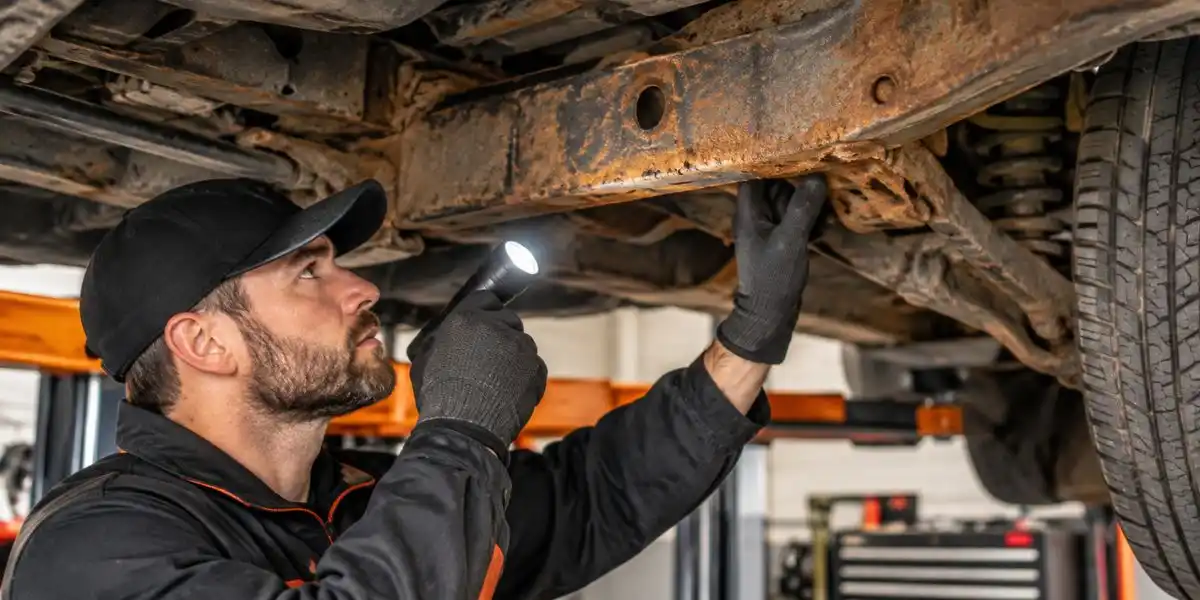
Identify the areas that matter to the vehicle’s structure and the reason they need attention. Depending on the design and concern, inspection points may include frame rails, crossmembers, brackets, suspension or body mounts, and nearby connections. These are prompts for a vehicle-specific inspection, not a diagnosis. A photo of surface scale cannot establish how much material remains, and a description such as “rusty underneath” is too broad to define a structural repair.
Before disassembly or cleaning changes what is visible, create a simple record. This helps an owner, restoration business, or fleet manager compare the initial condition with the findings after preparation. It can also clarify which areas were initially visible and which were concealed.
- Photograph the frame and the specific areas of concern from more than one angle.
- Note visible holes, flaking scale, damaged coatings, and any area that cannot be examined closely.
- List related parts or attachments that may need evaluation alongside the frame.
- Ask the shop to distinguish observed damage from areas that still require access or cleaning.
Keep the initial record descriptive, not diagnostic. A hole, a lifted coating, or a patch of scale is a visible finding; deciding whether a structural part can be repaired requires further assessment. If the frame’s condition could affect safe operation, arrange an appropriate inspection before driving or treating the job as cosmetic refinishing.
Choose removal and access for the work the frame needs
Rust removal can mean cleaning a limited area or preparing a larger assembly so a repairer can evaluate it. The right scope depends on the location and spread of corrosion, what blocks access, and what the restoration is intended to accomplish. Removing coatings from only the visible face may leave important joints or adjacent areas unexamined. Taking more of the vehicle apart may improve access, but it also adds disassembly work that should have a clear inspection or repair purpose.
When broader or frame-off preparation makes sense
Frame-off preparation may be worth considering when corrosion is widespread, when a restoration needs access to substantial portions of the structure, or when components conceal areas that must be assessed. It is not automatically required for every rust concern. For a limited, accessible spot, ask why a broader scope is needed; for a structural restoration, ask what the repairer would be unable to inspect with the frame assembled.
Before approving the work, get specific about its boundaries. Which components will be removed? Which surfaces will be cleaned? What will happen if preparation reveals damage beyond the original estimate? A useful scope describes both the intended access and the process for reviewing new findings, rather than promising a particular result before the metal is visible.
Bay State Rust Prevention identifies frame-off vehicle disassembly, rust removal through sandblasting, bare-metal preparation, and automotive frame repair among its capabilities. Its frame-off rust removal page describes that service category; the appropriate scope for an individual vehicle still needs to be confirmed through assessment.
Ask how blasting work is controlled
Abrasive blasting requires controls suited to the material and work environment. OSHA’s abrasive-blasting guidance describes hazards that can include dust and hazardous substances, and covers protective measures for workers and the work area (OSHA abrasive blasting guidance). OSHA’s ventilation standard also addresses abrasive-blasting operations and related ventilation requirements (29 CFR 1910.94). These sources support practical questions about containment, exposure control, and how the work area is managed; they do not establish that every media choice or setup is identical.
- Limited-area cleaning: may suit an accessible spot when surrounding structure can still be assessed.
- Broader component preparation: may help when coatings or corrosion extend beyond one visible patch.
- Frame-off preparation: can provide access for restoration, but disassembly should serve a defined inspection or repair need.
Read the cleaned surface without mistaking it for a repair
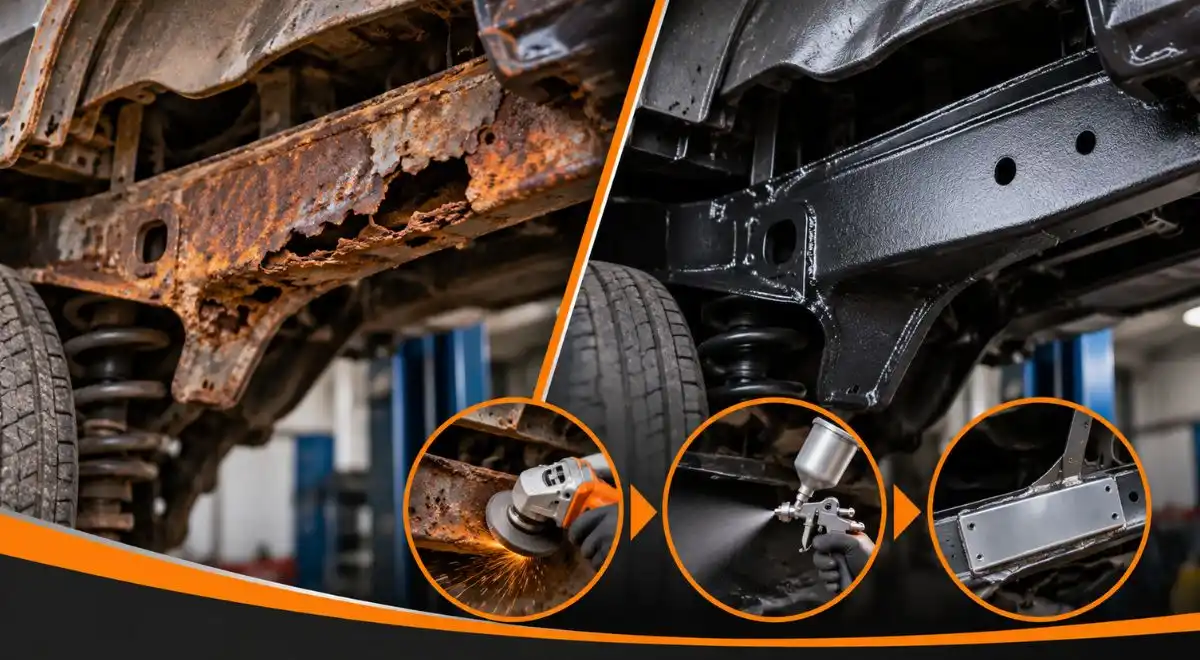
Removing rust and coatings can make the remaining surface easier to examine. It may reveal pitting, seams, edges, holes, or defects that were hidden by scale or paint. But a clean appearance does not prove that a frame retains its original thickness or strength. A rough or pitted surface, by itself, does not establish that a part is beyond repair either. The findings must be interpreted in relation to the affected structure and the applicable repair requirements.
The Association for Materials Protection and Performance describes corrosion as deterioration through interaction between a material and its environment (AMPP corrosion basics). For frame work, the practical point is that removing visible corrosion does not reverse metal loss that has already occurred. Blasting is preparation for inspection; it cannot rebuild a thin section, close a hole, or correct a distorted frame.
Separate what was examined from what remains unknown
After cleaning, ask the repairer to identify what was observed and what the observation means for the next decision. Relevant questions include whether the metal is continuous, whether there are perforations or cracks, whether an area is distorted, and whether corrosion affects an attachment or nearby structure. These are not conclusions an owner should draw from a single photograph. They are prompts for a qualified, vehicle-specific assessment.
Also ask what the preparation did not reach. Closed sections, overlapping joints, cavities, and areas still blocked by components may remain concealed. Cleaning one exposed face does not establish the condition of an inaccessible inner surface. A clear report should distinguish surfaces cleaned and examined from areas still concealed or uncertain, so an owner does not mistake partial access for a complete structural picture.
For example, a cleaned surface with no apparent perforation presents a different question from a rail with a hole or a corroded body mount. The first may lead to decisions about further inspection and protection; the latter calls for a repair assessment that accounts for the affected part and its connection to the rest of the structure. These are illustrative decision paths, not predictions about a particular vehicle.
Use the findings to define a vehicle-specific repair scope
Once relevant surfaces are accessible, ask for findings that connect each concern to a decision. A useful assessment identifies the location and type of damage, explains whether it affects a structural area or attachment, and notes whether more access or evaluation is needed before a repair can be specified. That is more useful than a general label such as “bad rust,” which does not tell the owner what work is proposed or why.
Structural repair procedures can vary by vehicle. I-CAR’s Repairability Technical Support provides repair information resources for the collision-repair industry (I-CAR Repairability Technical Support). For an owner discussing frame work, the practical question is how the repairer will identify the applicable guidance for the make and model. A general rust description or a procedure used on another vehicle is not a substitute for vehicle-specific repair information.
Use the post-cleaning review to agree on the next step before additional work begins. If preparation uncovers more damage than expected, ask the shop to explain the finding and proposed change in scope. That lets an owner, fleet manager, or restoration business understand why the estimate or plan needs to change, rather than treating newly discovered damage as an unexplained addition.
- Surface corrosion with no apparent section loss: clarify what additional inspection and protection are appropriate.
- Localized material loss: identify the affected area and ask how the proposed repair relates to adjacent structure.
- Widespread or uncertain damage: ask whether further disassembly or assessment is needed before work can be defined.
- Corrosion at an attachment or structural connection: ask what vehicle-specific repair information will guide the decision.
For a used-car buyer, the same distinction helps frame an inspection request: ask whether the concern is limited to visible surface corrosion or whether structural areas and attachments need closer assessment. For a fleet vehicle, recording the affected location and the decision made can help the people responsible for maintenance understand what was inspected and what remains unresolved. In either case, do not treat a new coating as evidence that underlying structural concerns were evaluated.
Plan corrosion protection after the frame work is settled
Rust removal, structural repair, and future corrosion protection are separate decisions. A frame that needs repair should be assessed and repaired before the owner treats a coating as the answer. Once the work is complete, ask what preparation the protective treatment requires, which surfaces are included, and whether cavities, seams, and joints can be addressed where suitable. Also clarify any exclusions caused by access, condition, or repair requirements.
Bay State Rust Prevention provides full-vehicle WaxOyl rust prevention undercoating and rustproofing for vehicle seams, panels, joints, and cavities, according to its verified capabilities. Its rust prevention undercoating page is relevant to the protection stage. Confirm the proposed coverage and its suitability for the vehicle’s condition rather than assuming a treatment can compensate for unfinished structural work.
Before signing off on the completed job, make the handoff concrete:
- Which surfaces and cavities were cleaned, inspected, repaired, or protected?
- Which areas could not be reached or remain uncertain?
- What repair procedure or assessment informed any structural work?
- What preparation and protection were applied after repairs, and what should be checked later?
For Central Massachusetts owners planning rust removal before frame restoration, the practical recommendation is to approve work in stages: define access, clean the relevant areas, review the exposed structure, and agree on repairs and protection based on the findings. Bay State Rust Prevention offers vehicle corrosion assessment, frame-off sandblasting, automotive frame repair, and WaxOyl undercoating; confirm the scope that fits your vehicle at baystaterustprevention.com.