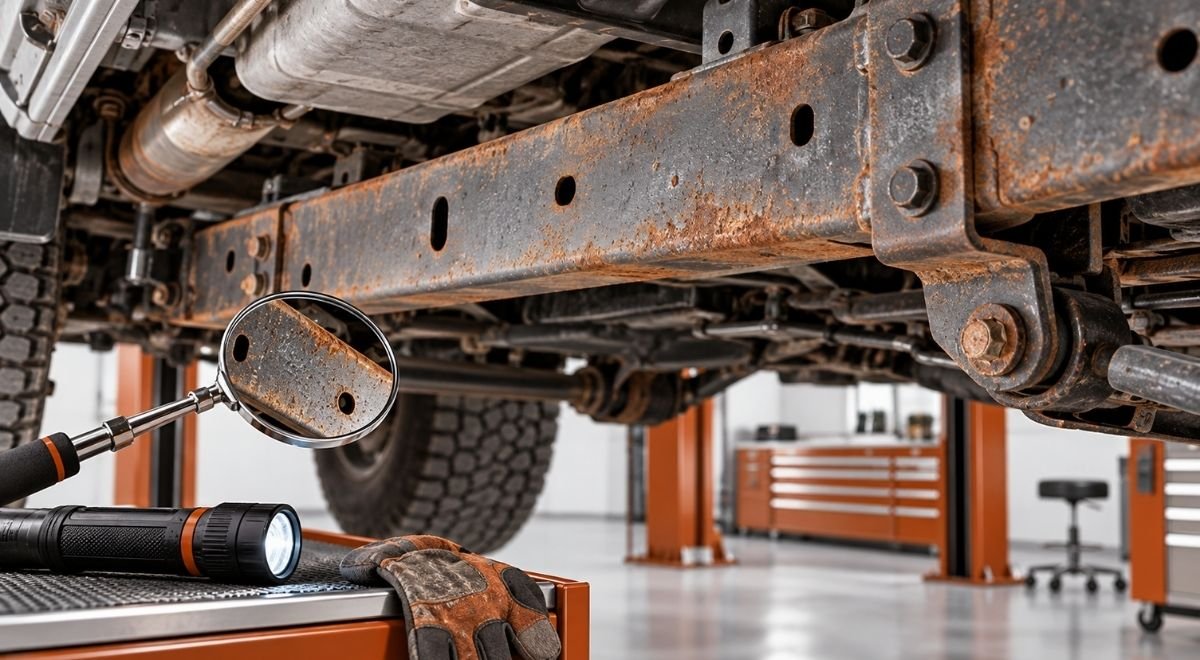
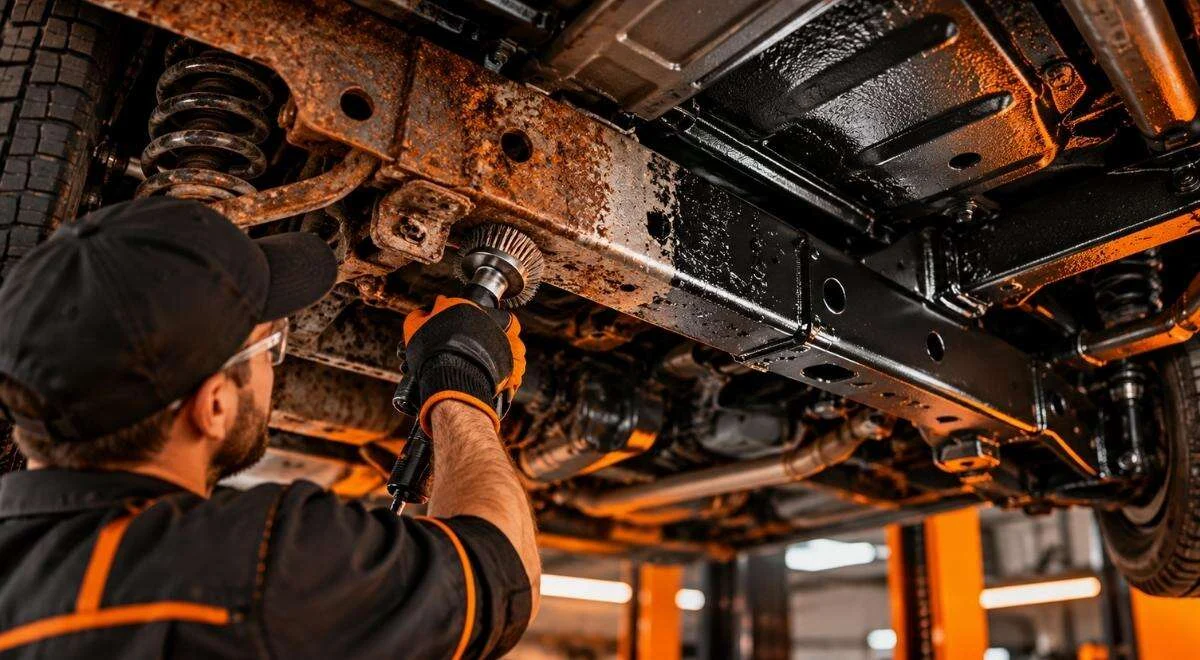
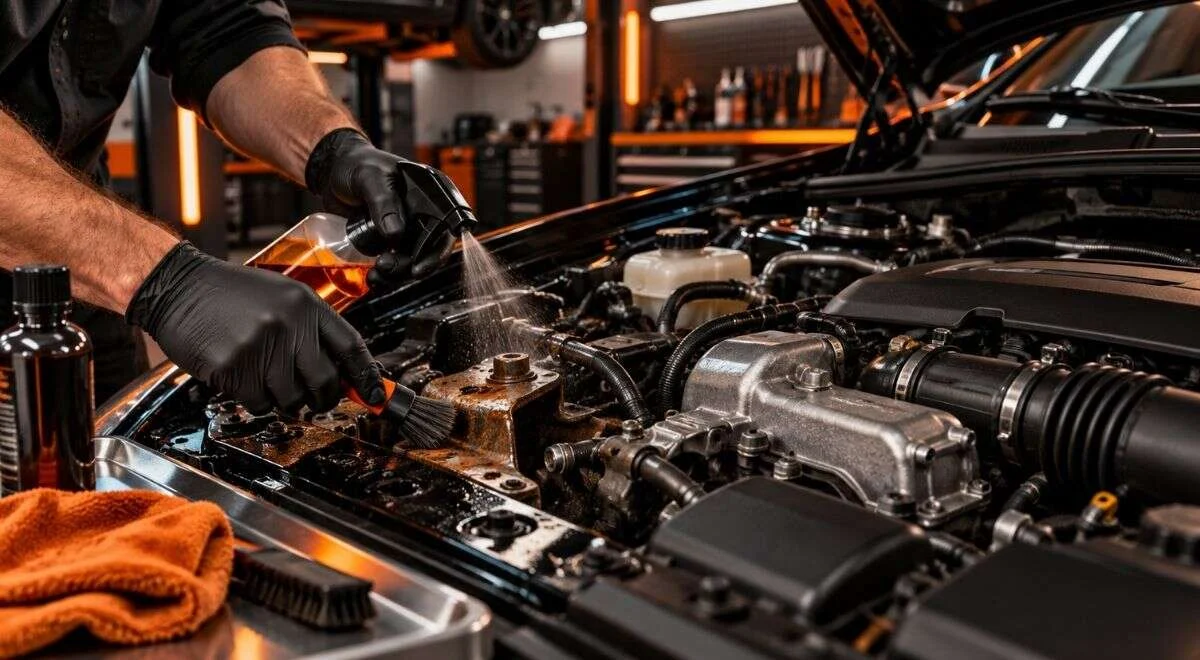
Acceptable frame rust is not a fixed amount of orange scale. For a truck, car, fleet vehicle, or restoration project, the practical question is whether corrosion has changed the frame’s strength, shape, attachment points, or ability to support a safe repair. Light surface discoloration may be manageable; layered scale, perforation, crushed sections, and rust around suspension or steering mounts require a much more cautious decision.
That distinction matters in Central Massachusetts, where winter road treatment repeatedly puts water, salt, and grit into frame seams and boxed sections. A used-car buyer may be deciding whether to walk away, while an owner of a newer truck may be choosing between preventive protection and waiting until corrosion becomes visible. The same photograph can support very different decisions depending on the frame design, the affected location, and whether sound metal remains behind the scale.
What “Acceptable Frame Rust” actually means
“Acceptable” is a condition assessment, not a color description. A frame can look rusty and still retain its original shape and load path. It can also look reasonably clean from the outside while hiding serious corrosion inside a boxed rail. The assessment should answer four questions:
- Is the metal still continuous? Surface oxidation and tight scale are different from holes, slots, cracks, or separated layers.
- Has the cross-section been reduced? Rust that removes meaningful thickness weakens a rail even if no large hole is visible.
- Is a critical attachment affected? Suspension, steering, body, engine, seat-belt, hitch, and crossmember mounts deserve more concern than an isolated flat area.
- Can the remaining metal receive a sound repair? Welding to thin, laminated, contaminated, or deeply pitted steel may create a repair that looks finished but does not restore dependable strength.
A useful field classification is not a legal pass/fail scale. It is a triage system for deciding what happens next:
| Condition | What it usually looks like | Reasonable next step |
|---|---|---|
| Surface oxidation | Discoloration, light scale, and intact edges with no deformation | Clean, inspect, protect, and schedule periodic review |
| Advanced scale | Flaking layers, rough seams, swollen brackets, or packed salt and dirt | Remove scale and coatings before deciding whether metal repair is needed |
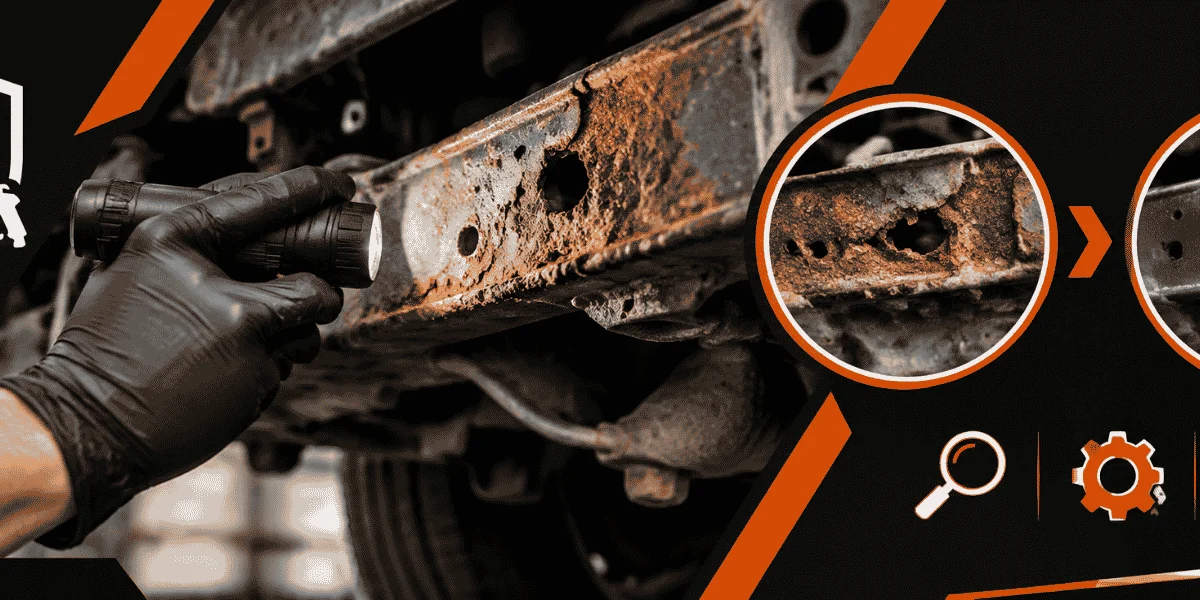
| Localized perforation | A hole or thin spot at a rail, bracket, crossmember, or mount | Stop treating it as cosmetic; obtain a structural evaluation |
| Structural deformation or separation | Cracked welds, sagging, shifted mounts, torn metal, or a visibly altered rail | Do not rely on undercoating; arrange repair or replacement assessment |
These categories are intentionally descriptive. There is no universal “one-inch hole” rule that makes frame rust acceptable. The same-size opening can be minor in a non-load-bearing shield and dangerous at a suspension-control-arm mount. Vehicle inspection requirements also depend on the applicable jurisdiction and vehicle condition. Massachusetts vehicle owners should consult the state’s current inspection information rather than treating an internet rule of thumb as approval; the official guidance is available through Mass.gov’s vehicle inspection information.
Why surface appearance can mislead
Frame steel often corrodes from both sides. A boxed rail can hold salty moisture against an inner wall for months, while an outer coating hides swelling and delamination. Rust scale is porous, so painting over it can trap the same electrolyte that caused the damage. Conversely, a frame that has been cleaned may look more alarming because the remaining pits are finally visible.
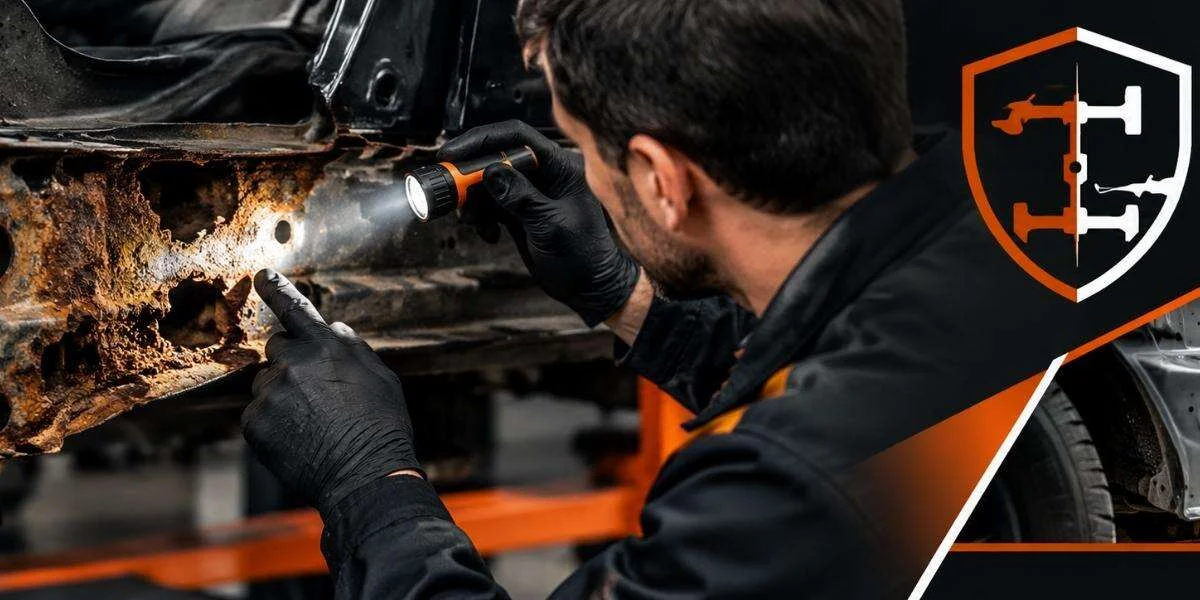
Probe the condition, not just the color. An inspection should include safe lifting, bright lighting, removal of loose debris, and careful examination of seams and mounts. A screwdriver or pick may identify loose scale, but aggressive stabbing can damage protective coatings or create a misleading hole. A trained technician should decide how much material can be removed and where a thickness or weld evaluation is appropriate.
Why frame rust matters more than body-panel rust
A body fender is usually replaceable and may not carry the vehicle’s primary loads. The frame, subframe, and welded attachment structures transfer forces between the suspension, wheels, powertrain, body, and occupants. Corrosion in those areas can change how forces travel during braking, cornering, towing, or a collision.
Location matters more than the total rusty area. A broad patch of superficial scale on an open rail may be less urgent than a small perforation around a spring hanger. The practical risk rises when rust affects:
- Leaf-spring hangers, shackle brackets, coil-spring seats, or control-arm mounts.
- Steering gear, steering rack, idler-arm, or related mounting structures.
- Crossmembers supporting the engine, transmission, suspension, or subframe.
- Cab, body, seat-belt, bumper, trailer-hitch, or body-mount attachment points.
- Brake-line clips and fuel-line supports where corrosion has allowed lines to rub or move.
- Frame sections near bends, weld clusters, fish plates, factory holes, or drain openings.
Rust can also create a chain of secondary failures. A weakened bracket may allow suspension geometry to shift. A loose line may rub through. A seized fastener may force a repairer to cut into surrounding steel, expanding the repair area. A hitch can remain bolted to a frame while the metal around the bolts loses the strength needed for towing loads.
Road salt changes the corrosion mechanism
Salt is not the only cause of corrosion, but it makes wet contamination more electrically conductive and helps moisture remain active on metal. Central Massachusetts vehicles see repeated cycles of wet roads, freeze-thaw conditions, slush, and drying. Federal Highway Administration research describes corrosion concerns associated with deicing chemicals and infrastructure materials; the agency’s technical material on corrosion and deicing is available through its official corrosion research publication.
For a vehicle, the troublesome areas are the places that do not dry quickly:
- Overlapping frame plates and welded seams.
- Inside boxed rails and crossmembers.
- Behind brackets and heat shields.
- Above skid plates, splash shields, and body mounts.
- At coating edges where water can travel under a film.
Rust prevention is most valuable before section loss begins. A new truck, leased vehicle, work van, or restored classic does not need to look rusty before it needs a plan. Prevention cannot reverse existing thinning, but it can reduce the chance that wet salt remains in concealed areas long enough to start the next corrosion cycle.
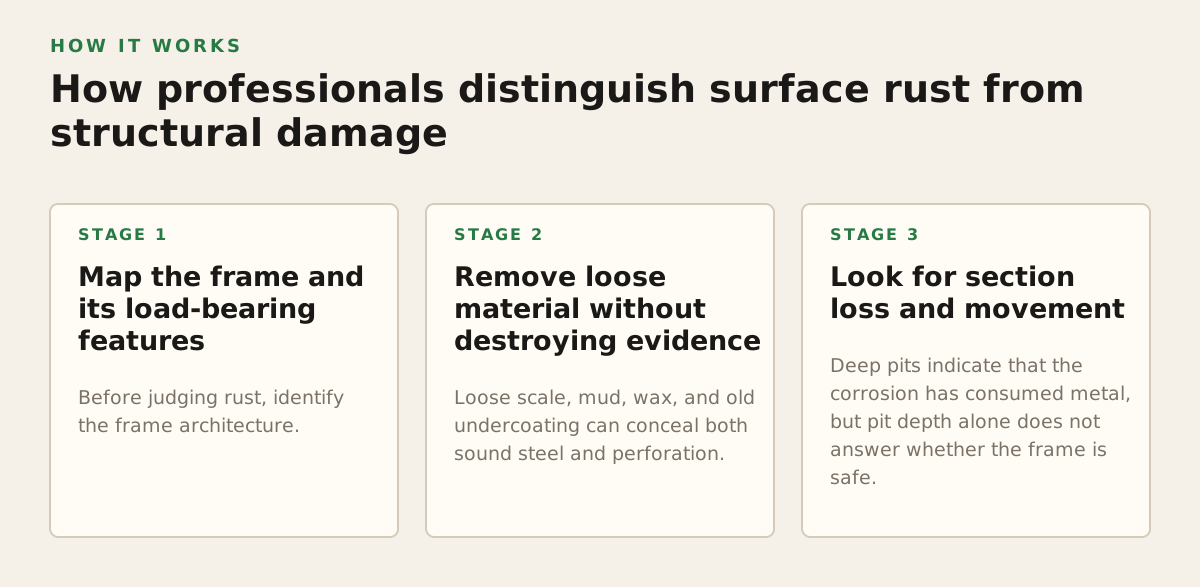
How professionals distinguish surface rust from structural damage
A sound evaluation proceeds from broad observation to targeted cleaning. It should not begin with a thick coating intended to make the frame look uniform. The goal is to expose the actual steel, identify the load path, and document what must remain original versus what can be removed or rebuilt.
Step 1: Map the frame and its load-bearing features
Before judging rust, identify the frame architecture. Full-size pickups may use boxed or partially boxed rails, while older vehicles and many classics may use open-channel sections. Unibody vehicles rely on stamped rails, reinforcements, pinch welds, and subframes rather than one separate ladder frame. A restoration shop also needs to distinguish factory seams from previous patches.
Mark the locations of:
- Suspension and steering mounts.
- Crossmembers and body mounts.
- Factory drain holes and access holes.
- Previous welds, plates, replacement sections, and drilled holes.
- Areas where the rail changes direction or carries a concentrated bracket load.
This map prevents a common mistake: judging a rusty section by its distance from the nearest obvious hole rather than by the forces it carries. A rust evaluation is a structural map, not a cosmetic walk-around.
Step 2: Remove loose material without destroying evidence
Loose scale, mud, wax, and old undercoating can conceal both sound steel and perforation. Cleaning must be controlled. A wire wheel can expose edges, but it can also smear soft corrosion across a surface. Abrasive blasting can reveal pits rapidly, yet it creates dust, heat, containment, and waste-handling considerations. The Occupational Safety and Health Administration’s guidance on abrasive blasting hazards addresses exposure controls and protective practices that matter in professional work.
For an owner inspecting a vehicle at home, the safe lesson is simple:
- Wash away loose salt and mud before judging the coating.
- Use eye protection, gloves, and suitable respiratory protection for the cleaning method.
- Do not crawl beneath an inadequately supported vehicle.
- Do not heat, grind, or blast near fuel, brake, electrical, or pressurized systems without a proper plan.
- Photograph the condition before and after cleaning so hidden changes are not confused with new damage.
On a classic vehicle or a frame-off project, controlled disassembly may be the only way to inspect every surface. The objective is not to make the steel bright at any cost. It is to remove corrosion products and failed coatings while preserving reference points for repair alignment.
Step 3: Look for section loss and movement
Deep pits indicate that the corrosion has consumed metal, but pit depth alone does not answer whether the frame is safe. Examine edges, holes, weld toes, and bracket transitions. These areas reveal whether corrosion has created a sharp notch, separated layers, or reduced the effective section.
Red flags include:
- Scale that lifts in sheets rather than dusting off.
- A hollow sound or visible gap between layered steel pieces.
- Cracks extending from welds or bolt holes.
- Mounts that move relative to the rail when loaded appropriately during a professional inspection.
- Brake, fuel, or electrical lines contacting newly rusted edges.
- Evidence that a prior patch was welded over active rust without restoring the surrounding section.
When the answer depends on remaining thickness, a qualified repairer may use appropriate measuring or nondestructive methods. Do not certify a frame from a photograph alone. Photos are useful for triage, but they cannot reliably show backside corrosion, metal thickness, alignment, or the quality of an old repair.
Where rustproofing and frame repairs break down
Undercoating is often misunderstood as a cure for any visible rust. It is not. A corrosion-protection material can slow future exposure on properly prepared metal, but it cannot restore steel already lost to corrosion. A coating can also hide a developing problem if it is applied over loose scale, trapped moisture, oil, or a failed previous layer.
Failure mode: sealing active corrosion
Rust expands as it forms. If a coating bonds only to the upper flakes, the flakes can lift later and carry the new coating with them. Moisture may continue moving through seams. The finished surface can look smooth while the steel underneath becomes more deeply pitted.
A durable sequence generally requires:
- Cleaning away salt, mud, oil, loose scale, and failed coating.
- Separating repairable surface oxidation from metal that must be cut out.
- Allowing the substrate to dry and inspecting seams and cavities.
- Repairing structural steel before applying final protection.
- Keeping drain paths and serviceable fasteners from being blocked unnecessarily.
Preparation determines whether protection is useful. That is why a frame needing substantial rust removal should not be treated as a routine spray appointment. Owners can review the dedicated rust prevention undercoating service when the metal is suitable for preservation, and discuss cleaning or repair first when it is not.
Failure mode: treating a structural hole as a coating problem
A patch can be appropriate, but “weld a plate over it” is not a complete repair specification. The repairer must determine how far corrosion extends, whether the original steel is weldable, how the replacement section should fit, and how loads will transfer at the repair boundaries. A patch that ends at a highly stressed bracket or leaves corrosion between layers can move the failure point rather than solve it.
Vehicle-specific repair information should guide the work whenever available. Questions for the shop include:
- Will the rusted material be removed back to sound metal?
- How will the vehicle be supported and aligned during cutting and welding?
- Does the repair restore the original bracket position and suspension geometry?
- Will the repair preserve drain paths and access for future inspection?
- What preparation and coating will protect the repaired area afterward?
There are also safety issues beyond the frame itself. Welding or grinding around fuel vapor, battery cables, airbags, brake fluid, or underbody insulation requires controls appropriate to the vehicle. A professional assessment should account for those hazards rather than treating frame repair as ordinary exterior bodywork.
Failure mode: confusing inspection approval with long-term condition
A vehicle can pass an inspection on one date and still be a poor long-term purchase. Inspection status is a point-in-time judgment under applicable rules; it is not a guarantee that concealed corrosion will not progress. Similarly, a vehicle can need a careful structural repair even when a seller describes the rust as “only surface.”
For a used-car purchase, the strongest process is:
- Inspect before signing, preferably on a lift.
- Request photos of the frame after loose material is removed.
- Compare both sides of the vehicle for symmetry and prior repair.
- Pay special attention to mounts, boxed sections, and patched areas.
- Make the purchase decision based on repair scope, not the seller’s rust vocabulary.
How to apply the decision to real vehicles
Acceptable frame rust depends on the vehicle’s job, remaining service life, repair access, and owner’s tolerance for uncertainty. The right recommendation for a leased crossover is not the same as the right recommendation for a rare classic or a municipal fleet truck that must remain in service.
New and leased vehicles
For a newer vehicle with intact factory coatings, prevention should focus on access and coverage rather than cosmetic thickness. Wash salt from the underside, correct damaged coatings, inspect after the first winter, and use a corrosion-protection system suited to the frame and cavities. Keep records and photographs so later inspection can distinguish ordinary dirt from a developing coating failure.
A leased vehicle deserves a conservative approach because returning it with concealed corrosion or blocked drain paths can create avoidable disputes. Protect clean metal early instead of waiting for visible scale. The protection plan should also leave drain holes, identification labels, exhaust components, brakes, and service points appropriately clear.
Used trucks and work vehicles
Pickup frames often collect wet debris at the rear of the cab, above brackets, and around suspension or hitch structures. A work truck may also see more loading, towing, and off-road flexing, which increases the consequence of weakened mounts. If the frame has advanced scale but no confirmed section loss, cleaning and close inspection may be worthwhile. If critical mounts are perforated or moving, undercoating is not the next step.
Illustrative triage examples—not universal pass/fail thresholds—look like this:
- Example 1: A 2024 pickup has light orange film on intact rails, no flaking, and clear drain holes. Starting policy: clean, dry, document, and apply suitable preventive protection before another winter.
- Example 2: A 2016 truck has roughly 3 millimeters of loose scale around a rear spring hanger, but the hanger and surrounding rail remain continuous after cleaning. Starting policy: remove scale, verify the mount, and protect only after the inspection is satisfactory.
- Example 3: A 2012 truck has a 40-millimeter opening beside a hitch attachment and layered metal that separates with light probing. Starting policy: obtain a structural repair assessment; do not seal the area with coating.
- Example 4: A classic chassis has several small perforations in an open rail but enough original metal to establish alignment. Starting policy: document dimensions, support the chassis correctly, remove compromised sections, and plan a controlled restoration repair.
- Example 5: A fleet van shows surface rust on rails but severe corrosion around brake-line clips and body mounts. Starting policy: correct the line support and mount issues first, then establish a repeatable inspection and protection schedule.
The numbers above illustrate decision thinking, not a substitute for an inspection standard. The critical variables are the location, depth, continuity, geometry, and load carried by the affected steel.
Classic and specialty vehicles
Restoration work has a different objective from daily-driver preservation. Owners may want to retain original stampings, factory weld appearance, patina, or historically correct components. Aggressive blasting can erase evidence of original construction and previous repairs. Before cleaning, photograph the chassis, mark reference points, and decide whether the project prioritizes originality, show presentation, road use, or all three.
Frame-off work allows access that an assembled vehicle cannot provide. It may justify careful media selection, fixture-supported alignment, replacement of boxed sections, and protection inside cavities after repair. A restoration shop or outsourced specialist should be able to explain what will be removed, what will remain, and how the finished frame will be inspected before reassembly. Bay State Rust Prevention’s frame-off rust removal option is relevant when complete access is needed rather than a quick exterior treatment.
Fleet and repair-shop decisions
Fleets should treat frame corrosion as a recurring maintenance risk rather than an occasional surprise. Record the vehicle identification, frame areas photographed, coating condition, repairs completed, and next inspection date. Consistent documentation helps a fleet manager prioritize vehicles that carry heavy loads or operate on treated roads.
A practical starting policy for a fleet—an illustrative policy, not a universal interval—is to inspect vulnerable underbody areas at the beginning and end of the 2026 winter season, and after any collision, suspension repair, or towing-related damage. Escalate immediately when an inspection shows:
- New movement at a mount or bracket.
- Cracking near a weld or fastener.
- Exposed bare steel after impact or service work.
- Coating that has lifted in sheets.
- Any perforation in a rail, crossmember, suspension mount, or hitch attachment.
Repair shops can outsource blasting or frame restoration when they lack containment, alignment equipment, or the labor to clean complex assemblies thoroughly. The handoff should include photographs, known symptoms, vehicle use, and any limits on preserving original parts. The best repair decision is the one made after the steel is visible and the vehicle’s intended use is understood.
What to do when you need a defensible answer
If you are buying a used vehicle, ask for an independent lift inspection before committing. If you own the vehicle, start with cleaning and documentation rather than a new layer of black coating. If corrosion is near suspension, steering, body, seat-belt, or hitch attachments, arrange a structural assessment before driving, towing, or authorizing cosmetic work.
A concise inspection record should state:
- Vehicle year, make, model, and use.
- Frame type and affected locations.
- Whether the damage is surface oxidation, scale, perforation, cracking, deformation, or a prior repair.
- What was removed during cleaning.
- Whether the remaining steel is suitable for protection, welding, section replacement, or further measurement.
- What must be rechecked after repair or before the next Massachusetts winter.
Acceptable frame rust is rust that has been evaluated in context, not rust that merely looks shallow from outside. For a Central Massachusetts daily driver, early cleaning and corrosion protection are usually simpler than rebuilding a mount after salt has consumed the surrounding steel. For a restoration or work truck, the right answer may involve frame-off cleaning, structural replacement, alignment checks, and a protective finish rather than a quick underbody application.
Bay State Rust Prevention serves Worcester and Central Massachusetts with rust prevention undercoating, rust removal, frame-off sandblasting, and automotive frame repair, including WaxOyl corrosion protection for suitable restored and intact components. Visit baystaterustprevention.com to discuss whether your vehicle needs preservation, deeper cleaning, or structural frame work before the next corrosion cycle.