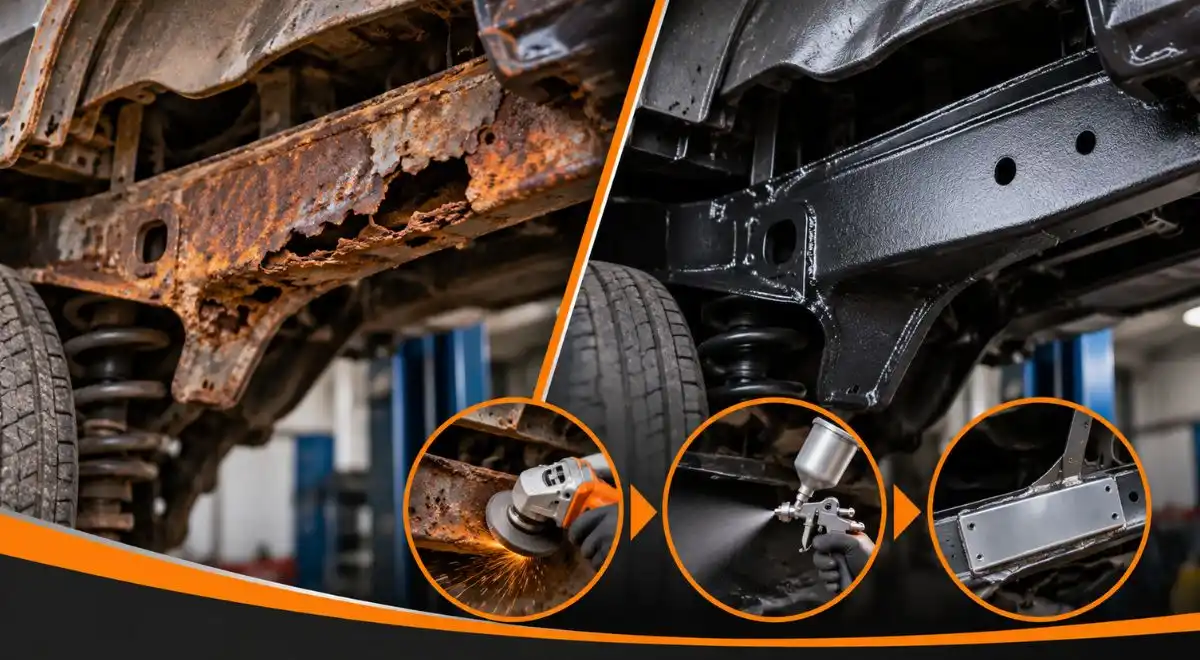
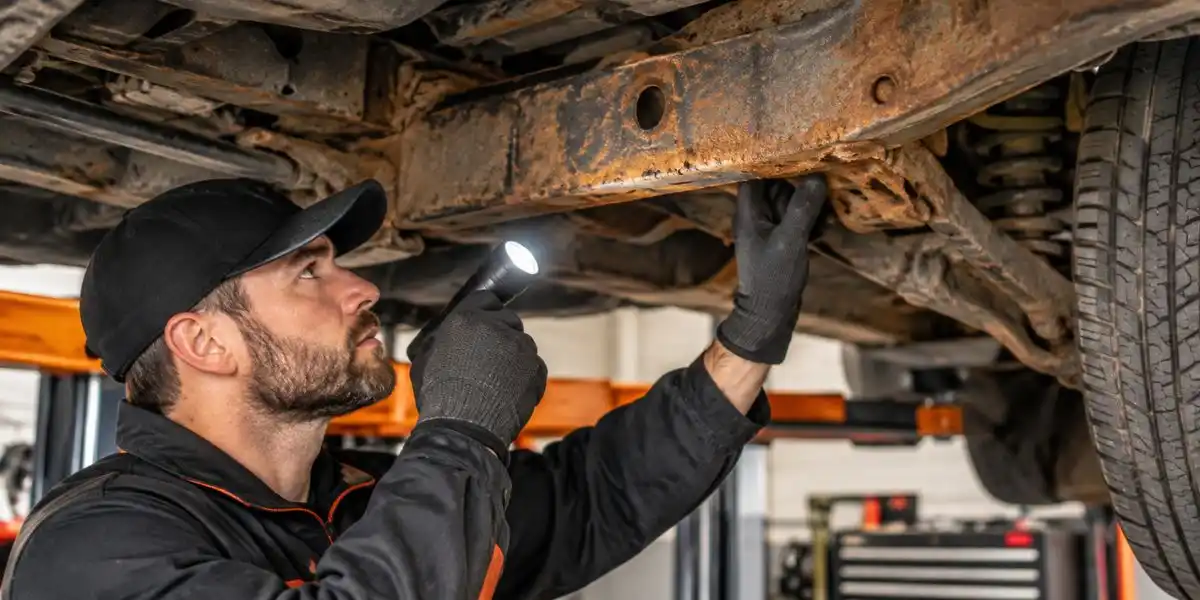
To get a useful central massachusetts rust-damaged frame restoration quote, give the shop the vehicle’s identity, explain what you know about its condition, and ask what inspection is needed before repair scope can be set. A photo or a quick look may help start the conversation, but hidden corrosion, access requirements, and the condition of connected components can change the work. This guide shows how to prepare, what to ask an inspector to document, and how to compare estimates without treating an uncertain repair as a fixed-price job.
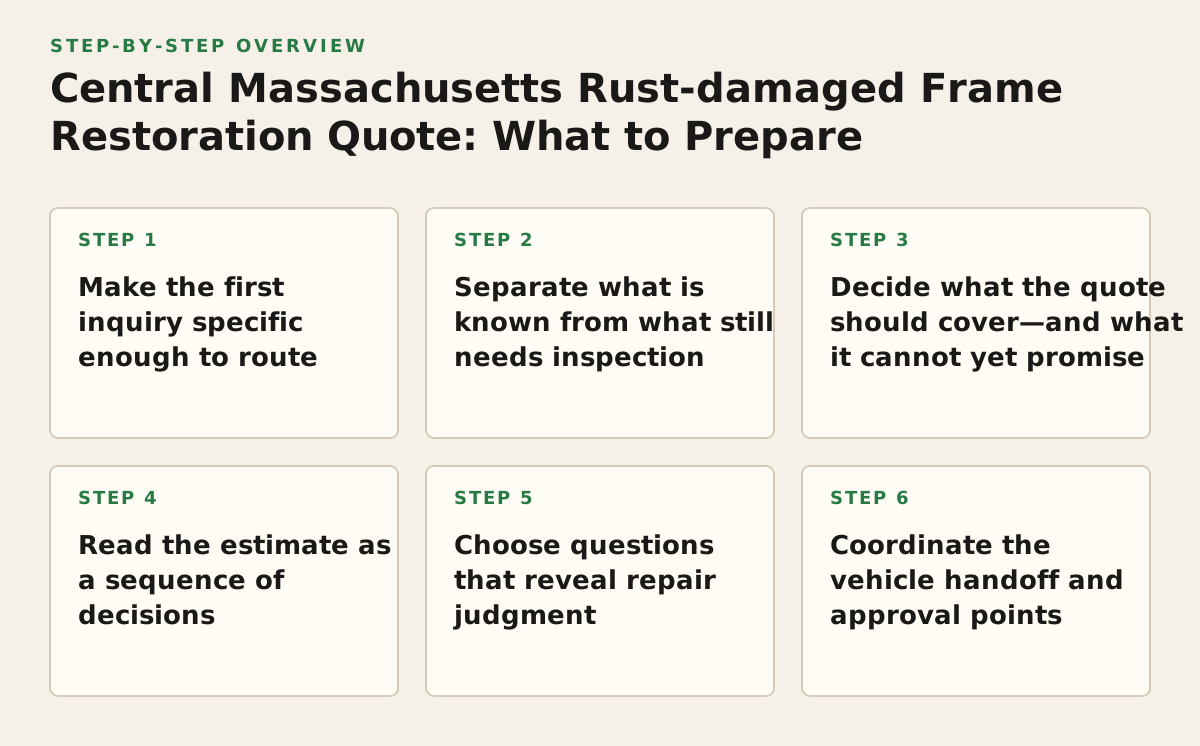
1. Make the first inquiry specific enough to route
This step applies when you have spotted rust, received a warning from a mechanic, or are planning a restoration and need to learn what assessment comes next. The shop needs to distinguish a potentially structural frame problem from surface corrosion, a body-panel issue, or a broader restoration project. Clear initial information can help it explain whether a vehicle inspection is needed before it can describe likely work.
Start with facts you can verify rather than diagnosing the repair yourself. Record the year, make, model, trim if known, mileage, and whether the vehicle is currently operable. Describe where the rust appears and how it came to your attention. If another shop has already inspected it, say whether you have a written report or photographs. The goal is to give the shop a useful starting point, not to ask it to confirm a diagnosis from a picture.
- Identify the vehicle: Include the VIN if you have it. A VIN can also be used to check for open recalls through NHTSA’s recall lookup; that check does not assess frame corrosion or establish repair scope.
- State your priority: For example, “I need a structural assessment before deciding whether to restore this truck,” or “I am evaluating a frame repair before buying this vehicle.”
- Share constraints that affect planning: Note if the vehicle is not drivable, is partly disassembled, or has a restoration deadline. Ask whether those circumstances affect how the shop can inspect it.
- Attach clear photos if available: Label the area and describe how the photo was taken. Do not crawl under a vehicle supported only by a jack to take pictures.
Failure mode: “The frame is rotten; how much to fix it?” leaves out the vehicle, location of the damage, and what has actually been observed. A more useful inquiry is: “This is a [year/make/model]. Rust is visible near [location]. Another shop raised a concern about the frame, but I do not have a written diagnosis. What inspection information do you need to determine whether a restoration estimate is possible?”
2. Separate what is known from what still needs inspection
Use this distinction when the rust is partly hidden, the vehicle has old coatings, or different people have given different opinions. Visible corrosion is evidence to investigate, not a complete map of damage. A shop may need to examine the frame and nearby structures directly before deciding whether corrosion is limited, whether metal is compromised, or whether more access is needed.
Ask the inspector to distinguish observations from conclusions. “Scale visible along the left rail” is an observation; “repair required” is a conclusion that should be tied to the affected area and the reason the current condition is unacceptable. If the vehicle must be cleaned, disassembled, or placed on a lift to see more, ask what that step is intended to reveal and whether it is part of the assessment or later repair work.
Build a short inspection record
- List each location discussed, using a consistent description such as left or right side and front, middle, or rear section.
- Ask for photographs of the areas that support the assessment, where practical, and request captions identifying each area.
- Record whether the inspector could see the metal directly or whether coating, dirt, components, or limited access obscured it.
- Ask what would change the assessment—for example, what a closer inspection could reveal that is not visible yet.
A state vehicle inspection and a restoration assessment answer different questions. Massachusetts provides information about its vehicle inspection program; a state inspection result should not be treated as a detailed repair plan or a guarantee that concealed corrosion is absent. If you are buying a used vehicle, the FTC likewise advises arranging an independent inspection rather than relying only on what a seller says; see its used-car buying guidance.
Failure mode: Treating a prior pass or a verbal “it looks fine” as proof that restoration is unnecessary. If structural condition is central to your decision, request an assessment that addresses the frame areas in question and identifies what could not be inspected.
3. Decide what the quote should cover—and what it cannot yet promise
This applies when a shop has identified rust but the full extent is uncertain. A useful estimate separates assessment, access, preparation, repair, and finishing so you can see which work is confirmed and which depends on findings after work begins. Those are different decisions: opening up access may reveal more, while cleaning the surface may make the repair boundary clearer.
Ask the shop to explain the proposed process in sequence. If frame-off disassembly or abrasive rust removal is being considered, clarify why it is appropriate for this vehicle and what it is expected to expose. Frame-off sandblasting is not automatically the right starting point for every rust concern. It is a preparation approach that should fit the project’s goals, condition, and repair plan. Bay State Rust Prevention identifies frame-off disassembly, sandblasting, bare-metal preparation, and frame repair among its capabilities; its page on frame-off rust removal is relevant when that route is under consideration.
Use a scope boundary, not a vague promise
Ask the estimator to label each item as one of the following:
- Observed and included: Work tied to an area that has been inspected and is included in the proposed scope.
- Provisional: Work that may be needed but depends on what becomes visible after access or cleaning.
- Excluded: Related work not included in the estimate, such as other rusted structures or components outside the agreed repair area.
- Decision point: Work that should pause for your approval if inspection reveals a different condition or additional scope.
For a classic vehicle, the owner may value retaining original structure or minimizing changes; for a work truck, the priority may be restoring a safe, serviceable frame. Those aims can affect what repair options are acceptable. Ask which vehicle-specific repair information supports the proposed method. I-CAR’s Repairability Technical Support resources provide access to repair-related information; the shop should be able to explain how the method applies to your particular vehicle rather than relying on a generic rule.
Failure mode: Comparing a detailed repair proposal with a low figure that covers only visible work. If the quote does not say whether cleaning, disassembly, metal repair, and finishing are included, ask for those boundaries in writing before comparing totals.
4. Read the estimate as a sequence of decisions
Use the estimate to understand both the planned work and the point at which you may need to choose whether to continue. A total without a scope can hide important differences: one proposal may include access and preparation, while another may assume the damaged area is already exposed. Compare like-for-like scope, not just the amount at the bottom of the page.
Ask for separate descriptions of assessment, access or disassembly, cleaning or rust removal, frame repair, and any coating or reassembly included in the proposal. The estimate does not need to predict every hidden condition. It should make clear what the shop knows now, what could change, and how it will handle additional work. Ask whether any inspection or preparation charge applies and what it covers; do not assume such a charge is included or waived.
| Estimate item | Question to ask | What a useful answer clarifies |
|---|---|---|
| Assessment | What areas were inspected, and what remains uncertain? | Whether the scope rests on direct inspection or limited visibility. |
| Access and preparation | What must be removed or cleaned to expose the repair area? | Which steps are included and what additional findings might follow. |
| Repair | Which damaged areas are included, and what method is proposed? | The repair boundary and the reason for the selected approach. |
| Additional findings | Will work pause if the exposed condition changes the scope? | How you will be informed and asked to authorize a change. |
| Finishing and reassembly | What protection or reassembly is included after repair? | Whether the vehicle will be returned in the condition you expect. |
Failure mode: Assuming “rust repair” includes every step from initial cleaning through final protection. Ask the estimator to mark exclusions and identify any work that will be priced or approved only after further inspection. That gives you a meaningful comparison without pressuring a shop to guess at hidden damage.
5. Choose questions that reveal repair judgment
This principle matters when you are choosing between estimates, or when a proposal recommends extensive disassembly. You are not expected to select a welding method from a photograph. You can, however, ask the shop to connect its findings to its proposed repair and explain the trade-off. A clear answer should identify the affected area, the reason it needs work, and the consequence of leaving it as-is or choosing a different scope.
Ask for reasoning you can check
- “Which specific frame areas are included, and how were they assessed?”
- “What is the purpose of the proposed cleaning or disassembly step?”
- “What information or condition would make you stop and revise the plan?”
- “How will I see and approve a scope change before that added work proceeds?”
- “What parts of the vehicle or restoration are outside this estimate?”
Look for answers that distinguish confirmed damage from possible additional damage. A shop should be able to describe why its recommendation fits the vehicle and the goal you stated. If the answer is simply “we will know when we get in there,” ask what is included in the initial scope, what would trigger a pause, and how the next decision will be presented.
For a buyer assessing a used car, do not let a seller’s description substitute for an independent inspection; the FTC’s guidance supports having a qualified mechanic inspect a vehicle before purchase. For an owner already committed to restoration, the same discipline helps keep the work plan tied to documented findings rather than assumptions.
Failure mode: Treating confidence or a broad guarantee as a substitute for a defined repair plan. Ask for the reasoning and boundaries behind the recommendation, not a promise that no hidden corrosion will appear.
6. Coordinate the vehicle handoff and approval points
Use this step once you are ready to proceed with an inspection or have a written proposal to review. The practical details can affect what the shop can inspect and how efficiently it can evaluate the vehicle. Confirm how the vehicle should arrive, whether it needs to be operable, and what components or prior repair records should accompany it. These are questions to verify with the shop; do not assume transport, pickup, storage, or a particular scheduling option is available.
Before authorizing work, keep the written estimate and any supporting inspection notes together. Identify who may approve changes and how the shop should reach that person. If you are managing a fleet vehicle or a restoration for someone else, decide in advance who can authorize added work. That avoids a delay or an unintended commitment when newly exposed metal changes the scope.
- Agree on the initial scope: Confirm the work authorized now and distinguish it from possible later repair.
- Set a change-approval rule: Ask the shop to stop and explain the new finding before proceeding beyond the agreed scope.
- Keep a record: Save the estimate, photographs, inspection notes, and written approvals in one place.
- Revisit the objective: If new findings materially change the project, decide whether the revised work still fits your budget, intended use, and restoration priorities.
Failure mode: Leaving approval authority unclear, especially when a vehicle belongs to a business or is being restored for another person. A named decision-maker and a documented pause point make the repair process easier to manage without assuming how long the work will take.
7. Follow a practical quote-to-repair plan
Use this sequence to move from concern to a decision without confusing an early conversation with a final repair commitment:
- Prepare the vehicle record. Gather identifying details, describe the rust locations, and collect any existing inspection notes or photographs.
- Inquire about assessment. Explain what you need to decide—such as whether to restore a frame, evaluate a purchase, or plan a larger restoration—and ask what inspection is needed.
- Review the findings. Check which areas were directly assessed, what remains concealed, and what additional access or preparation could reveal.
- Request a bounded scope. Separate included work, provisional work, exclusions, and approval points. Ask why each proposed step fits the vehicle.
- Compare proposals on the same basis. Check that the estimates address comparable inspection, preparation, repair, and finishing work before weighing their totals.
- Authorize only the agreed stage. Keep a written record of the approved scope and ask for a pause before additional work proceeds.
If corrosion protection after restoration is part of your plan, treat it as a separate decision from structural repair: ask what surfaces and cavities are being addressed and when protection belongs in the sequence. Bay State Rust Prevention describes WaxOyl corrosion protection and vehicle rustproofing among its capabilities; its information on rust prevention undercoating can help you consider that follow-on question. For an inspection or repair inquiry, visit baystaterustprevention.com and describe the vehicle and the decision you need to make.
Authored with NotFair SEO