

If you need a central massachusetts frame-off sandblasting quote, Bay State Rust Prevention’s official website is the only verified starting point available here: visit the business website and use the contact route currently shown there. A quote-specific form, phone number, price, or response time has not been verified, so this guide cannot submit a request or promise a quote. It can help you prepare a vehicle-specific inquiry that explains what access and work you want considered, so the business can tell you what information or assessment it needs.
Specify the access you mean by “frame-off”
This decision matters most when a vehicle is assembled or partly disassembled. “Frame-off” indicates that the body is separated from the frame for access; it does not, by itself, say which other parts are removed, what areas are blasted, or whether reassembly is part of the work. Those details affect what a shop is being asked to estimate. A request that leaves them unstated may describe a different job from the one you have in mind.
Start by describing the vehicle’s current state and the access you want priced. If you are unsure whether full separation is appropriate, ask for an assessment of access needs rather than presenting disassembly as an already-agreed plan. A frame-off job and cleaning reachable surfaces with the body in place should not be treated as equivalent scopes.
Make the access request concrete
- State whether the vehicle is assembled, partly disassembled, or already body-off.
- Say whether you are requesting an estimate for body separation, cleaning with current access, or advice on which access level is needed.
- Identify known attachments or components that may affect access, such as lines, wiring, brackets, or suspension parts. Ask what the shop needs to know about them; do not assume removal or replacement is included.
Failure mode: “Please quote a frame sandblast” leaves the access plan open to interpretation. For example, an owner could write, “The body is still on the frame; I’m seeking an estimate for frame-off access and cleaning, or advice if you need to inspect it before defining that scope.” That wording asks a clear question without assuming a particular sequence or price.
Send a short vehicle and condition brief
A shop needs to identify the vehicle and understand the known condition before it can judge what further information is useful. Provide the year, make, model, body style, location, and current state. Add modifications, prior frame repairs, coatings, or previous rust removal if known. If the vehicle has a VIN, you can include it through the business’s current contact route. NHTSA’s VIN decoder can help identify vehicle information from a VIN, but decoded information should be checked against the actual vehicle, especially when it is older or modified.
Separate what you have observed from what you suspect. “Corrosion visible near the left rear mount” reports an observation; “the frame is unsafe” is a conclusion that requires an appropriate assessment. Mention areas you could not see and say when the vehicle’s repair or coating history is unknown. This makes uncertainty visible instead of letting an estimate depend on a guess.
Use a compact brief
- Identity and state: vehicle details, location, and whether it runs or is disassembled.
- Known history: repairs, modifications, coatings, and prior cleaning—or “unknown” where appropriate.
- Visible concerns: locations and observations, without diagnosing hidden damage.
- Objective: cleaning for inspection, preparation for restoration, or another clearly stated goal.
Failure mode: a long restoration history can bury the information needed to identify the job. A more useful opening might be: “Older pickup, partly disassembled, prior frame patches known; I’m seeking an estimate for frame-off cleaning to prepare for assessment.” This is an illustrative format, not a diagnosis or a claim that cleaning is the right next step.
Use photos to locate visible concerns
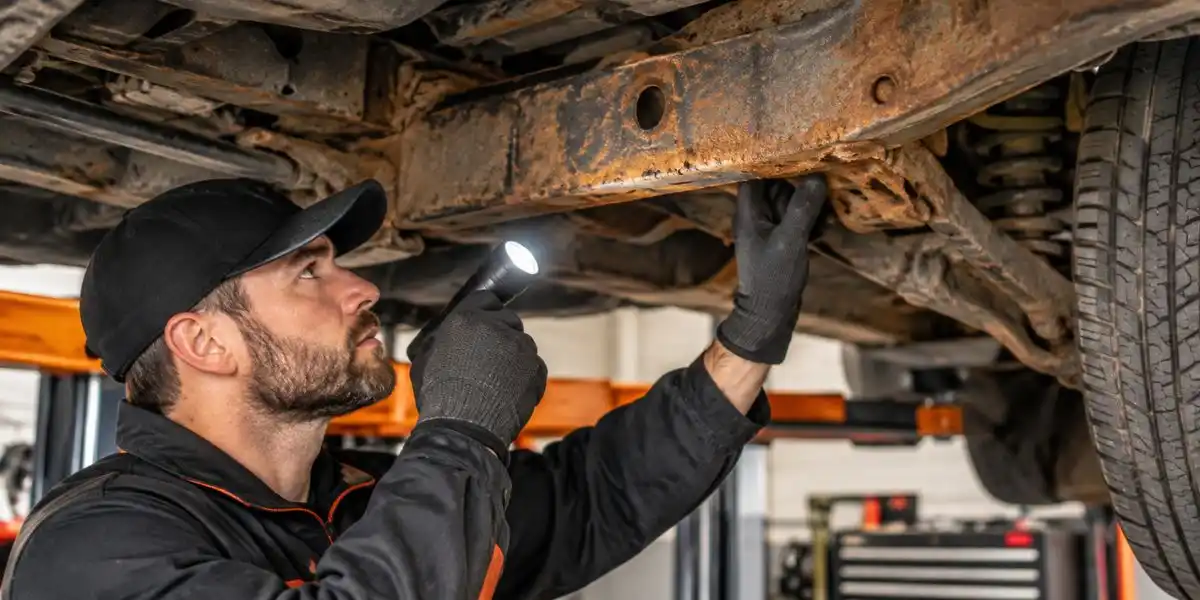
Photos are most useful when a vehicle cannot yet be examined in person or when you want to show where a concern sits. Take a full or wide view for context, then closer views of accessible areas such as mounts, crossmembers, seams, and previous patches. A close-up can show texture, but without a wider view it may be difficult to tell where the area is on the vehicle.
Images are evidence of visible conditions, not a certification of the frame. Dirt, brackets, coatings, and overlapping sections can hide metal. A photo may help a shop decide what to ask next, but it cannot establish the extent of concealed corrosion or whether a frame needs repair. Bay State Rust Prevention’s listed capabilities include in-house inspection and vehicle corrosion assessment; whether a particular vehicle needs an in-person assessment should be confirmed through the business’s current contact route.
Build a useful, safe photo set
- Use clear light and show several accessible angles.
- Pair a close-up with an image that identifies its location.
- Label locations plainly, such as “right front crossmember,” and note areas that could not be viewed.
- Do not scrape or grind a surface just to improve a photo, and do not get beneath a vehicle that is not properly supported.
Failure mode: asking for a final scope based only on a few close-ups can leave important access and hidden-condition questions unanswered. For example, send a context view and two labeled detail views, then ask whether the images are enough to discuss the job or whether the vehicle needs assessment before an estimate can be defined.
Separate cleaning from inspection and repair decisions
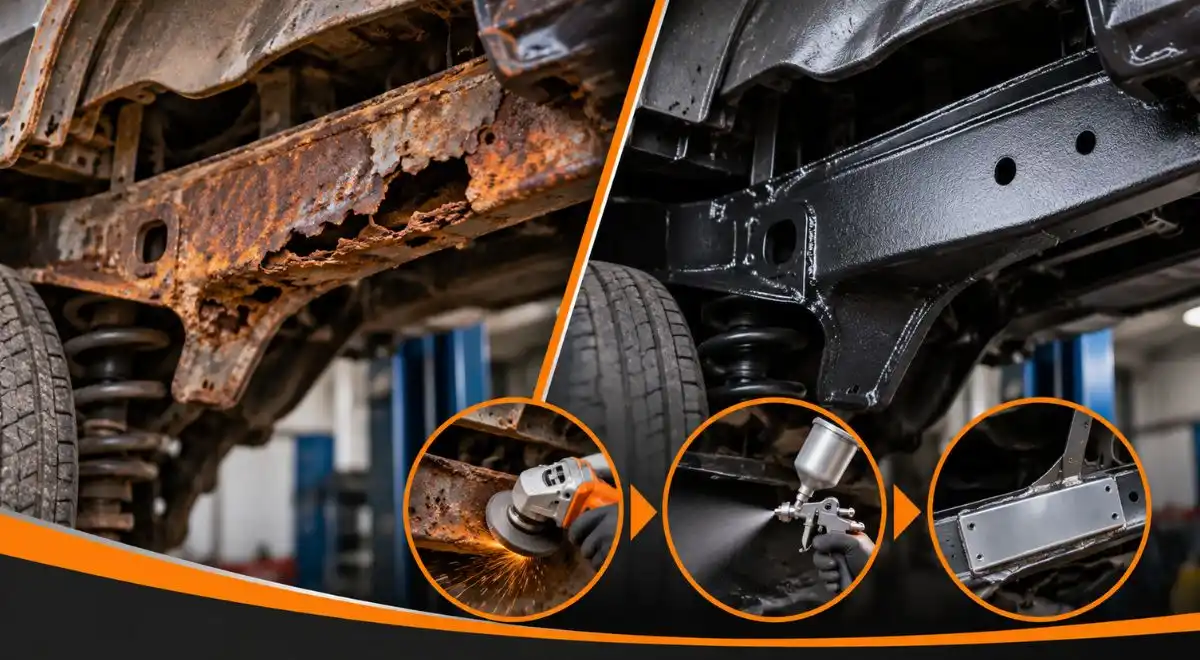
Blasting can remove coatings and corrosion from surfaces within the agreed scope, but it does not replace metal that has been lost. Cleaning may make a surface easier to evaluate; it does not, by itself, determine the repair a vehicle needs. Bay State Rust Prevention’s listed capabilities include frame-off disassembly, sandblasting, bare-metal preparation, automotive frame repair, and restoration of rust-damaged vehicle structures. Those capabilities do not establish what work a particular vehicle requires or what an estimate will include.
This distinction is useful when you are restoring a classic vehicle, preparing a frame for assessment, or deciding whether to proceed with a larger project. State whether you want an estimate for cleaning alone, or whether you want potential repair work discussed as a separate or conditional item. Ask how the business handles newly visible damage before authorizing work. That keeps a cleaning request from being mistaken for approval of repairs that have not yet been assessed.
Ask how findings will be handled
- What work is being estimated before cleaning, and what remains undecided?
- If blasting exposes damage, how will it be documented and explained?
- Will frame repair be excluded, separately estimated, or included only under stated conditions?
- How will approval be obtained before work outside the agreed scope proceeds?
Failure mode: a single “restoration” description can blur cleaning and structural work. An illustrative request could ask for frame-off cleaning to be estimated first and any repair needs to be discussed separately if they become apparent. The business must confirm its own process and scope.
Ask about the proposed blasting process
Blasting is not defined only by the word “sandblasting.” The areas included, the intended surface condition, and how nearby components are handled are useful questions to resolve. Ask what material and method the shop proposes, what remains installed, and what protection or follow-up work is included. Do not assume that bare-metal preparation includes a coating, corrosion protection, or reassembly.
There are also workplace hazards associated with abrasive blasting. OSHA describes potential hazards including dust, flying particles, noise, and hazardous substances in coatings or abrasive materials; actual exposures depend on the materials and work conditions. Its abrasive-blasting guidance gives context for asking how the work area and materials are managed. As a customer, you can ask about the proposed process without assuming that every shop uses the same setup.
Where relevant, ask what abrasive material is proposed. NIOSH explains that respirable crystalline silica can cause serious health effects and identifies abrasive blasting as an activity that can create silica exposure when silica-containing materials are involved; it does not follow that every blasting job uses such material. See NIOSH’s silica information. OSHA’s ventilation standard for covered workplaces is a reference for workplace requirements, not evidence that a specific shop uses a particular ventilation system.
Failure mode: asking only whether a shop blasts frames does not clarify coverage or the intended result. For example, ask whether the estimate covers the whole frame or specified areas, what condition the cleaned surface is intended to have, and whether any protective finish is a separate item.
Compare written estimates by scope, not headline total
Once you have estimates, compare what each one describes. A lower total may cover less access or fewer areas; a higher total may include additional work. The useful comparison is whether the providers are estimating the same job, not whether their line-item labels sound similar. The table below is a prompt for resolving differences, not a checklist that every project must include every task.
| Decision | What to check in writing | What a difference can mean |
|---|---|---|
| Access | What is removed, what stays installed, and whether disassembly or reassembly is included | Different access can mean different areas are reachable |
| Cleaning | Which frame areas are covered and what result is intended | “Blasting” alone may not define coverage |
| New findings | How exposed damage is assessed and communicated | The initial plan may not settle later repair decisions |
| Repair | Whether frame repair is included, excluded, or separately discussed | Cleaning and structural repair are distinct work decisions |
| After cleaning | Whether protection, finishing, or reassembly is included | These tasks should not be inferred from a blasting line item |
Read exclusions and conditions alongside the included work. If one estimate covers cleaning with the body in place and another covers frame-off access, their totals do not compare the same scope. Ask each provider to explain unclear terms in writing and identify what would cause a proposed change. You can then decide whether to request revised estimates for a shared scope or choose between genuinely different approaches.
Failure mode: comparing totals before reconciling scope can make an incomplete estimate appear less expensive. For instance, mark “reassembly: not stated” on one estimate and ask the provider to clarify it before treating that amount as comparable to an estimate that explicitly includes reassembly.
Prepare and send the inquiry in sequence
- Choose the question you need answered. Decide whether you are asking about frame-off access, cleaning of an already separated frame, or an assessment to determine the appropriate scope.
- Write the vehicle brief. Include identity, location, current state, relevant history, visible concerns, and your objective. Mark unknown details as unknown.
- Attach a small, labeled photo set. Include context and close-ups where safely accessible; do not present photos as proof of hidden condition.
- Visit the official website. Use Bay State Rust Prevention’s website to find the contact route currently provided. A specific quote form, phone number, or other contact detail is not verified here.
- Ask what is needed to define the estimate. State that you are seeking an estimate for frame-off sandblasting, give the vehicle brief, and ask whether the business needs further information or an assessment.
- Resolve scope differences before authorizing work. Clarify access, coverage, repair decisions, protection, and how changes will be approved. Keep the written estimate and your questions together so you can compare them accurately.
This sequence prepares a specific inquiry but does not guarantee that an estimate can be made from photos or that a particular repair is necessary. If your vehicle is sound and your goal is corrosion prevention rather than rust removal, see rust prevention undercoating; for the rust-removal work relevant to this guide, see frame-off rust removal. Bay State Rust Prevention lists frame-off disassembly, sandblasting, and frame repair among its capabilities; review baystaterustprevention.com and use the current contact information there to confirm the next step for your vehicle.
Authored with NotFair SEO