

Central Massachusetts rust-damaged vehicle structure restoration should start by identifying which structural parts are affected, what their condition is, and whether enough access exists to choose a repair method. After that assessment, the next step may be to expose and inspect more metal, repair a defined area, replace a component, or pause because the damage cannot yet be evaluated. For owners, used-car buyers, and fleet managers, the useful deliverable is a reasoned scope—not a promise to “fix the frame” or a coating applied before the structural question is answered.
Start with the affected part, not the word “frame”
“Frame rust” is often used loosely. Some vehicles have a separate frame; others use a unibody, where structural sections are integrated into the body. In either case, the assessment should name the actual component and location: for example, a rail, crossmember, rocker, floor section, or attachment area. The distinction matters because visible corrosion on an outer panel does not establish the condition of a structural part, and rust in one location does not prove that every nearby component needs replacement.
Look for findings that merit closer assessment, rather than trying to make a repairability decision from appearance alone. Examples include:
- Perforation, heavy flaking, or crumbling on a structural section rather than only on a removable or exterior trim piece.
- Corrosion near an attachment for suspension, steering, a seat, or another body component, where the mounting area itself needs assessment.
- Cracking, separation, or distortion near a joint, a previous repair, or a visibly corroded section.
- Rust continuing behind a bracket, liner, seam, or overlapping panel, where the visible face may not show the full condition.
These are reasons to investigate, not a do-it-yourself pass/fail test. A photograph or view from one angle cannot establish the condition of concealed metal. If a structure appears shifted or an attachment appears compromised, do not treat rustproofing as a repair; seek a qualified assessment before deciding whether the vehicle should be driven.
The federal frame rule has a defined scope: 49 CFR § 393.201 addresses cracked, loose, sagging, or broken frame members and crossmembers on commercial motor vehicles covered by that regulation. It is not a general repair standard for every passenger car. Its relevance here is narrower: for covered vehicles, frame condition is explicitly a safety concern, and owners should not substitute a cosmetic treatment for assessment of damaged structure.
Ask for an inspection that resolves a decision
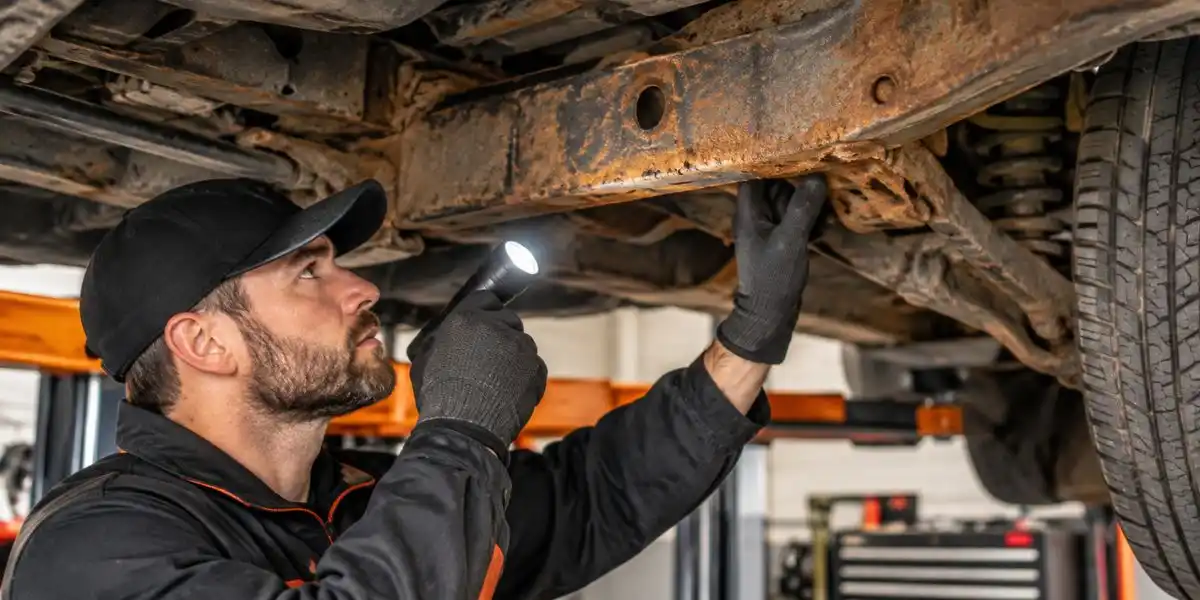
A useful corrosion assessment separates confirmed damage from suspected damage. “Rusty underneath” is not a sufficiently precise finding: it does not say whether the issue is surface corrosion, perforation, or metal loss at an important location. Ask for the affected components to be identified in plain language, along with the areas that could not be assessed and the reason access was limited.
Make the inspection evidence useful
Photos can help show where a finding is located, but they should support a description rather than stand in for one. A picture of the visible face of a rail may not show its back, the area behind a mount, or metal hidden under a coating. The inspection should connect each image or note to a component and explain what it establishes—and what remains unknown.
Access limitations are part of the finding, not a minor detail. If a liner, bracket, coating, or attached component blocks the view, ask what additional access would be needed to assess the area. The answer may be that cleaning is enough to clarify the surface, or that more disassembly is required. Either way, distinguish an initial assessment from a final repair scope if the metal condition has not yet been exposed.
For the vehicle being assessed, a focused inspection should produce answers to these questions:
- Where is the observed damage? Identify the part and location rather than grouping unrelated areas under “underbody rust.”
- What is confirmed, and what is only suspected? Separate visible findings from areas that remain concealed or uncertain.
- What would the next inspection step establish? State how cleaning or access would change the repair decision.
Keep a state inspection and a structural corrosion assessment distinct. Massachusetts provides information about its vehicle inspection program; a state inspection result should not be assumed to answer a separate question about concealed structural corrosion. A used-car buyer can ask specifically which areas were examined and whether coverings limited access. A fleet manager can identify whether the request is for a condition assessment of a known concern or for preventive treatment on a vehicle without identified structural damage.
Choose whether to expose, repair, replace, or pause
Once the affected area and access limits are known, the decision becomes more concrete. The next step should follow from the finding, not from a generic preference for extensive work. A plan may involve further inspection, a defined repair, component replacement, or a pause while the repairability question is resolved.
Cleaning is an assessment step, not a structural repair
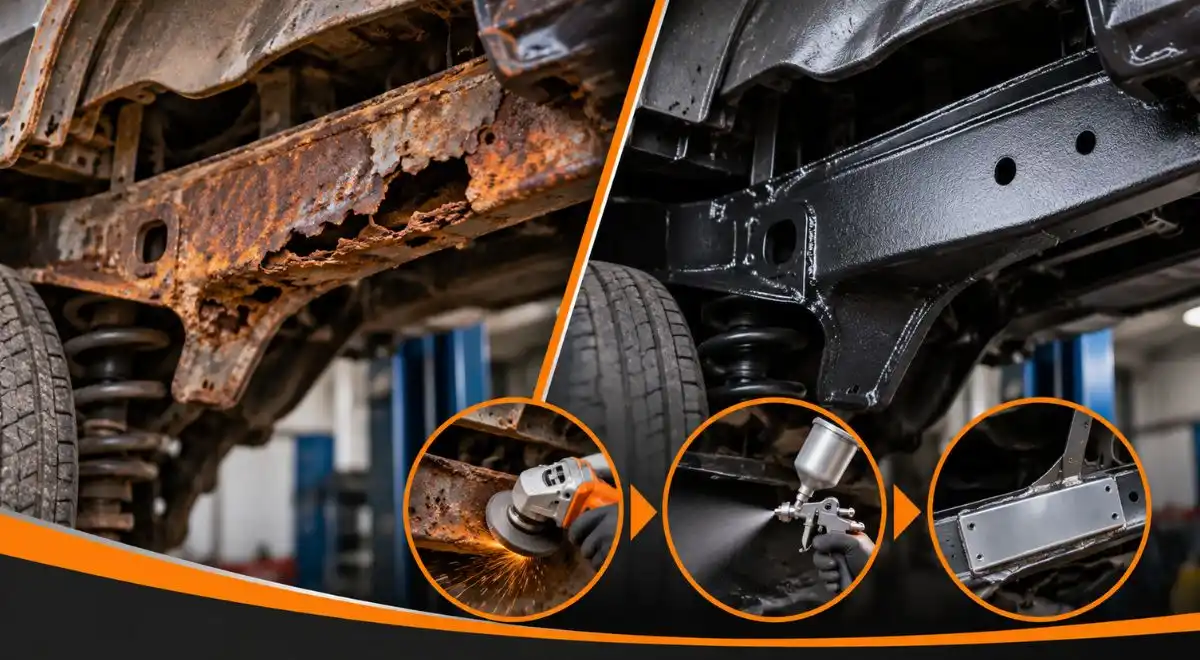
Rust removal or surface preparation can make metal easier to assess. It does not restore metal that has been lost. If preparation reveals holes, cracks, or more extensive deterioration than expected, the original scope may no longer fit. Before protective coating is applied, the owner should understand whether the exposed condition has been assessed and whether additional structural work is needed. For a job involving access through disassembly and abrasive cleaning, see frame-off rust removal.
Frame-off work can make sense when the restoration plan requires access to areas that cannot be adequately inspected or addressed in place. It is not automatically the right choice simply because it is more extensive. Ask which areas require access, what the inspection is intended to establish, and how newly visible damage will affect the plan. For a classic or specialty vehicle, this can also help separate restoration choices—such as the desired extent of disassembly—from the independent need to establish a sound structural repair.
Use the evidence to select the next route
These are decision paths, not universal repair prescriptions:
- Clean and inspect further if a coating or surface corrosion prevents a clear assessment of the metal.
- Repair a defined area if the damage and repair boundary can be established and an appropriate method is available for that vehicle.
- Consider component replacement if the assessment supports it and the relevant vehicle-specific information is consistent with that approach.
- Pause or decline the proposed work if access is inadequate, the extent remains unknown, or the method cannot be justified for the vehicle.
Do not authorize a cosmetic treatment as though it resolves an open structural question. If a proposed repair cannot be explained in relation to the affected part and the remaining uncertainty, seek clarification before work proceeds. An open safety recall is a separate issue: NHTSA’s recall lookup lets owners check for recalls by VIN, but a recall check does not diagnose rust or establish that a corroded structure is repairable.
Match the repair plan to the vehicle and its use
Vehicle-specific repair information matters because a method for one model or location may not apply to another. Ask what manufacturer service information is relevant to the proposed work, particularly when the repair involves a structural component. Toyota’s Technical Information System is an example of a manufacturer service-information portal; owners should look for information appropriate to their own vehicle rather than assume that a procedure transfers across models or structural locations.
The intended use affects the decision, even though it does not change what the inspection found. A daily driver, a work truck, a fleet vehicle, and a project vehicle can have different practical constraints around downtime, restoration goals, or whether further work is worthwhile. Those constraints should be discussed after the structural findings are clear; they should not be used to minimize an unresolved safety concern.
For example, a used-car buyer who finds corrosion near a mount needs to know whether the mounting area was actually assessed, not just whether the underside looks clean in photos. A fleet manager may need to separate vehicles needing structural evaluation from vehicles being considered for prevention alone. A classic-car owner may accept more disassembly to inspect hidden areas, but still needs a defined repair scope rather than an open-ended restoration description.
Repair and prevention are different jobs. Undercoating may be considered for suitable surfaces after assessment and any required structural work; it cannot rebuild a weakened rail or make a compromised attachment sound. If the vehicle is structurally suitable and the need is protection rather than repair, consider rust prevention undercoating as a separate decision from the structural estimate.
Approve a scope that can be checked
An estimate should make it possible to compare the proposed work with the inspection findings. It should identify the component and location, describe whether the work is assessment, metal repair, or component replacement, and state what is excluded. If cleaning or disassembly may reveal more damage, the estimate should explain how the scope will be reviewed before additional work is authorized.
This is different from repeating the inspection checklist: the owner is now deciding what work to approve and how a change will be handled. Before authorizing structural work, check that the estimate answers the following:
- What work is included? The component and repair area should be identifiable, not just labeled “frame repair” or “rust work.”
- What is outside the scope? Note inaccessible areas or adjacent components that are not included.
- What happens if new damage appears? Agree that the findings and revised scope will be reviewed before extra work proceeds.
- What finishing or protection is included? Distinguish structural work from cleaning and any later corrosion-protection treatment.
For repair businesses or restoration shops considering outsourced work, a clear handoff matters: identify the vehicle, the known affected locations, the inspection already completed, and the decision the outside work needs to support. That helps distinguish a request to remove rust and expose metal from a request to repair a defined structural area. It also avoids treating the same broad word—“restoration”—as though it describes one fixed scope.
Keep the findings, estimate, and approvals together, especially if the plan changes after hidden areas are exposed. If the revised work differs materially from the original scope, review the new finding and proposed work before deciding whether to continue. That record lets an owner or fleet manager understand what was known at each decision point without confusing a protective coating with structural repair.
Bay State Rust Prevention’s documented capabilities include in-house vehicle inspection and corrosion assessment, frame-off disassembly, rust removal through sandblasting, bare-metal preparation, automotive frame repair, and restoration of rust-damaged vehicle structures. For a vehicle in Worcester or Central Massachusetts, use baystaterustprevention.com to ask whether its condition and the work being considered fit those capabilities.