

Body frame repair starts with finding out whether corrosion has weakened a structural part or remains a surface problem. The right next step may be cleaning and protection, further inspection, or repair or replacement of damaged metal; a coating alone does not restore metal that has been lost. If you are buying a used vehicle, restoring a classic, or maintaining a work truck, ask for an assessment that identifies the affected part and explains what can and cannot be seen.
Worried about rust on your vehicle’s frame? See our frame rust repair service for how the repair works, starting prices and booking.
What Body Frame Repair covers
“Body frame” can refer to different structures. A body-on-frame vehicle has a separate frame that supports the body and connects with suspension components. In many cars and crossovers, structural rails and reinforcements are integrated into the body rather than built as a separate frame. Identify the vehicle’s construction and the damaged part first; the same visible rust spot can call for different access and repair plans on different designs.
Structural repair is not the same job as rustproofing or rust removal. Rustproofing is intended to protect suitable surfaces from corrosion. Rust removal exposes affected metal for assessment and preparation. Structural repair addresses metal that is damaged or weakened, using an approach suited to the part and the vehicle. These steps can be related, but one does not automatically replace another.
- Prevention: a treatment applied to appropriate, prepared surfaces to help limit future corrosion.
- Removal: cleaning away rust or coatings so the exposed surface can be assessed and prepared.
- Repair: work on damaged structure, which may involve repairing or replacing a section as the assessment and vehicle-specific information support.
Corrosion is deterioration caused by reactions between a material and its environment, as described in AMPP’s corrosion basics. That helps explain why limiting exposure can matter, but it does not mean a protective treatment can replace metal already lost to corrosion. Do not treat a structural defect as a coating problem: first establish the condition of the metal, then decide whether protection is appropriate.
How to recognize rust that needs a closer look
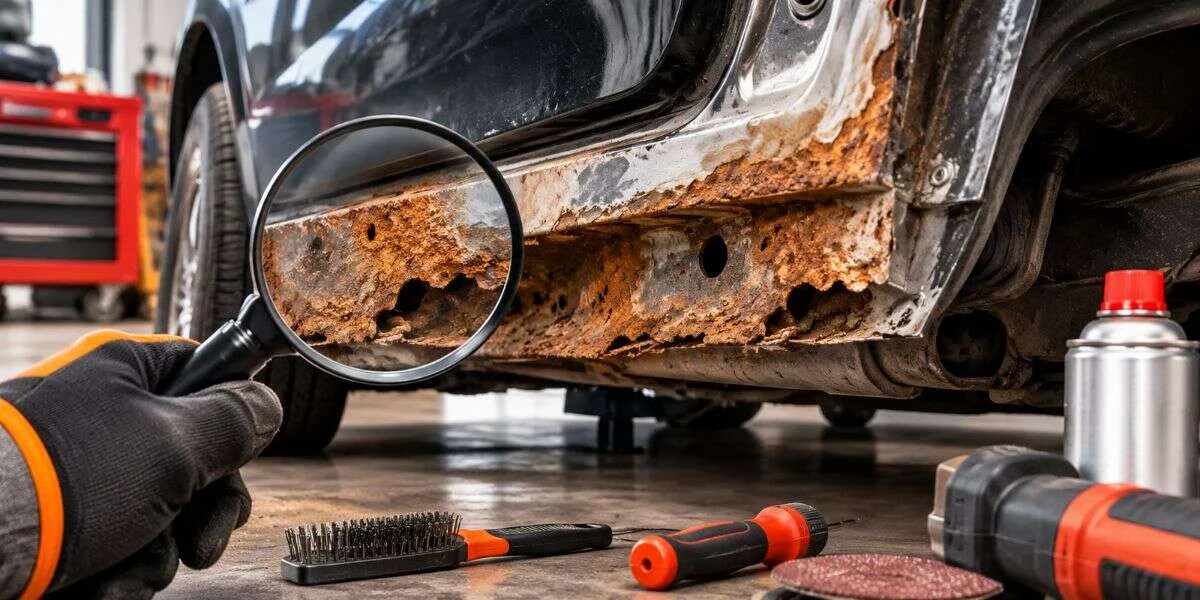
Rust color alone cannot show how much sound metal remains. A surface may look rough while the extent of damage is uncertain, and a clean exterior does not rule out corrosion inside a boxed section or behind a seam. Look at the location, the condition of the metal, and whether the corrosion appears limited or widespread. Rust near a structural attachment deserves more attention than an isolated spot on a non-structural outer panel.
Check for changes in the metal
Flaking scale, swelling along a seam, perforation, separation, or visible distortion are reasons to arrange a closer assessment. These signs do not, by themselves, establish whether a vehicle is safe or which repair is appropriate. They do indicate that the affected area should not be judged only by its appearance from a distance or covered before its condition is understood.
- Look for scaling, holes, cracks, or distortion on visible frame rails and crossmembers.
- Pay attention to suspension or steering attachment areas, body mounts, and brackets.
- Note swelling, peeling coatings, or trapped debris around seams and overlapping sections.
- Record whether corrosion is concentrated in one area or appears across several structural parts.
If you notice an apparent change in how a vehicle sits, unusual movement, or a component that seems loose, arrange an inspection rather than trying to diagnose the structure from photographs. These observations are prompts for assessment, not a do-it-yourself test of structural strength. Avoid scraping, drilling, or attempting a repair before the affected area and nearby components have been considered.
Ask what the inspection actually covered
A useful inspection identifies the suspected component, the visible corrosion, and any limitations on seeing concealed areas. Depending on the vehicle and location, access may require moving shields, trim, or other parts; the inspector should explain what was examined and what remains uncertain. A broad description such as “rust underneath” does not tell an owner whether the concern is a surface, a replaceable component, or a structural section.
For a used-car buyer, ask to see the underside in good light and consider an independent mechanic’s inspection before purchase. NHTSA’s vehicle-buying tips recommend having a used vehicle inspected by a mechanic. If a fresh coating makes an area difficult to evaluate, ask what preparation was done and whether earlier photographs or repair records are available; those materials may help provide context, but they do not substitute for examining the vehicle.
In Massachusetts, vehicle inspections are governed by 540 CMR 4.00. A state inspection and a repair assessment serve different purposes: an inspection result does not necessarily describe the full extent of corrosion or specify a repair procedure for a particular vehicle. If you need a structural decision, ask for an assessment focused on the affected part.
Choose a repair path from the condition of the metal
The repair plan should follow the assessment, not assume that every rusty section needs the same treatment. Ask the shop to connect its recommendation to the part, the observed damage, and the vehicle’s construction. A proposal that begins with coating or welding before the condition is understood leaves an important question unanswered: what is the work intended to correct?
- Sound metal with limited surface corrosion: cleaning and suitable corrosion protection may be appropriate after the surface is assessed and prepared.
- Heavy scale or uncertain condition: more access or cleaning may be needed before anyone can determine whether the metal is reusable.
- Perforated, cracked, distorted, or substantially weakened structure: seek a structural repair assessment; applying a coating does not replace lost metal.
- Corrosion near an attachment or adjoining structure: ask whether the plan accounts for the connected area, not just the easiest visible spot.
For structural work, vehicle-specific repair information matters. I-CAR provides access to OEM repair information resources; the applicable instructions can vary by vehicle and component. Ask what information will guide the work and how the proposed approach relates to it. This is especially important for a restoration or a repair involving more than one structural area, where cleaning may reveal additional damage.
Do not assume a visible rust spot defines the full scope. Corrosion can extend into a seam or concealed section, while the nearby metal may remain suitable for a narrower repair. The responsible plan distinguishes confirmed findings from areas that have not yet been exposed. For a commercial motor vehicle within its scope, 49 CFR 393.201 addresses frame condition. It is a regulatory requirement for its specified context, not a repair recipe for every passenger vehicle; fleet operators should confirm which rules apply to their vehicles.
When frame-off rust removal makes sense
Frame-off work involves disassembly to expose areas that are difficult to reach while the vehicle remains assembled. It can be useful for restoration or when corrosion and existing coatings make a meaningful assessment difficult in place. It is not automatically the right response to every rusty vehicle: the decision depends on the vehicle’s design, where corrosion is found, and what the owner needs the work to accomplish.
Use disassembly to improve access, not as a promise of repair
Cleaning a frame can make the underlying metal easier to assess, but cleaning is a preparation step rather than structural repair. Sandblasting can remove rust and old coatings from accessible surfaces; the condition revealed afterward may show that metal is suitable for further preparation, or that additional structural work is needed. A sound plan allows for those findings rather than assuming in advance that every section will be reusable.
- Consider broader access when corrosion is widespread or important areas cannot be assessed in place.
- For a restoration, clarify which frame and related areas will be exposed before reassembly.
- If coatings or scale obscure a repair area, ask whether cleaning is needed to decide what work is justified.
- When corrosion is limited and accessible, ask whether a more localized assessment and treatment can address the actual problem.
Before approving disassembly, ask what parts will be removed, what areas that access is expected to expose, and when the shop will review newly visible findings with you. The scope may need to change if cleaning reveals more extensive damage than was visible beforehand. Bay State Rust Prevention’s frame-off rust removal page describes its frame-off rust removal service; whether that approach fits a particular vehicle depends on its condition and repair needs.
What to settle before authorizing structural work
A useful estimate or work discussion separates what is known from what can only be determined after access or cleaning. That distinction helps a used-car buyer decide whether to proceed, a fleet operator document a vehicle’s condition, and a classic-car owner plan a restoration without treating a preliminary visual impression as a final repair scope.
- Which parts show corrosion, and how were those areas inspected?
- Is the proposed work rust removal, prevention, structural repair, or a combination?
- What cannot be evaluated until a part is removed or the surface is cleaned?
- What vehicle-specific repair information will guide the structural work?
- Which findings could change the scope, and how will those changes be discussed?
- How will repaired and cleaned areas be protected after the work?
For a fleet, record the vehicle, the affected location, the inspection findings, and the work completed. That makes it easier to compare conditions across vehicles without assuming that a recurring exposure means every frame has the same damage. For a restoration, photographs taken before cleaning, after the metal is exposed, and after repairs can document what was found and how the repair decision followed those findings.
Be clear about the job you are approving. “Remove rust” describes surface work; it does not necessarily include structural repair. “Repair the frame” should be tied to identified areas and a stated scope. Ask what protection, if any, is planned once the metal has been assessed and the structural work is complete, rather than assuming that preparation, repair, and prevention are all included in one service.
Protect repaired metal and decide what to do next
After structural work, corrosion protection should suit the surfaces being treated and their preparation. Ask which areas will be covered and whether the plan includes the seams, joints, panels, or cavities relevant to the vehicle. A treatment for prepared surfaces should not be assumed to stabilize heavy scale hidden in a cavity or correct a defect that has not been repaired.
For a vehicle with sound structure, prevention may be the main job; for one with active structural rust, start by establishing the damage and the repair scope. Bay State Rust Prevention provides rust removal, frame-off sandblasting, frame repair, and WaxOyl rust-prevention undercoating, with vehicle inspection and corrosion assessment among its verified capabilities. Its rust prevention undercoating information can help owners consider protection for a vehicle ready for treatment. If the frame condition is uncertain, contact baystaterustprevention.com to ask whether an assessment is appropriate for your vehicle.