

Chevy frame repair should start with identifying the damaged structure, assessing how much sound metal remains, and checking the repair information for that specific vehicle. Surface corrosion may need cleaning and protection; heavy scale, perforation, cracks, or distortion call for a structural assessment before anyone recommends cutting, welding, or covering the area. Get the vehicle identified and the damage documented, then ask for a written plan that explains what is confirmed, what remains uncertain, and why the proposed work fits the vehicle.
Rust on a Chevy frame you want checked by a shop? See our frame rust repair service for how the repair works, starting prices and booking.
Identify the Chevy and pinpoint the affected structure
Owners use “frame” to describe several things: a separate truck frame, a rail, a crossmember, or another structural section that supports or locates vehicle components. Repair choices depend on the actual part and its condition, not just the vehicle’s make. A procedure used on one Chevy model or year is not automatically appropriate for another.
Give the shop enough information to identify the vehicle
Record the model year, model, VIN, and relevant configuration details, such as cab and bed style for a pickup. If you need help decoding the VIN, the NHTSA VIN Decoder provides vehicle information from a VIN. Share the result with the repair facility so it can look for information that matches the vehicle rather than relying on a general description such as “older Chevy truck.”
Describe how the concern came to your attention. An inspection finding, a visible hole, suspected damage after an impact, or a loose-looking mount can help the shop choose where to begin. Those observations are useful context, not a diagnosis: a photo or brief description cannot establish the condition of concealed metal.
- Mark the location: Note the side and approximate area, such as a rail near a mounting point or a crossmember.
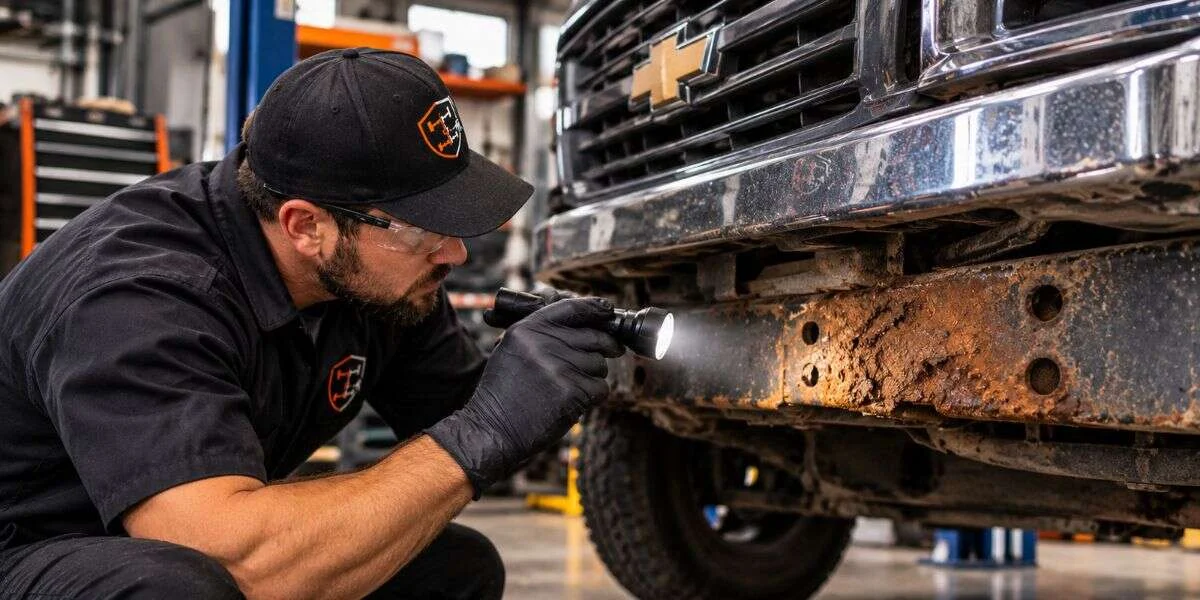
- Describe what is visible: Record flaking scale, an opening, a crack, distortion, or an earlier patch without aggressively scraping or probing it yourself.
- Note the concern: Include an inspection comment, a new noise, or a change in how a component appears, if applicable.
- Explain the use: Tell the shop whether the vehicle is a daily driver, a restoration project, or used to carry loads or tow.
Use photos to show where the issue is and how it relates to nearby components, but do not treat them as proof of repairability. Dirt, undercoating, overlapping sections, and limited access can hide the edge of the affected area. Ask the inspector to separate what was visible from what was confirmed after cleaning or gaining access.
Assess whether rust is cosmetic or structural
Rust color alone does not show how much strength the metal has lost. Discoloration may be limited to the surface, while thick scale can conceal thinning or a hole. The relevant question is the condition and function of the affected part, including the surrounding metal, not simply how rusty the area looks.
Look closely at mounting areas, joints, and prior repairs
Ask for a closer assessment if corrosion appears near a suspension or body mounting point, at a joint, on a crossmember, or elsewhere that supports or locates vehicle components. Perforation, split seams, cracks, distortion, and old patches also warrant investigation. These observations do not establish that a frame must be replaced or that a particular repair will work; they identify reasons to inspect further.
A coating is not a substitute for assessing weakened metal. Undercoating can protect a suitable prepared surface, but it cannot restore metal lost to corrosion. Similarly, a patch that looks sound from the outside may leave questions about the condition of the base metal and the extent of the rust unless the area was properly inspected and prepared.
For a vehicle flagged during a Massachusetts inspection, ask for the specific observed condition and the applicable inspection finding. Massachusetts vehicle inspections are governed by 540 CMR 4.00. An inspection result helps identify a concern; it does not, by itself, describe the full repair scope or establish which structural repair method is appropriate.
Understand what the first inspection can and cannot establish
Corrosion may extend behind a visible edge or between overlapping sections. Conversely, a rusty-looking outer surface does not prove that every part behind it is equally affected. The shop should explain whether its assessment was limited to a visual check or whether it cleaned the area or improved access enough to evaluate more of the metal.
This matters when reviewing an estimate. A preliminary quote may need revision if removing loose scale, coatings, or nearby components reveals additional damage. Before authorizing work, ask what inspection and preparation are included, what findings could change the scope, and whether the shop will pause to discuss a revised plan before proceeding.
- Ask which areas were directly inspected and which remain concealed.
- Ask whether the estimate is final or conditional on further cleaning or access.
- Agree how the shop will contact you if the findings change the proposed work.
Choose a repair path based on the findings
The decision is not limited to “patch it” or “replace the frame.” Depending on the inspection, the next step may be to clean and protect a suitable surface, remove coatings or scale to assess the metal, carry out structural repair, or investigate further before choosing a method. The shop should connect its recommendation to the damaged component, surrounding metal, vehicle-specific repair information, and your intended use.
- Surface corrosion with sound underlying metal: Ask whether cleaning and protective treatment are appropriate and what preparation is needed first.
- Heavy scale or uncertain metal condition: Ask what additional access or cleaning is necessary before the repair can be defined.
- Perforation, cracking, distortion, or corrosion near a mount: Request a structural assessment and a written explanation of the proposed repair.
- An old patch or coating over the concern: Ask whether it must be removed to inspect the underlying metal and adjacent structure.
For cutting, welding, sectioning, or replacement, ask the shop to identify the exact component and explain the basis for its chosen method. Repair information can vary by vehicle and location. ACDelco TDS provides access to GM service and repair information, while I-CAR Repairability Technical Support offers repairability information for collision professionals. These resources can inform a repair plan; they do not replace inspection of the individual vehicle or prove that a proposed method suits a particular rust-damaged area.
Make the estimate specific enough to evaluate
A useful estimate names the affected part, describes the observed condition, and distinguishes confirmed work from possible additional work. Ask questions such as:
- How far does the corrosion extend, and what is the condition of the adjacent metal?
- Was the area cleaned enough to judge its condition, or is the recommendation provisional?
- What vehicle-specific repair information applies to this location?
- Does the proposal involve cleaning, repair, sectioning, replacement, or another method, and why?
- What is included in the estimate, and what findings would change its scope?
- How will the repaired area be inspected and protected after the structural work?
Be cautious about approving a plate over rust if the estimate does not explain how far the corrosion extends or why that method is suitable. “Patch frame” is also too vague to assess without a location and scope. Such wording does not prove a repair is wrong, but it leaves important questions unanswered. Ask for clarification before authorizing work.
For a used-truck buyer, unresolved frame corrosion is a reason to arrange an independent assessment before purchase rather than rely on a seller’s description or photographs. For a classic Chevy owner, preserving original material may matter, but that preference should be discussed alongside the metal’s condition and the vehicle’s intended use. In either case, ask what evidence would change the recommendation.
Decide whether frame-off rust removal belongs in the plan
Frame-off work is a way to gain access for inspection and preparation, not a diagnosis or a repair by itself. It may be considered when a restoration or rust-removal project calls for the frame to be separated from the vehicle. It is not automatically necessary for every rust concern, and removing coatings or rust does not replace metal that corrosion has already weakened.
Before approving extensive disassembly or sandblasting, clarify what the work is intended to accomplish and how the bare or cleaned metal will be assessed. The useful sequence is to expose and inspect the relevant areas, determine the structural work, and then prepare the frame for any finishing or protection. If cleaning reveals more damage than expected, the original repair plan may need to change.
- Ask what access is needed: Which areas cannot be inspected or prepared adequately without removing components?
- Agree on a decision point: What will the shop do if the exposed metal shows more corrosion than anticipated?
- Separate preparation from repair: Confirm which work removes rust or coatings and which work addresses structural damage.
- Consider the project scope: For a localized concern, ask what a frame-off approach adds compared with a more limited inspection and repair plan.
Frame-off rust removal can be relevant when broad access is needed for cleaning and restoration. Bay State Rust Prevention lists frame-off rust removal among its capabilities; whether that approach fits a particular Chevy depends on an inspection and the project’s repair needs. Do not approve disassembly simply because a frame looks rusty, ask what it will reveal or make possible.
Protect the repaired structure and keep a clear record
After structural work, request a record of what was repaired, what was replaced or retained, and any limitations the shop identified. Keep the estimate, invoices, and photos with the vehicle’s records. This is useful for a restoration continued in stages, for later inspections, and when explaining prior work to a prospective buyer or another repair facility.
Protection belongs after suitable preparation. A coating over loose scale, trapped debris, or an unresolved structural problem can make later inspection harder without fixing the underlying condition. Ask which surfaces are included, how they were prepared, and whether the chosen treatment suits the vehicle’s use. If the concern is still active rust or weakened metal, clarify whether that needs to be addressed before corrosion protection is applied.
For an otherwise suitable vehicle that needs preventive treatment, see rust prevention undercoating. Bay State Rust Prevention uses WaxOyl for corrosion protection, including treatment of seams, panels, joints, and cavities; an inspection can help distinguish that work from rust removal or structural frame repair. Owners of work trucks and fleet vehicles can also ask how the proposed inspection or treatment applies to the vehicle’s actual condition and use, rather than assuming every vehicle needs the same work.
Check recall status separately from physical rust damage. The NHTSA recall lookup lets vehicle owners search for safety recalls, but a recall search does not assess an individual frame or determine whether it can be repaired. Treat recall status and the vehicle’s inspected condition as separate questions.
For suspected structural rust, request an inspection and a written repair basis before choosing a coating, patch, or frame-off project. Bay State Rust Prevention provides vehicle corrosion assessment, rust removal, frame-off disassembly, and automotive frame repair; visit baystaterustprevention.com to review whether an inspection or restoration service fits your Chevy.