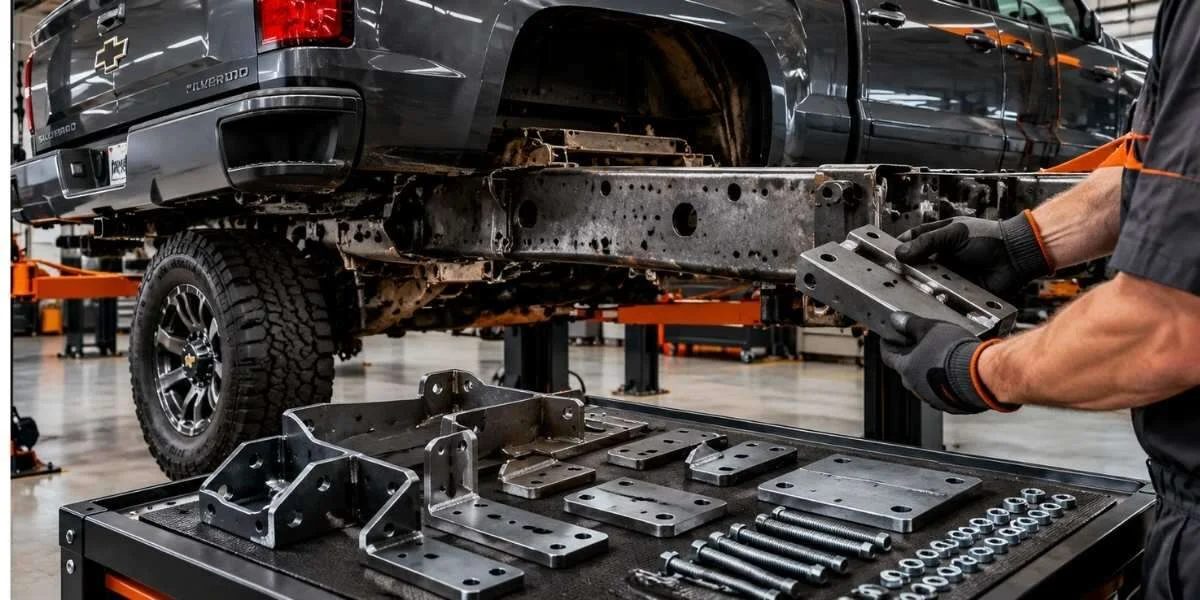


A silverado frame repair kit is not a reliable fit based on the word “Silverado” alone. No specific kit, model-year range, or generation fitment can be verified from the information available here, so treat any listing as a candidate, not a confirmed match, until the seller or repairer checks it against your truck’s VIN, configuration, damaged frame location, and repair plan. The most useful next step is to gather those details and request written, part-specific fitment confirmation before buying.
Weighing a kit against a shop repair? See our truck frame repair in West Boylston, MA for how the repair works, starting prices and booking.
What “fits a Silverado” needs to mean
Silverado is a model name, not a complete parts specification. A listing may use broad wording without clarifying which model years, configurations, frame sections, or repair purposes it covers. Do not infer a generation range from a product photo, a search result, a seller’s general category, or another truck that looks similar. The available evidence does not establish a verified catalog of Silverado repair kits or year-by-year fitment distinctions; a vehicle-specific lookup is necessary.
Begin with the truck’s VIN and vehicle identification labels. NHTSA’s VIN Decoder can help identify vehicle information from the VIN, but a VIN lookup is not a substitute for confirmation that a particular part fits. Give the supplier the exact vehicle details it requests and ask it to confirm the part number and application in writing. If the lookup results and the truck’s documents appear inconsistent, resolve that discrepancy before ordering.
Collect details a fitment lookup can use
Prepare a short vehicle-and-damage description rather than sending only “Silverado frame rust.” The repair location matters: a part intended for one section or side should not be assumed to fit another because both are described as rear frame, for example. Identify nearby components or mounting points to help distinguish the location, and label photos with the truck’s side and orientation.
- Vehicle identity: VIN, model year, and the model or configuration information shown on the vehicle documents or labels.
- Configuration: cab, bed, drivetrain, and any other chassis details requested by the supplier. Do not guess if you cannot confirm a detail.
- Damage location: side of the vehicle, frame section, and nearby bracket, crossmember, or mounting feature where the damage appears.
- Part information: listing URL, part number, stated year range, included pieces, and any installation document supplied with the product.
- Inspection status: what the repairer has actually inspected and whether coatings or limited access leave part of the area unseen.
That information makes the fitment question answerable; it does not itself establish that the part is suitable. Ask the supplier to confirm whether the listing covers the exact vehicle and location, and ask the repairer to confirm that the part’s purpose matches the inspected damage. If either party cannot make that connection, pause rather than treating a broad compatibility label as approval.
Establish what the frame damage requires
A repair kit cannot be selected responsibly from the visible rust color or the size of a photographed patch alone. Coatings, dirt, prior repairs, and corrosion on surfaces that are hard to see can conceal the condition of the metal. The repair decision depends on what the inspection establishes about the affected section and the material where the proposed repair would attach or otherwise connect. A listing cannot establish those conditions for your truck.
Use the inspection to define the repair area
Ask the repairer to describe the damage in specific terms: where it is, what is visible, what was accessible for inspection, and what remains uncertain. Surface scale, a crack, distortion, perforation, or a failed attachment are not interchangeable findings. These observations do not diagnose a Silverado remotely; they help identify when a product choice should wait for a closer structural assessment.
For example, imagine a Silverado with visible corrosion around a frame attachment. A photo might show the outer edge but not the metal behind the attachment or the extent of corrosion under a coating. The useful decision is not to guess which kit goes over that spot; it is to ask the repairer what inspection is needed to define the repair and whether the proposed part addresses the resulting scope. If opening or cleaning the area changes what is visible, the plan may need to be reassessed.
- Visible rust is a prompt to inspect, not proof that the frame is either structurally sound or beyond repair.
- Damage at a mounting or attachment area needs an assessment that considers the attachment and surrounding material, not just the visible surface.
- Existing coating or repair material can limit what an exterior view establishes; ask how the shop will resolve that uncertainty.
- Severe weakening, a failed attachment, or distortion calls for a repairer’s assessment before you decide whether to drive or buy a part.
Ask what happens if more deterioration appears after access or preparation. A useful answer distinguishes the work already defined from work that would require a revised scope and your approval. That conversation helps prevent a part purchase from being mistaken for a complete diagnosis or a complete repair plan.
Read the listing as a description, not a repair instruction
Terms such as “replacement section,” “reinforcement,” or “repair kit” describe a product, but the label alone does not establish how it should be used on your truck. A replacement description suggests a different intended role from an added reinforcement, yet neither tells you whether that part matches the damage, vehicle configuration, or applicable repair procedure. Get the seller’s documentation and have the repairer explain how the product relates to the inspected area.
Compare the part’s stated purpose with the repair scope
Consider a hypothetical listing that calls a part a reinforcement while the inspection describes deteriorated metal that may need to be removed. The name does not resolve whether the proposed repair is suitable; the repairer must explain how the part and method address the documented condition. In the reverse situation, a replacement section listed for one specific location should not be assumed to address corrosion beyond that location. The key is a clear connection among the product description, the damage assessment, and the proposed work.
Before ordering, ask for the information below. If the listing does not provide it, ask the seller to clarify rather than relying on a photograph or a broad fitment phrase.
- Application: What exact model years and configurations does the seller confirm for this part number?
- Location and orientation: Which frame section and side is it intended for, and how is that location identified?
- Purpose and contents: Is it a replacement, a reinforcement, or another component, and what pieces or hardware are included?
- Limits: What damage or surrounding area is outside the part’s stated scope?
- Documentation: Are there installation instructions or fitment notes the repairer can compare with vehicle-specific information?
Do not assume a part can be modified to fit just because it can be positioned near the damaged area. Ask the repairer to explain whether the proposed part and method are supported for this vehicle and repair location. If the answer depends on an unverified assumption, resolve it before paying for the part or authorizing structural work.
Check the repair information and estimate
Correct part fitment and a suitable repair procedure are separate questions. Ask the shop what vehicle-specific repair information it consulted for the truck and the affected frame area. I-CAR’s OEM information resources help repair professionals locate manufacturer information, and GM service information is available through ACDelco TDS. These resources are places to seek applicable information; their existence does not prove that a particular aftermarket kit or repair method is approved for your truck.
You do not need to choose a technical repair method yourself. You do need an estimate that describes the proposed work clearly enough for you to understand what is included, what assumptions it makes, and how unexpected damage will be handled. If two estimates differ, compare their repair scope and assumptions rather than comparing only the product names or totals.
- Ask what information was used to identify the truck and select the part.
- Ask which vehicle-specific repair information applies to the proposed work and location.
- Check what the estimate includes, such as inspection, access, preparation, the specified part, and work outside the part’s footprint.
- Clarify how additional damage will be documented and who must approve a change to the scope.
- Request a written explanation if the part’s stated purpose and the repairer’s description of the damage do not seem to match.
A seller’s fitment confirmation answers whether the part is represented as compatible; it does not inspect the frame or establish the repair procedure. A repairer’s assessment addresses the vehicle’s condition, but it should still identify the product and information behind the proposed work. Keeping those responsibilities distinct makes it easier to spot unanswered questions before they become part of the repair.
Plan corrosion protection and keep the repair record
Structural repair and corrosion protection serve different purposes. The repair plan addresses the damaged structure; protective treatment concerns suitable surfaces after the work and preparation have been completed. Ask the shop how it will handle coatings that obstruct inspection, what preparation is included, and when any protection would be applied. Applying a coating over an area whose condition is still uncertain does not answer the structural question.
Bay State Rust Prevention lists automotive frame repair, rust removal, frame-off vehicle disassembly, sandblasting, bare-metal preparation, vehicle corrosion assessment, and WaxOyl rust prevention among its capabilities. Its frame-off rust removal page describes frame-off rust removal, while rust prevention undercoating describes rust prevention undercoating. Whether either service belongs in a Silverado repair plan depends on the truck’s condition and the agreed scope; verify directly with the business rather than assuming a particular treatment is required.
Keep records that let a future repairer understand what was done. Save the estimate, part number and fitment correspondence, the repair location, the shop’s description of the repair information used, and photographs or notes the shop provides. These documents do not independently certify the repair, but they preserve the details that can otherwise be difficult to reconstruct after coatings or components are back in place.
- Keep the final estimate and any approved changes to the work.
- Record the part number, seller’s fitment confirmation, and supplied instructions.
- Retain the repairer’s description of the affected area and procedure information referenced.
- Save available before-and-after photographs and any notes about additional corrosion or protection work.
Recommendation: do not order a Silverado frame repair kit until its exact application, the inspected damage, and the repairer’s proposed procedure line up. Bay State Rust Prevention provides rust removal, frame repair, and WaxOyl corrosion protection; visit baystaterustprevention.com to review its services and verify directly whether they suit your truck’s repair needs.