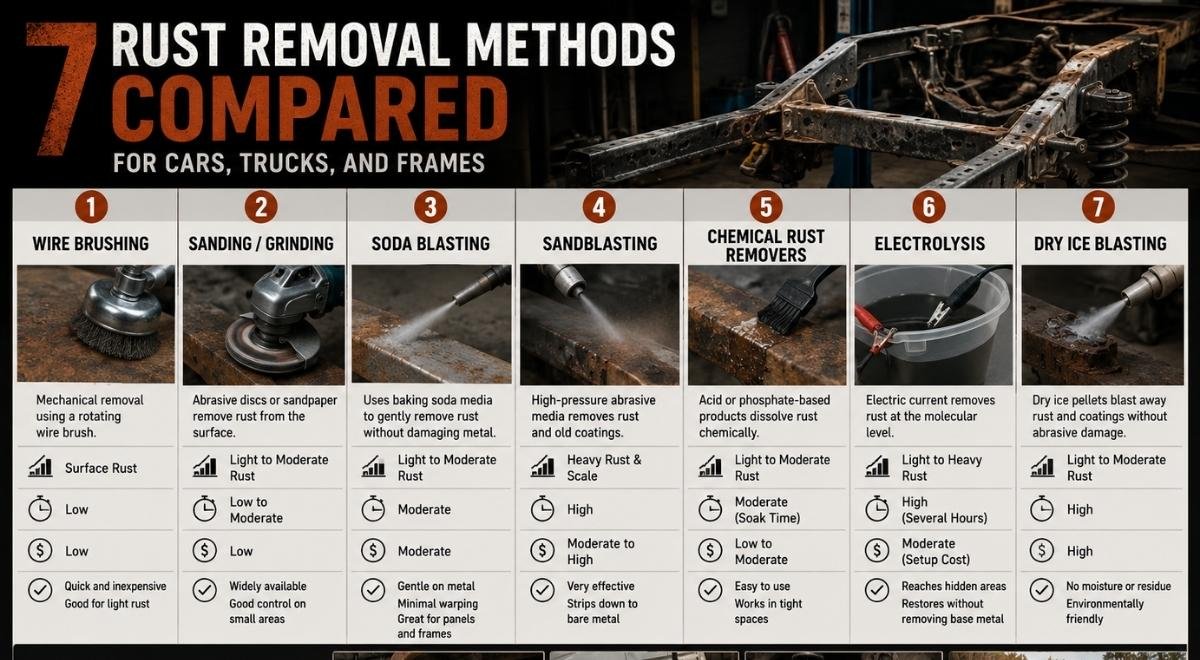
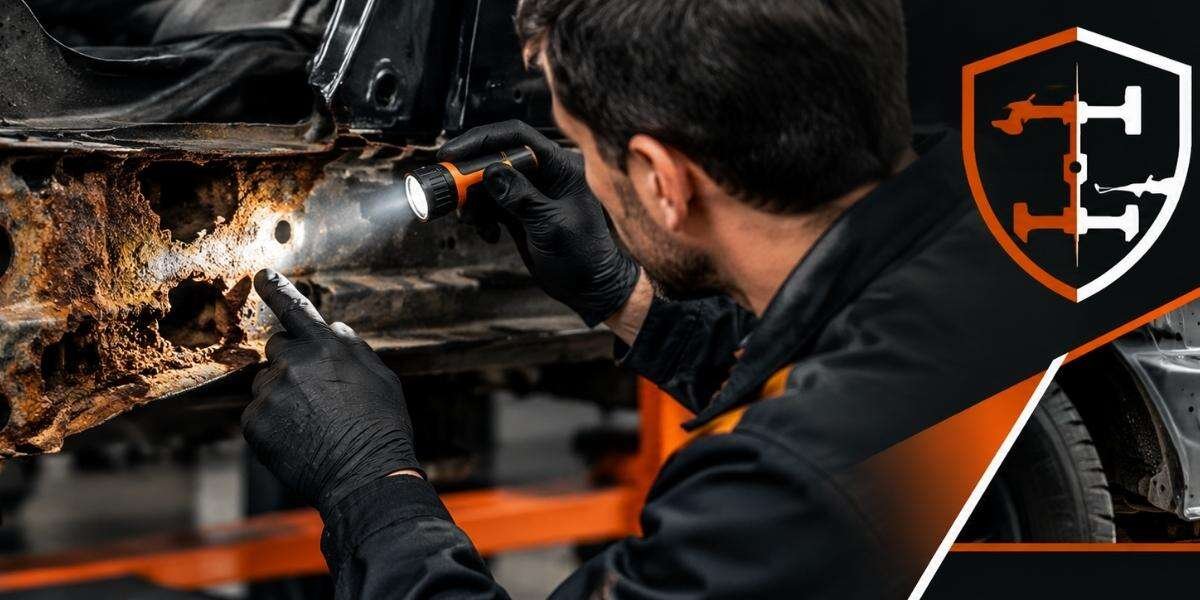
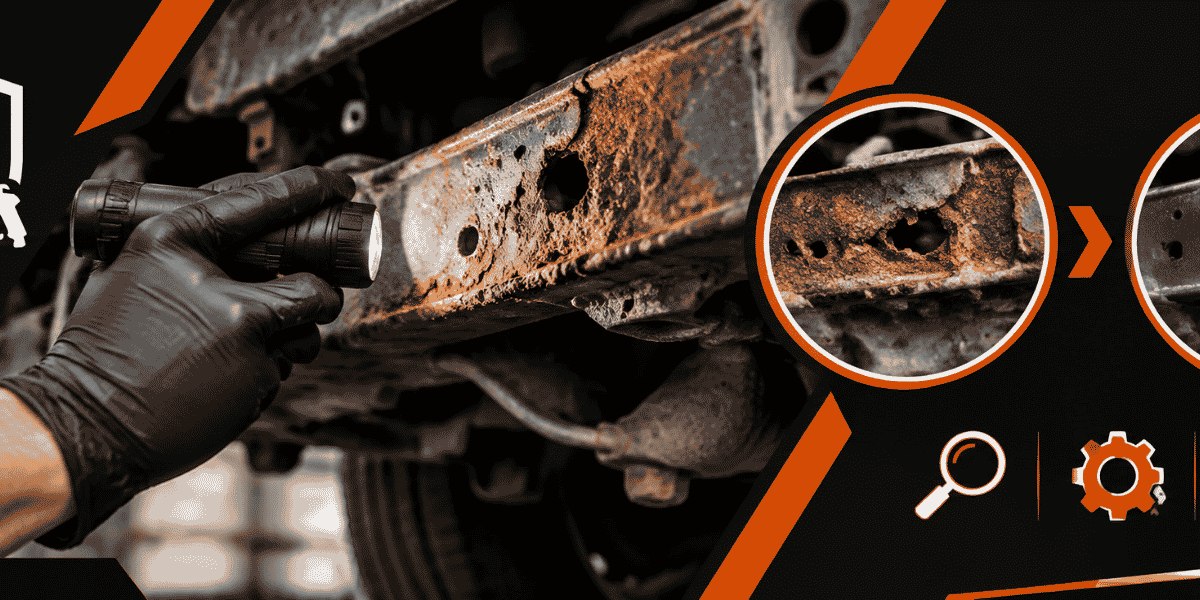
Rust removal methods are not interchangeable: a removable bracket, a truck frame with layered scale, and a classic fender each need a different level of preparation. This comparison is for Central Massachusetts vehicle owners, restoration shops, repair businesses, and fleet managers deciding whether to use a chemical product, mechanical abrasion, mobile blasting, or a professional frame-restoration service.
The buyer job here is specific: remove active corrosion and leave a sound, protectable surface. That does not always mean making every pit disappear. Rust removal can expose thin metal, hidden perforation, seized fasteners, and previous repairs. A sensible process therefore separates cleaning from structural diagnosis and from final corrosion protection. If you are evaluating a used vehicle, the same distinction matters: a clean-looking surface can conceal section loss behind a bracket, under a coating, or inside a boxed frame.
I compare the seven options using four criteria: corrosion reach into pits, seams, and boxed sections; metal-control risk such as distortion or unnecessary removal of sound steel; implementation burden for a vehicle owner or shop; and commercial model, including retail purchase versus quote-based work. I also identify who each option does not suit. Product formulas and service capabilities can change, so verify current labels, safety instructions, availability, and pricing in 2026 before committing a vehicle or fleet.
1. Evapo-Rust
Best use and mechanism
Evapo-Rust is a liquid chelating rust remover intended for removable ferrous parts that can be immersed or kept wet. That makes it useful for brackets, hand tools, fasteners, shields, and small restoration components after grease and paint have been removed. The official Evapo-Rust site identifies the product and its rust-removal application; consult its current instructions for compatible metals, dwell time, reuse, and disposal.
The practical advantage is low mechanical aggression. A chemical bath does not throw abrasive into a bearing, carve a sharp edge into a bracket, or create the same dust profile as dry blasting. The limitation is reach. A complete truck frame cannot normally be submerged, and a liquid cannot reliably clean the inside of every boxed rail unless the part is designed for circulation and drainage. Heavy scale may also need scraping before treatment.
Verdict, burden, and commercial model
- Best for: removable steel parts, hardware, tools, and detail restoration where immersion is realistic.
- Does not suit: vehicle bodies, installed boxed frames, large panels, or corrosion that has already removed structural metal.
- Standout: controlled chemical action with less risk of changing the shape of a thin part through aggressive abrasion.
- Implementation burden: moderate; you need a container, safe handling area, part cleaning, rinsing or residue management, drying, and immediate protection.
- Commercial model: retail chemical purchase, with total cost depending on quantity, container size, labor, and the follow-up coating.
For a Massachusetts restoration shop, this is often a component-stage method rather than a complete-vehicle answer. A useful example is a detached battery tray with surface rust and intact metal: chemical treatment may be sensible. A frame crossmember with swelling scale and uncertain thickness needs inspection before anyone assumes a bath has solved it.
2. POR-15 Rust Remover
Where it fits
POR-15 Rust Remover is a branded chemical preparation in the POR-15 product family. It is aimed at rust removal or preparation work rather than serving as a substitute for cutting out perforated steel. The official POR-15 website is the appropriate place to confirm the current product identity, directions, substrate limitations, and companion-system requirements.
This type of product can make sense when a restorer is working on detached components with accessible surfaces. It is less useful when the real problem is layered scale trapped between overlapping seams. Chemical treatment may remove corrosion from exposed areas while leaving a mechanically weak lap joint untouched. That is why a bright surface is not proof of structural soundness.
Decision profile
- Best for: project parts that can be cleaned, treated, rinsed or neutralized as directed, dried, and coated promptly.
- Does not suit: owners expecting a bottle to repair holes, restore lost frame thickness, or reach inaccessible cavities.
- Standout: a recognizable restoration-oriented product ecosystem, useful when the buyer wants to follow one manufacturer’s preparation sequence.
Burden, pricing, and failure points
Implementation burden is moderate. The part must be accessible, degreased, and kept within the product’s process conditions; afterward, flash-rust control becomes important because clean bare steel can oxidize quickly in humid shop air. A shop should also protect drains, floors, and adjacent finishes according to the label and applicable waste rules.
The commercial model is retail purchase rather than a quoted vehicle service. That can be economical for a small collection of parts, but the apparent product cost excludes labor, masking, disassembly, drying, and coating. It does not suit fleet operators who need predictable throughput without removing components, nor owners who cannot inspect the back side of the treated metal.
3. Rust-Oleum Rust Dissolver
Product category and practical fit
Rust-Oleum Rust Dissolver belongs to the consumer rust-treatment category. Use the official Rust-Oleum site to verify the current Rust Dissolver label, available formats, surfaces, application directions, and safety information. Product names and packaging can vary by market, so the label—not an old forum recommendation—should control the process.
This is a reasonable category for localized surface corrosion: a small steel bracket, a hand-tool restoration job, or an exposed area where the user can thoroughly clean and observe the metal. It is not a structural repair system. If a pickup bed has pinholes, a body mount is separating, or a frame rail has deep scaling, dissolver alone cannot replace thickness measurement and fabrication.
Verdict bullets
- Best for: accessible, limited rust where a consumer can control wetting, dwell, cleanup, and follow-up coating.
- Does not suit: complete chassis restoration, hidden frame cavities, or vehicles needing guaranteed cosmetic uniformity.
- Standout: broad consumer availability and a familiar brand, subject to current local stock and label directions.
- Implementation burden: low to moderate for small areas; it rises sharply when disassembly, repeated applications, or overhead work is involved.
- Commercial model: retail product purchase, not a diagnosis, structural inspection, or repair quote.
The key decision is surface access. If you can see, clean, treat, rinse or wipe as directed, dry, and inspect every edge, a localized product has a defined job. If the rust is under seam sealer or inside a boxed section, selecting a stronger bottle does not solve the access problem. Mechanical opening, blasting, or component removal may be the more honest next step.
4. Eastwood Rust Dissolver
Restoration-oriented chemical treatment
Eastwood sells restoration supplies, including rust-removal products under the Eastwood name. Start at the official Eastwood homepage and verify the current Rust Dissolver listing, directions, size, compatibility, and price before purchase. Because inventory and formulations can change, this comparison does not assume a particular package or performance claim beyond its category.
Its natural buyer is a hands-on restorer with removable parts and a controlled workspace. A classic-car owner might use a chemical product on a pedal assembly, small suspension hardware, or a fabricated bracket before priming. That same owner should not interpret the disappearance of loose scale as evidence that a pitted frame rail remains serviceable.
Verdict and workload
- Best for: hobbyist and professional restoration parts where access and inspection are straightforward.
- Does not suit: time-sensitive fleet work, large installed assemblies, or corrosion requiring welding and section replacement.
- Standout: convenient sourcing alongside restoration abrasives, tools, coatings, and preparation supplies.
Implementation burden is moderate because chemical rust removal is only one stage. Plan for degreasing, containment, handling, drying, inspection under bright light, and a compatible protective finish. The commercial model is retail purchase, with the economic trade-off favoring small parts and controlled batches rather than a complete vehicle. It does not suit a customer who wants a single accountable party to diagnose, remove, repair, and protect a rust-damaged truck.
A useful stopping rule is to quit chemical treatment when the metal’s condition—not its color—becomes the question. If a pick, thickness check, or visual inspection shows a sharp edge, perforation, delamination, or a weakened mounting area, route the part to repair evaluation instead of adding more dwell time.
5. Dustless Blasting
Blasting as a vehicle-scale preparation method
Dustless Blasting is a branded wet-abrasive blasting system and service network. Its official Dustless Blasting site explains the brand’s equipment and service model; confirm the current process, media guidance, equipment requirements, and local provider details there. Wet abrasive blasting can remove coatings and corrosion from larger assemblies more efficiently than hand scraping, but it remains a process that requires operator judgment.
The mechanism combines abrasive impact with water. That can help manage airborne dust compared with dry blasting, but it does not make the work consequence-free. Media selection, pressure, angle, drainage, and drying determine whether the operator cleans a panel responsibly or damages thin metal and leaves moisture in seams. OSHA’s abrasive-blasting guidance covers hazards such as airborne contaminants, noise, pressure equipment, and protective measures; those controls remain relevant even when water is part of the process: OSHA abrasive-blasting guidance.
Verdict, burden, and commercial model
- Best for: vehicle shells, frames, trailers, and larger parts when a qualified operator can control rebound, runoff, media, and drying.
- Does not suit: a casual driveway job without drainage planning, thin panels handled by an inexperienced operator, or assemblies that cannot be dried internally.
- Standout: vehicle-scale wet-abrasive capability without relying solely on hand tools or a small immersion tank.
- Implementation burden: high for do-it-yourself owners; professional service reduces equipment burden but still requires disassembly and post-blast protection planning.
- Commercial model: equipment purchase or quote-based service, depending on whether the customer hires a provider or operates the system.
Blasting is preparation, not automatically preservation. A frame may look clean while still needing thickness assessment, weld inspection, drain-hole clearing, and repair. The customer should ask where the vehicle will be blasted, how cavities will be dried, what happens to seams and bearings, and how soon the bare metal will receive a compatible protective system. It does not suit owners who want a guaranteed “rust removed” result without making repair decisions visible.
6. Bay State Rust Prevention
Integrated removal, frame inspection, and protection
Bay State Rust Prevention provides vehicle rust prevention undercoating, rust removal, frame-off sandblasting, and automotive frame repair for owners across Worcester and Central Massachusetts. The service is especially relevant when the job has moved beyond a product choice and become a vehicle-condition decision: what must be removed, what metal can remain, what needs fabrication, and what protection should follow.
Its frame-off process is described through the site’s frame-off rust removal service information. A professional workflow can be appropriate for a rust-damaged truck frame, classic-car chassis, or component set that needs disassembly before blasting and repair. The precise scope still needs an inspection and quote; no responsible provider can price hidden corrosion accurately from a single photograph.
Verdict, burden, and commercial model
- Best for: Central Massachusetts owners needing coordinated rust removal, frame evaluation, structural repair, and corrosion protection.
- Does not suit: someone seeking the cheapest bottle for one small bracket, a no-disassembly cosmetic touch-up, or an instant walk-in result.
- Standout: the ability to address rust removal and structural consequences together, rather than handing the owner separate unresolved stages.
- Implementation burden: low equipment burden for the customer but potentially substantial vehicle downtime, transport, disassembly, and coordination.
- Commercial model: inspection- and scope-based service quoting rather than fixed retail pricing.
The important limitation is that professional service does not repeal physics. Severely thinned steel may require replacement; seized hardware may expand the scope; hidden cavities may not be fully visible until components are removed. Ask for the proposed sequence: disassembly, cleaning or blasting, inspection, repair authorization, coating, and reassembly. For a newer truck or leased vehicle, a less invasive rust prevention undercoating appointment may be more appropriate than full restoration when corrosion is not yet advanced.
For a fleet, the commercial advantage is accountability: the manager can define which vehicles need inspection, which need preventive treatment, and which should be held for structural work. The poor fit is a buyer unwilling to authorize inspection or unwilling to accept that a clean frame may reveal additional repair rather than eliminate it.
7. WaxOyl
Protection after removal, not a substitute for it
WaxOyl is a corrosion-protection product brand, not a primary rust-removal method. The official WaxOyl website is the source to check for current product families, application guidance, market availability, and technical information. It belongs in this comparison because the buyer job is incomplete if removed or disturbed metal is left exposed to moisture and road salt.
Wax-based cavity and underbody protection works by creating a barrier or film over prepared surfaces. That means surface preparation is decisive. Applying protection over loose scale, trapped water, mud, or active rust can conceal the defect and make later inspection harder. It cannot restore lost steel, close a crack, or make a perforated frame structural.
Verdict, burden, and commercial model
- Best for: maintaining sound or properly prepared vehicle surfaces against seasonal moisture and salt exposure.
- Does not suit: perforated frames, heavily scaled metal, wet cavities, or anyone treating coating as structural repair.
- Standout: a protection stage that can follow cleaning, repair, and inspection instead of ending the job at bare metal.
- Implementation burden: moderate; access, masking, ventilation, cleanliness, and future inspection points all matter.
- Commercial model: product purchase or professional application, with scope and price varying by vehicle access and preparation required.
For a new truck, leased vehicle, or working fleet, prevention may be the correct first decision because it avoids turning surface oxidation into a restoration project. For a classic frame, protection should follow documented repair and cleaning. The poor fit is an owner trying to seal a visibly deteriorating rail without first learning whether the rail has enough remaining thickness to carry load.
Comparison
The table uses the same decision dimensions for every option. Chemical products are compared as owner-applied tools; blasting and Bay State are compared as vehicle-scale or service workflows. WaxOyl is explicitly a protection product, so its “removal reach” is listed as none rather than implying that prevention and removal perform the same job.
| Option | Primary job | Reach and metal control | Implementation burden | Commercial model and poor fit |
|---|---|---|---|---|
| Evapo-Rust | Immersion treatment for removable ferrous parts | Good access in a bath; gentle compared with aggressive abrasion; weak fit for installed frames | Moderate: container, cleaning, handling, drying, and protection | Retail purchase; poor fit for large assemblies, hidden cavities, and structural damage |
| POR-15 Rust Remover | Restoration-oriented chemical preparation | Useful on accessible parts; cannot replace steel or expose every sealed seam | Moderate: preparation, treatment control, cleanup, and flash-rust management | Retail purchase; poor fit for perforated metal and no-disassembly projects |
| Rust-Oleum Rust Dissolver | Localized consumer rust treatment | Suitable for exposed surface corrosion; limited by access and scale depth | Low to moderate on small areas; higher with repeated applications | Retail purchase; poor fit for chassis restoration and structural diagnosis |
| Eastwood Rust Dissolver | Restoration-part chemical treatment | Practical on removable components; limited on lap joints, cavities, and lost metal | Moderate: degreasing, containment, drying, inspection, and coating | Retail purchase; poor fit for fleets and quote-based structural work |
| Dustless Blasting | Vehicle-scale wet-abrasive cleaning | Broad reach on exposed assemblies; operator controls risk to thin metal and seams | High for DIY; lower customer equipment burden with a qualified service provider | Equipment purchase or service quote; poor fit for uncontrolled driveway work and undrainable assemblies |
| Bay State Rust Prevention | Removal, frame-off cleaning, frame repair, and protection workflow | Appropriate for exposed vehicle structures; inspection determines repair and replacement needs | Customer equipment burden is low; downtime, transport, disassembly, and authorization matter | Inspection- and scope-based quote; poor fit for tiny retail jobs or instant cosmetic work |
| WaxOyl | Corrosion protection after sound preparation | No rust-removal reach; useful as a barrier on prepared surfaces and cavities | Moderate: access, masking, cleanliness, ventilation, and inspection planning | Retail product or professional application; poor fit for active scale and structural loss |
How to choose the right rust removal method
Start with access and metal condition
Do not begin by asking which chemical is strongest or which blasting process is fastest. Begin with what you can inspect. Use this sequence:
- Classify the part: removable hardware, body panel, open frame, boxed rail, or load-bearing mount.
- Remove contamination: grease, mud, undercoating, loose scale, and old repairs can hide the actual corrosion boundary.
- Look for section loss: holes, swollen seams, knife edges, layered flakes, elongated mount holes, and cracked welds change the job from cleaning to repair.
- Choose the least aggressive effective process: chemical treatment for accessible small parts, controlled abrasion for broader exposed surfaces, and professional evaluation for structural assemblies.
- Plan protection before removal: bare steel needs a compatible next step, not an indefinite wait in a damp shop.
A removable bracket with intact edges is a chemical-treatment candidate. A body panel with shallow orange corrosion may need careful mechanical preparation and refinishing. A boxed frame rail with heavy scale needs inspection before coating because the visible exterior does not show the internal condition. A classic chassis with multiple layers of old paint, filler, and undercoating may justify frame-off disassembly so every repair boundary can be seen.
Match the decision to the vehicle’s job
- New truck or leased vehicle: prioritize inspection, drainage, and preventive protection before road salt creates layered corrosion.
- Daily driver in Central Massachusetts: choose a process that can be repeated and inspected, not a coating that simply hides wet dirt or loose scale.
- Used-car purchase: inspect frame rails, body mounts, brake and fuel-line areas, and suspension attachment points before judging a clean underbody.
- Classic or specialty vehicle: preserve sound metal, document original construction, and avoid aggressive abrasion on thin panels without an experienced operator.
- Fleet or repair shop: standardize triage categories so preventive vehicles do not wait behind structural restorations.
For chemical products, verify the label’s substrate, handling, cleanup, and storage instructions. For blasting, ask about media, pressure, water management, drying, and protection of bearings, seals, wiring, and cavities. For professional frame work, request a scope that distinguishes surface cleaning from structural repair. For any coating, ask how future inspections and drain paths will remain possible.
A practical recommendation for 2026
Use a retail chemical product when the part is small, removable, accessible, and structurally sound. Use controlled blasting when contamination and corrosion cover a large exposed assembly and the operator can manage thin metal, seams, runoff, and drying. Move directly to a professional frame-restoration evaluation when there is perforation, deep layered scale, a compromised mount, or uncertainty about remaining thickness. Treat WaxOyl or another approved protection system as the final preservation stage—not the rust-removal stage.
For Worcester and Central Massachusetts owners who need that inspection-to-repair decision made on an actual vehicle, Bay State Rust Prevention offers rust removal, frame-off sandblasting, automotive frame repair, and corrosion protection at baystaterustprevention.com. Its scope is a better fit than a retail bottle when the vehicle’s rust condition, structural safety, and long-term protection must be considered together.