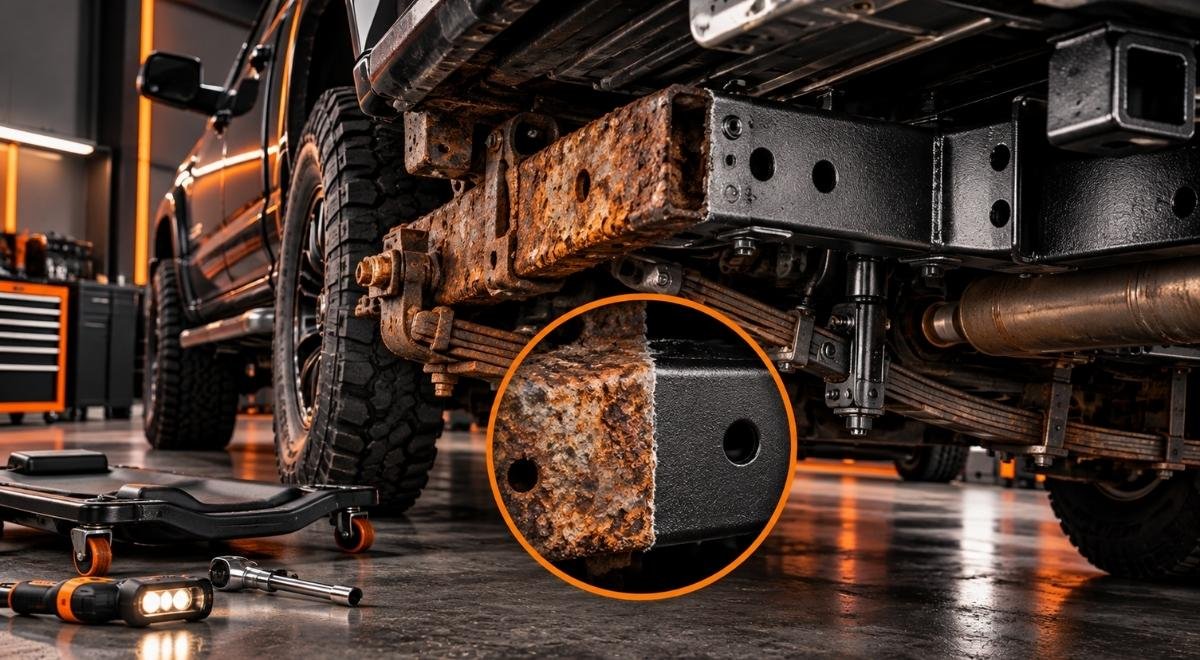
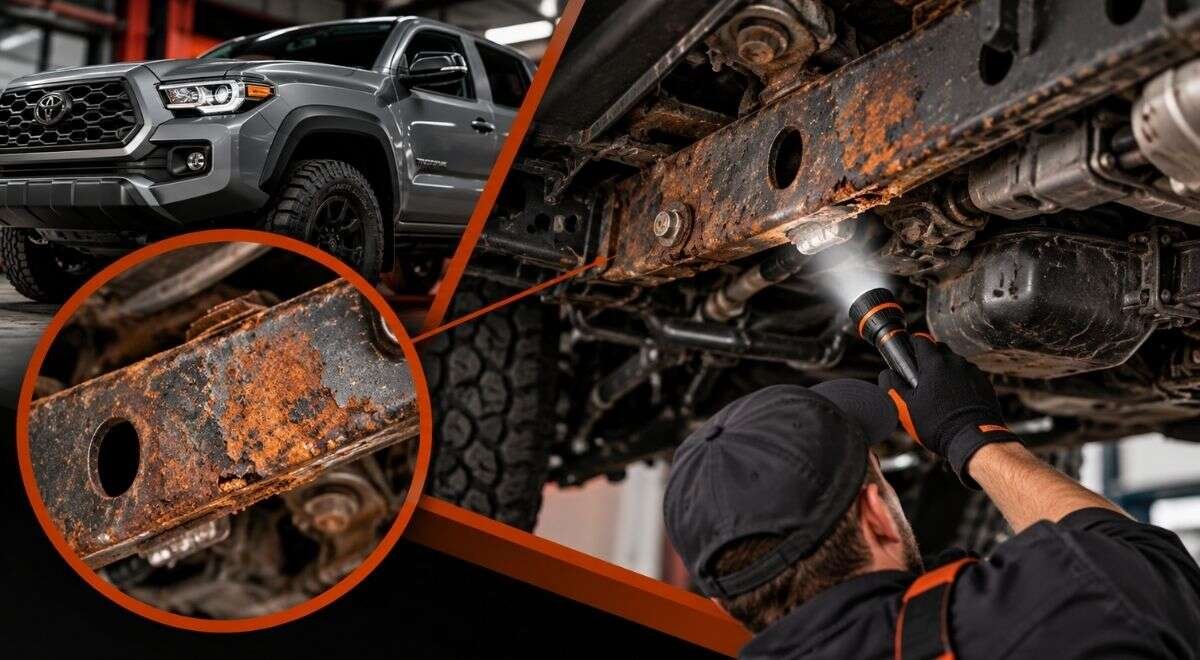
Truck frame repair is the process of evaluating and restoring the structural rails, crossmembers, brackets, and attachment areas that support a truck’s body, suspension, steering, drivetrain, and towing loads. It is not the same as covering surface rust with paint or undercoating. A proper repair begins by exposing the affected metal, determining whether the frame has lost meaningful thickness or alignment, and selecting a repair method that restores strength without trapping corrosion.
This distinction matters in Central Massachusetts, where trucks are exposed to winter road salt, wet snow, freeze-thaw cycles, and mud that stays packed against the frame. A truck can look presentable above the wheel wells while corrosion is advancing inside a boxed rail or around a suspension mount. The owner’s real decision is usually not “Can this rust be hidden?” but rather does the remaining metal still support a safe repair, and what must be done before protection is applied?
What Truck Frame Repair actually includes
A truck frame is a load path. The longitudinal rails carry bending and twisting forces, crossmembers keep the rails positioned, and brackets transfer concentrated loads from the suspension, cab, bed, steering gear, fuel system, and hitch. Rust damage becomes a repair issue when corrosion reduces the section of metal, creates holes, loosens a welded attachment, or changes the frame’s geometry.
That means “frame repair” can describe several very different jobs:
- Surface corrosion treatment: removing loose scale and applying a compatible corrosion-control system when the underlying metal remains sound.
- Localized reinforcement: replacing or reinforcing a limited section around a hole, crack, or weakened bracket when the surrounding rail is structurally suitable.
- Component replacement: removing and rebuilding a severely damaged crossmember, spring hanger, body mount, or suspension bracket.
- Rail section repair: cutting away compromised steel and fitting a properly shaped replacement section with appropriate weld preparation.
- Frame restoration: stripping a chassis extensively, repairing multiple areas, correcting corrosion, and refinishing it as part of a restoration or major rebuild.
These categories should not be confused with cosmetic work. A thin patch welded over scale may look solid for a short time while corrosion continues between the patch and the original rail. Likewise, a thick coating can conceal a perforation from a future visual inspection. Coating is the final protection step, not a substitute for structural diagnosis.
Which parts deserve priority
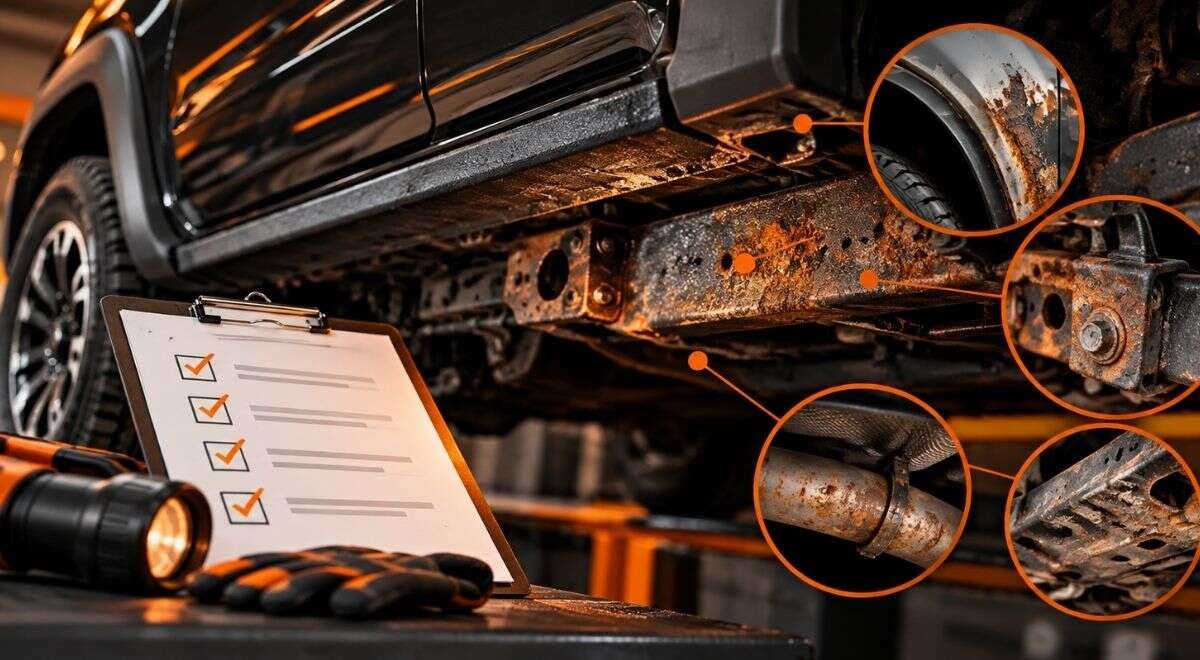
Technicians pay particular attention to areas where water, salt, and road debris collect or where loads concentrate. Common inspection targets include:
- the lower flanges and inner walls of boxed frame rails;
- rear spring and shackle hangers;
- front suspension and steering gear mounts;
- cab, bed, and body mounts;
- crossmember ends and weld seams;
- brake-line, fuel-line, and wiring retainers that trap moisture;
- hitch mounting areas and rear frame extensions;
- sections directly above snowplow, salt-spreader, or towing equipment.
On a work truck or fleet vehicle, the inspection also has to account for how the truck is used. A pickup that carries tools every day, pulls a trailer, or supports a plow experiences different loads than a lightly used weekend vehicle. The same visible rust spot can therefore lead to different repair decisions depending on its location and duty cycle.
Why frame corrosion becomes a safety and ownership problem
Rust is an electrochemical process, not merely dirt that discolors steel. Bare steel loses electrons when moisture and an electrolyte are present; road salt makes that wet film more conductive and helps it remain active. Crevices, overlapping seams, packed mud, and the inside of boxed sections can stay damp after exposed surfaces appear dry. Once corrosion creates a pit, the pit holds more moisture and becomes a more favorable location for further attack.
Massachusetts’ winter maintenance program uses salt and other materials to maintain roadway safety during snow and ice events. The state’s highway materials and winter operations are described by the Massachusetts Highway Division; the practical consequence for truck owners is that road exposure can place salt-bearing water on frame surfaces throughout the winter season. That does not predict the condition of any particular vehicle, but it explains why a frame that was clean several years ago can deteriorate quickly when seams and cavities are left untreated.
How a small defect becomes a structural concern
Corrosion does not need to remove an entire rail to affect the truck. Damage at a bracket can concentrate stress at the edge of a weakened area. A crack can grow from a sharp corner, a weld toe, or a drilled hole. A perforation can allow dirt inside a boxed section, where the internal surface cannot be judged from the outside.
There are also secondary consequences:
- A weakened spring hanger can change suspension location and loading.
- A corroded steering mount can allow movement that is not corrected by an alignment.
- A damaged body mount can create cab movement, noise, or uneven gaps.
- A rusted hitch area can reduce confidence in towing hardware even when the receiver itself looks clean.
- Corroded brake-line retainers can let lines rub against the frame or suspension.
- Rust around a crossmember can reduce resistance to twisting under load.
Not every rust hole means the truck is beyond repair. The important variables are location, remaining thickness, shape of the damage, alignment, and access for a sound repair. A small opening in a noncritical area may be treatable after cleaning. A similar-sized opening beside a suspension mount may require a much more extensive repair because the loads and consequences are different.
Inspection records and vehicle history
A used-truck buyer should treat a frame inspection as separate from a general mechanical inspection. Engine condition, tire wear, and a clean exterior do not establish that the chassis is sound. The National Highway Traffic Safety Administration provides a public recall lookup tool, which can help identify open safety recalls by VIN, but a recall search does not replace a hands-on examination of corrosion, previous repairs, or frame alignment.
Ask for photographs before and after major repairs, invoices for prior frame work, and any information about plowing, towing, collision damage, or prolonged storage. A seller’s statement that the frame was “undercoated” is not enough by itself. The useful questions are what was removed first, whether scale was left in place, whether cavities were accessed, and whether the coating is hiding seams that should be inspected.
How a sound repair is planned and performed
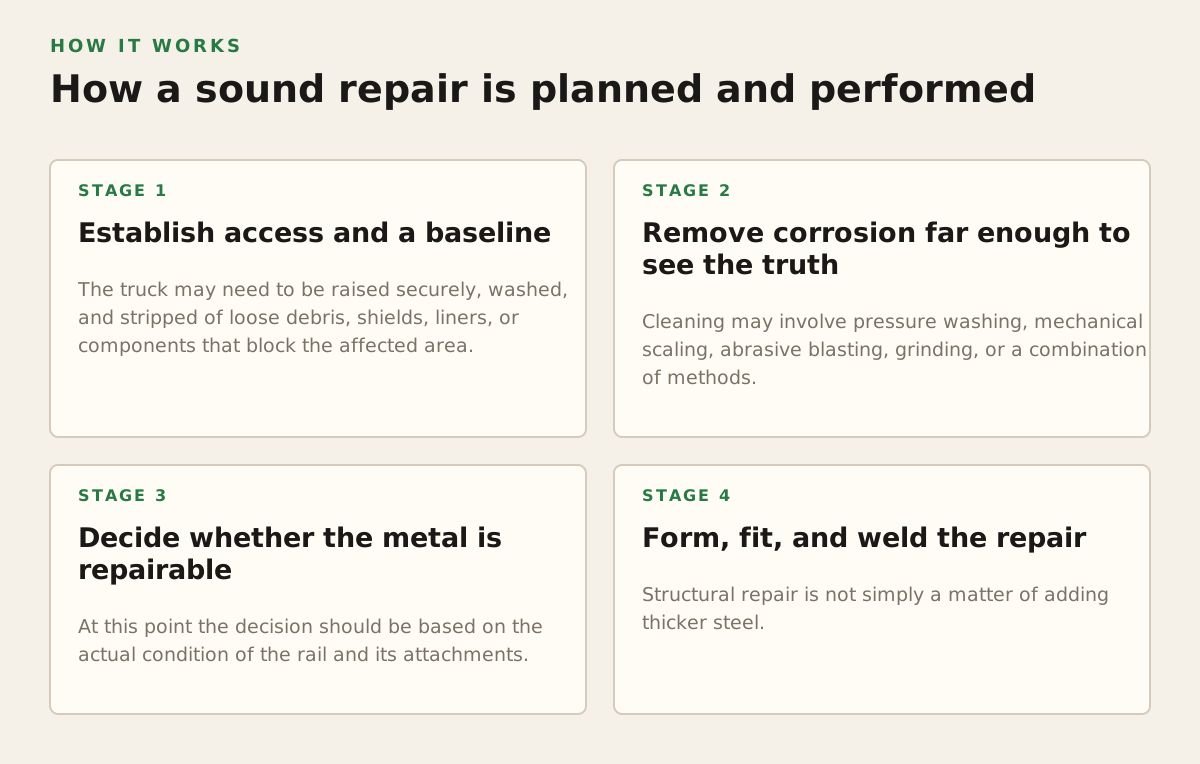
A durable result depends more on diagnosis and preparation than on the final color or coating. The exact sequence changes with the truck and the damage, but a careful process normally moves from access and documentation to cleaning, measurement, repair, inspection, and corrosion protection.
1. Establish access and a baseline
The truck may need to be raised securely, washed, and stripped of loose debris, shields, liners, or components that block the affected area. A technician records the location of holes, cracks, distorted brackets, and previous patches before removing material. If the frame appears bent or a suspension mounting point is displaced, measurements should be taken before cutting.
Photos and measurements are valuable because corrosion can make a damaged area look smaller after loose scale falls away. They also help distinguish old repairs from new findings. For a restoration vehicle, documenting routing and original bracket locations before disassembly prevents a clean but incorrectly assembled chassis.
2. Remove corrosion far enough to see the truth
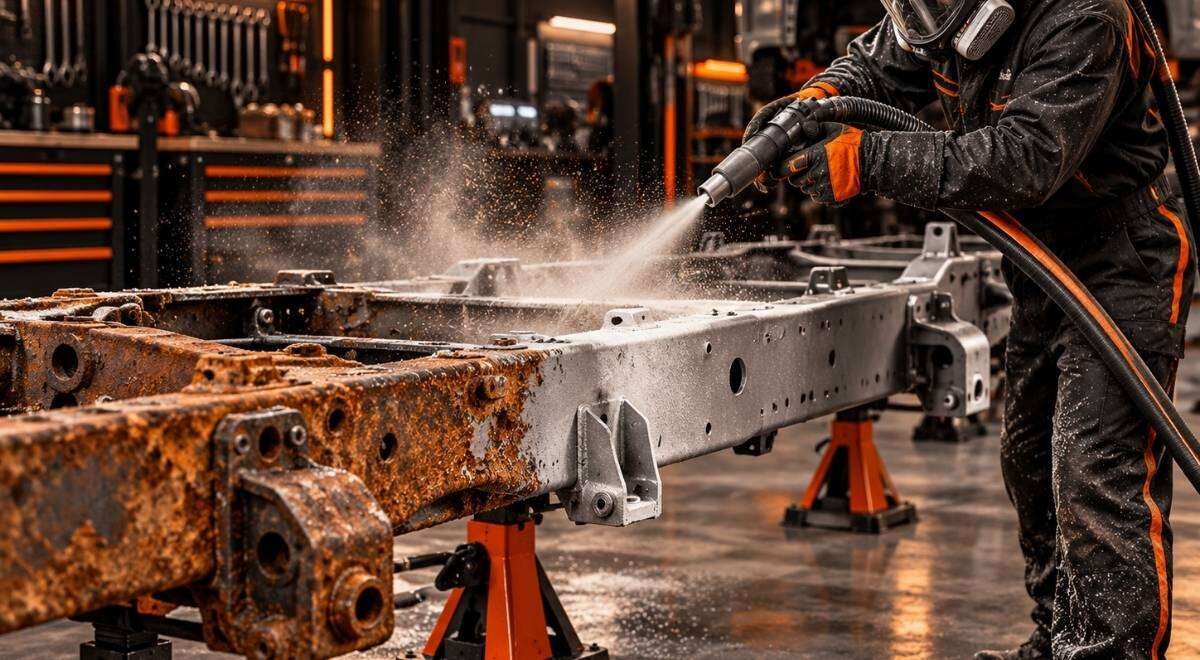
Cleaning may involve pressure washing, mechanical scaling, abrasive blasting, grinding, or a combination of methods. The objective is not to make every frame cosmetically bright at any cost. It is to remove loose corrosion and coatings until the technician can identify sound boundaries, cracks, perforations, weld condition, and the shape of the remaining steel.
Do not decide the repair size before the damaged metal is exposed. A visible quarter-inch hole can sit at the center of a larger thin area. Conversely, heavy surface scale can make a frame appear worse than it is until sound metal is revealed around the edge.
Abrasive blasting requires control of dust, noise, rebound, containment, and worker exposure. The Occupational Safety and Health Administration explains hazards and protective requirements for abrasive blasting in its abrasive blasting safety guidance. That is one reason frame-off work should be planned as a controlled restoration operation rather than treated as a quick cosmetic spray job.
3. Decide whether the metal is repairable
At this point the decision should be based on the actual condition of the rail and its attachments. A technician considers:
- how much solid steel remains around the damaged area;
- whether corrosion extends inside a boxed rail;
- whether the rail is straight and correctly positioned;
- whether the damage reaches a suspension, steering, body, or hitch mount;
- whether a replacement section can be shaped and supported correctly;
- whether heat, cutting, or welding could affect nearby lines, wiring, or sensitive components;
- whether the repair can be inspected after completion and protected against renewed corrosion.
The repair boundary should finish in sound material, not at the visible edge of a rust blister. If a rail is broadly delaminated or distorted, a small patch may be the wrong solution. The honest options may be a larger section replacement, a donor component, or declining the repair when safe restoration is not practical.
4. Form, fit, and weld the repair
Structural repair is not simply a matter of adding thicker steel. A reinforcement that is too abrupt can create a new stress concentration. A patch that does not match the rail’s shape can leave unsupported gaps or alter clearance. A repair near a suspension mount must preserve the mount’s position, fastener access, and load path.
Before welding, the affected area and replacement steel need suitable preparation. Components that can be damaged by heat should be removed or protected as appropriate. The technician must also consider the truck manufacturer’s repair information where available, especially for high-strength steel, hydroformed rails, or assemblies with special joining requirements.
Weld quality involves fit-up, cleanliness, heat control, access, and inspection. A repair can look neat on the outside while being incomplete on the inside or contaminated by remaining scale. Where the design calls for a particular joint or reinforcement shape, improvising a visually convenient patch can create more problems than it solves.
5. Verify before sealing the work
After structural work, the frame should be checked for alignment, clearance, bracket position, and interference with lines or moving components. Fasteners and mounts should be inspected as part of the surrounding repair, not assumed to be sound because the rail was fixed. A frame that is protected before this stage can hide defects and make later correction harder.
For collision-related or heavily modified work, the vehicle manufacturer’s repair procedures should guide the inspection. For welding safety and procedure qualification, the American Welding Society maintains standards information through its structural welding code resources; the applicable requirements depend on the repair, material, and shop process, so a general code page is not a substitute for project-specific engineering or manufacturer instructions.
Where frame repairs break down
Most failed repairs are not caused by a lack of paint. They begin with an incorrect diagnosis, inaccessible corrosion, unsuitable repair geometry, or premature sealing. Understanding the failure modes helps an owner evaluate a proposed job without pretending that every frame needs the same treatment.
Covering scale instead of removing it
Undercoating over loose scale creates a concealed corrosion layer. The coating may adhere to flaky rust rather than to sound steel, and moisture can remain at the boundary. This is especially risky inside boxed rails, around drain holes, and behind brackets. A protective product has value only when the surface and cavities are prepared for it.
For a truck with intact structural steel but exposed seams and vulnerable cavities, a dedicated rust prevention undercoating program can be sensible after cleaning and inspection. It should not be used to disguise perforation or postpone a needed structural repair.
Using a patch that is too small or too abrupt
A patch that stops at the visible edge of corrosion may leave thin steel around its perimeter. A patch with sharp corners can also concentrate stress. The correct shape depends on the rail profile, loading, access, and the extent of sound metal. There is no universal patch dimension that can be safely prescribed for every make, model, and damaged location.
Ignoring the inside of a boxed frame
External blasting cannot automatically clean every internal surface. Mud and salt can enter through openings, drain holes, seams, and damaged coatings. If the inside remains active, an exterior repair may be attacked from behind. Internal access, drainage, cavity treatment, and inspection openings therefore belong in the repair plan.
Welding over contamination or leaving heat-sensitive parts in place
Oil, undercoating residue, rust scale, and trapped moisture can interfere with a sound weld. Heat can also damage brake hoses, fuel lines, wiring, bushings, sensors, and nearby coatings. Removing or shielding adjacent components takes time, but skipping that planning can turn a frame repair into a larger mechanical or electrical problem.
Confusing inspection failure with a repair specification
Inspection rules and repair methods are related but not identical. Massachusetts vehicle inspection information is published through the Massachusetts Registry of Motor Vehicles, but an inspection result alone may not describe the complete engineering scope needed to restore a severely corroded truck. A failed inspection can identify a problem; the repair plan still requires examination of the full structure and affected attachments.
Examples of decisions, not universal thresholds
The following figures are illustrative examples only, useful for showing how scope changes. They are not universal safety limits, pass/fail measurements, or a substitute for an inspection:
- A 3-inch area of surface scale on a straight, solid rail may call for cleaning and corrosion protection rather than cutting.
- A 2-inch perforation beside a rear spring hanger may require a larger inspection area because the surrounding flange and mount carry concentrated load.
- A 6-inch section with layered corrosion on both sides of a boxed rail may be considered for section replacement instead of a small cover plate.
- A 1/8-inch visible crack at a bracket can justify inspecting the bracket, adjacent welds, and rail on all sides; the crack length alone does not establish the repair size.
- A fleet truck used 5 days per week for plowing may reasonably receive more frequent inspections than a summer-only collector truck, even if both have similar surface rust.
The useful lesson is that a measurement starts an investigation. It does not finish one.
How practitioners apply repair and prevention to different trucks
The best plan depends on the vehicle’s purpose, condition, and expected years of service. A new truck, a daily work pickup, a classic vehicle, and a heavily corroded fleet unit should not receive identical preparation or protection.
New and lightly corroded trucks
For a newer truck, prevention is mainly about access and timing. The frame should be inspected for shipping coatings, exposed weld seams, drain paths, and areas where factory coatings are thin or damaged. Washing the underside after winter use helps remove salt, but washing alone does not protect a boxed rail or a hidden overlap.
Before applying a protective coating, the owner should confirm that the surface is clean and dry, drain holes remain open, and the product is compatible with existing finishes. Avoid sealing wet mud, active flaky corrosion, or leaks into a cavity. On a leased vehicle, ask about restrictions on drilling, permanent modifications, and end-of-lease inspection requirements before authorizing cavity access or refinishing.
Daily work trucks and fleets
Fleet operators need a repeatable inspection policy rather than occasional visual guesses. Record the vehicle identification, mileage, operating role, photographs, corrosion locations, and repair status. The policy can be adjusted after experience with the fleet, but it should define who is responsible for reporting damage and what triggers a professional examination.
- Inspect after winter equipment is removed, especially around plow mounts and rear attachments.
- Check spring hangers, steering mounts, hitch extensions, and body mounts during scheduled service.
- Photograph new perforation, cracking, or distorted brackets before cleaning changes the evidence.
- Separate cosmetic coating work from structural repair approvals.
- Reinspect repaired areas after the first major winter season and after any collision or overload event.
Those intervals are a starting policy for planning, not a universal maintenance schedule. A salt-spreading truck, coastal vehicle, and enclosed-warehouse fleet experience different exposures. The goal is to discover changes before a small repair becomes a vehicle replacement decision.
Classic and specialty vehicles
Restoration work raises a second requirement: preserve originality where practical. A classic frame may have nonstandard brackets, thin original sections, previous collision repairs, or modifications that are not obvious beneath paint. Photographing and measuring before disassembly is particularly important when parts are scarce or the owner wants the original appearance retained.
Extensive corrosion may justify frame-off rust removal when the chassis must be stripped to expose rails, crossmembers, and brackets. Frame-off work is more disruptive than an underside service, but it can be the appropriate route when repairs are widespread or when every surface needs to be evaluated before refinishing.
Used-truck buyers
Arrange the inspection before purchase, not after negotiating around a low price. If possible, view the frame when it is dry enough to distinguish fresh coating from old scale, and ask that suspicious areas not be covered with a quick spray beforehand. Look for:
- thick, uneven undercoating that may conceal repairs;
- fresh black paint limited to one frame section;
- weld beads, plates, or drilled holes near suspension mounts;
- flaking scale at the inside edge of rails and crossmembers;
- crushed, bent, or poorly drained boxed sections;
- brake or fuel lines resting against corroded brackets;
- mismatched hardware or missing fasteners around repaired mounts.
A clean inspection does not guarantee future protection, but it gives the buyer a basis for deciding whether to purchase, budget for preventive treatment, or walk away. A seller who will not allow an independent underside inspection is creating a risk that a low price cannot reliably quantify.
What to ask before approving Truck Frame Repair
Before work begins, ask for a written description of the affected locations and the intended sequence. You do not need to dictate the weld design, but you should understand what condition was found and what will be done before coating hides the result.
- Which parts are structurally affected? Ask whether the issue is limited to surface corrosion, a bracket, a crossmember, a rail section, or multiple areas.
- Will the frame be cleaned far enough to find the repair boundary? Clarify whether loose scale and old coating will be removed before the final scope is approved.
- How will alignment and mounting positions be checked? This is especially important near steering, suspension, cab, bed, and hitch attachments.
- What happens to nearby lines and wiring during cutting or welding? A sound structural repair should not create an avoidable secondary failure.
- How will boxed sections and drain paths be handled? Ask whether internal corrosion and trapped moisture are part of the assessment.
- What will be documented before the protective coating is applied? Progress photographs can show the cleaned metal, repair boundary, and completed work.
- What maintenance is expected afterward? Protection is not permanent immunity; washing, inspections, and prompt repair of chips or damaged coating still matter.
Be cautious with promises that rely on a product name alone. A corrosion-control coating can slow future attack on properly prepared metal, but it cannot restore missing steel or correct a bent rail. Similarly, blasting can reveal the condition of a frame, but it does not automatically make a damaged frame safe. The quality of the decision before coating determines the value of the coating afterward.
For a Central Massachusetts truck owner, the practical recommendation is to inspect structural rust before winter protection, repair compromised rails or mounts before sealing them, and match the treatment to the vehicle’s use. Bay State Rust Prevention serves Worcester and Central Massachusetts with rust prevention, rust removal, frame-off sandblasting, and frame repair; visit baystaterustprevention.com when you need the frame condition evaluated before deciding between preservation, localized restoration, or more extensive rebuilding.
Authored with NotFair SEO