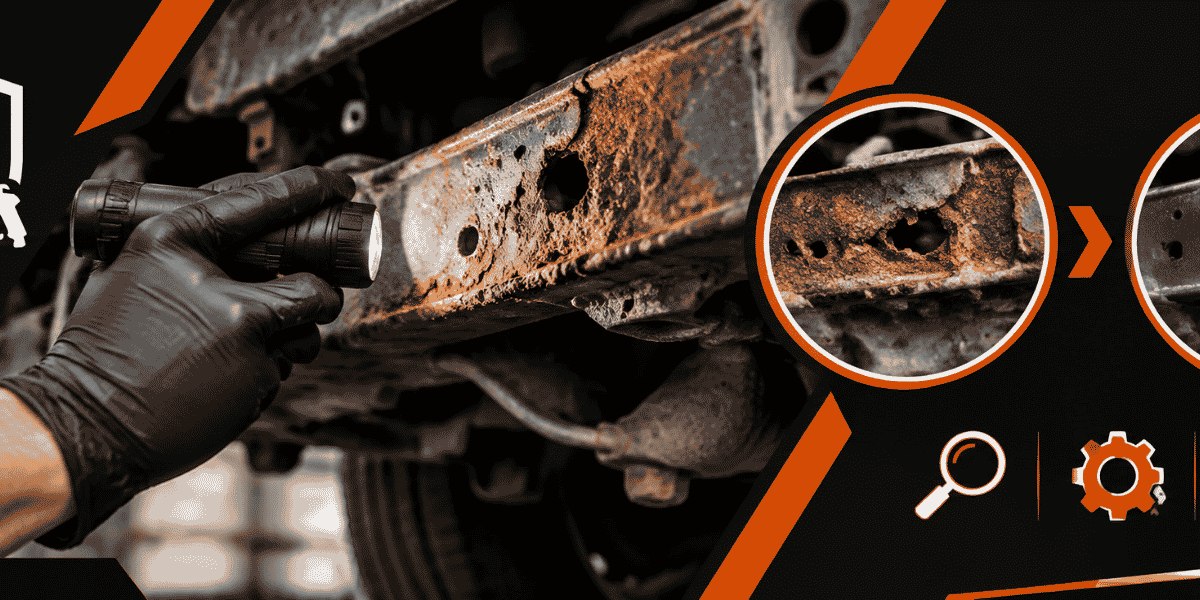
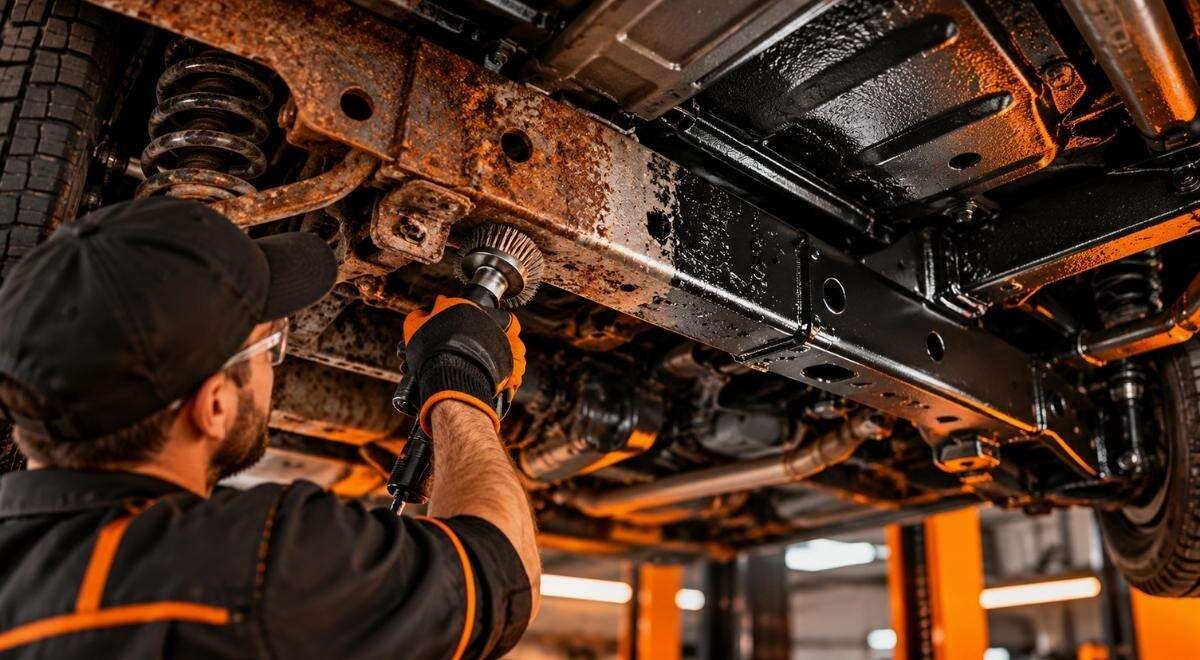
Choosing rust removal services is not simply a matter of finding someone who can make a rusty part look clean. A Central Massachusetts vehicle owner must decide whether the job calls for surface treatment, component removal, frame-off rust removal, structural repair, or corrosion protection after the metal is restored. This guide helps truck, car, classic-vehicle, fleet, and repair-shop owners define the job, compare service categories, control the delivery burden, and judge whether the finished work is likely to hold up through future road-salt exposure.
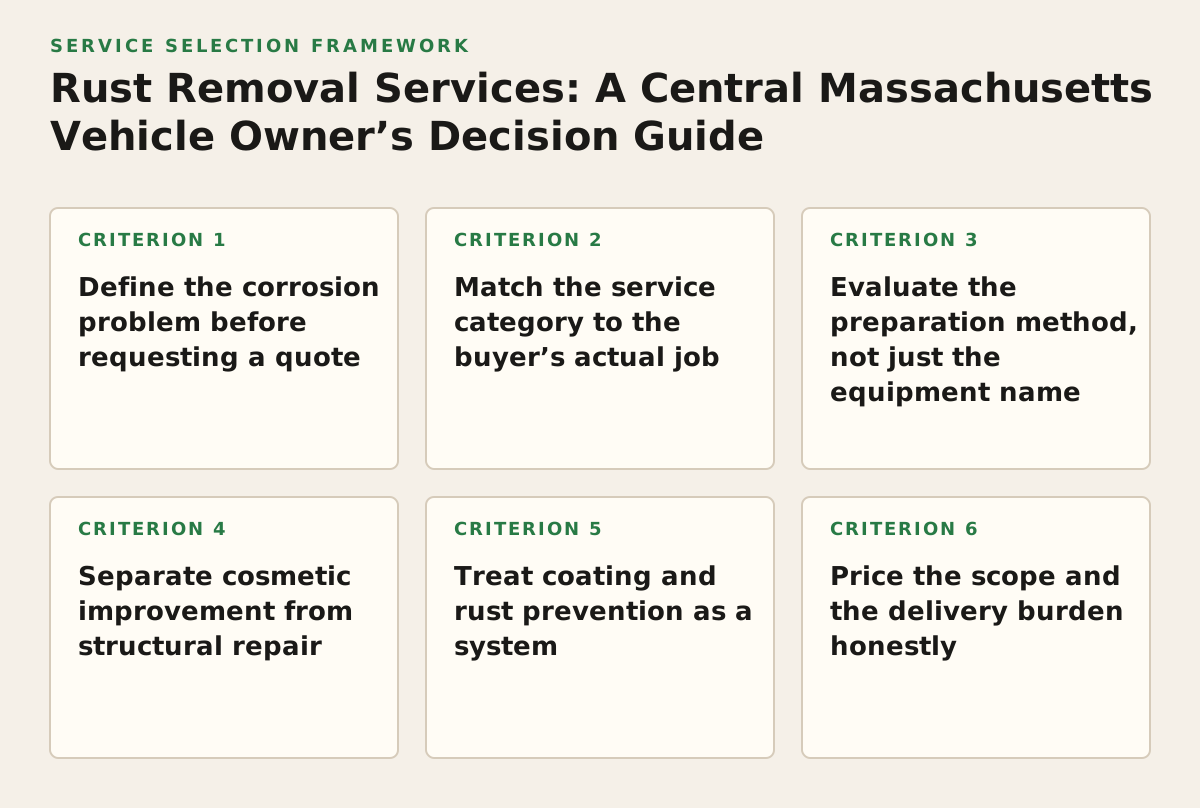
1. Define the corrosion problem before requesting a quote
Rust is a condition to diagnose, not a single repair category. Brown staining on a door seam, perforated rocker panel, flaking frame rail, and deeply pitted suspension bracket may all be described as “rust,” but they require different levels of access and risk control.
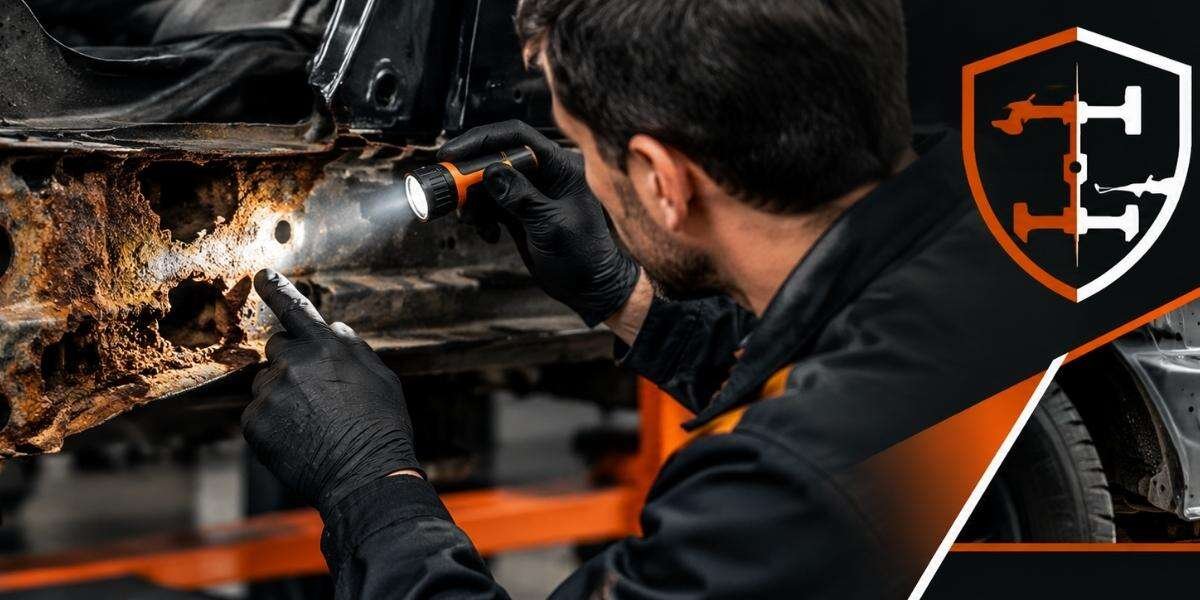
Start by documenting the vehicle and the decision you need to make. Photograph the affected areas after washing away loose dirt, then record the vehicle year, make, model, mileage, intended use, and whether it must remain roadworthy during the work. For a used-car purchase, obtain an independent inspection before committing to cosmetic repairs. For a fleet, record which units are exposed to brine, plowed roads, construction sites, or coastal air.
Use these practical problem categories
- Surface corrosion: light oxidation or scale that has not created holes or materially reduced the section.
- Localized perforation: rust-through in a panel, bracket, wheel arch, cab corner, or body mount area.
- Hidden corrosion: rust inside boxed frame sections, behind liners, beneath seam sealer, or between overlapping panels.
- Structural corrosion: thinning, cracking, separation, or perforation in a frame rail, crossmember, suspension mount, body mount, or other load-bearing area.
- Restoration corrosion: widespread rust on a classic or specialty vehicle that requires disassembly, media removal, metal fabrication, and refinishing.
The location matters more than the color. A small hole in a nonstructural fender may be a body repair. A similar-sized hole near a spring hanger or steering mount may change the vehicle’s safety and inspection position. Massachusetts requires periodic vehicle safety inspections, and its inspection information identifies structural components and frame-related conditions among items that can affect inspection outcomes; review the current state guidance when a vehicle has serious frame rust. Massachusetts inspection guidance should inform the conversation, but it does not replace a qualified structural assessment.
Failure mode: asking for “a price to remove the rust” before the provider has seen the vehicle. That encourages a surface-only estimate and leaves hidden metal loss, seized fasteners, broken clips, and access limitations to become change orders.
Implementation example: an owner of a 2015 pickup sees scale along the driver-side frame. Instead of requesting “undercoating,” the owner supplies underside photos, notes that the truck carries a plow, asks for frame-thickness and mount-area inspection, and requests separate pricing for cleaning, repair, and post-repair protection.
2. Match the service category to the buyer’s actual job
Different rust removal services solve different problems. The right choice depends on how much metal must be exposed, whether the vehicle can be disassembled, and whether the objective is preservation, inspection, repair, or restoration.
| Buyer need | Best-fit service type | What it usually involves | Main trade-off |
|---|---|---|---|
| Protect a newer truck, car, or leased vehicle before serious corrosion develops | Rust prevention undercoating and cavity protection | Cleaning, drying, masking, application to vulnerable exposed and enclosed areas, and a maintenance plan | It slows future corrosion but does not restore metal that is already weakened |
| Remove loose scale from an accessible frame or component | On-vehicle rust removal | Mechanical cleaning, localized blasting or other preparation, inspection, and coating | Lower disassembly burden, but hidden faces and enclosed sections may remain untreated |
| Expose a badly corroded frame or body shell for accurate assessment | Frame-off rust removal | Component removal, controlled abrasive or media blasting, cleaning, inspection, and documented repair scope | Greater labor, storage, labeling, and reassembly responsibility |
| Restore load-bearing metal | Automotive frame repair | Assessment, engineered or manufacturer-consistent repair approach, fabrication, welding, alignment checks, and corrosion protection | Safety and documentation matter more than cosmetic speed |
| Restore a classic or specialty vehicle | Restoration metal preparation and component work | Disassembly, media selection, rust removal, metal repair, surface preparation, and coordination with refinishing | Preserving original metal may conflict with replacing severely compromised sections |
| Maintain several work trucks or commercial vehicles | Fleet inspection, prioritized repair, and repeat protection program | Condition ranking, scheduling, standardized records, and recurring inspections | Consistency and vehicle availability may matter more than treating every unit identically |
Choose based on the endpoint. If the endpoint is “slow corrosion on an intact vehicle,” prevention is appropriate. If the endpoint is “prove what remains of a frame,” cleaning and exposure come first. If the endpoint is “return a vehicle to safe service,” structural evaluation and repair must control the scope.
For a frame that needs complete access, a frame-off rust removal may be more informative than cleaning only the visible underside. For a newer vehicle with sound metal, rust prevention undercoating can be the more proportionate service because it addresses future exposure rather than charging restoration-level effort for an intact frame.
Failure mode: selecting the least expensive category without asking what it cannot reach. A coating over packed scale, wet seams, or unexamined frame interiors can hide the condition instead of solving it.
Implementation example: a restoration shop outsourcing a 1968 vehicle does not ask for “blasting.” It specifies whether the shell, frame, suspension parts, and small brackets are separate work orders, which surfaces must remain identifiable, and whether the provider returns parts bare, primed, repaired, or ready for topcoat.
3. Evaluate the preparation method, not just the equipment name
“Sandblasting” describes a family of abrasive-cleaning processes, not a guarantee of quality. The useful questions concern access, media, pressure control, contamination, heat, moisture, and what happens immediately after the metal is exposed.
Ask how the method fits the part
- Mechanical scaling: useful for loose flaking rust and localized access, but it can leave tight corrosion in pits and seams.
- Abrasive blasting: effective for exposing broad metal surfaces, but it requires containment, cleanup, respiratory protection, and careful control around thin panels and delicate features.
- Non-abrasive or low-aggression media: may reduce damage to selected components, but the provider must explain how residue and remaining corrosion will be handled.
- Chemical treatment: can help with selected parts or residues, but compatibility, rinsing, drying, and waste handling become critical.
- Combination preparation: often makes sense when heavy scale, tight seams, and thin sheet metal occur on the same vehicle.
Controlled work is especially important when abrasive blasting is performed. OSHA identifies hazards associated with abrasive blasting, including airborne particles, noise, and equipment-related risks, and its guidance addresses ventilation, respiratory protection, protective clothing, and exposure control. Those requirements are not a decorative safety detail; they indicate whether a provider treats the process as an industrial operation rather than a quick cosmetic service. OSHA’s abrasive blasting guidance is a useful reference for evaluating the provider’s containment and worker-protection answers.
The post-cleaning window is part of the method. Bare steel can flash-rust when moisture remains in seams or the vehicle sits in a damp shop. Ask how the provider blows out cavities, checks for trapped media, handles residue, verifies dryness, and protects the surface before transport or repair.
Failure mode: treating maximum blast aggression as maximum quality. Excessive heat or pressure can distort thin panels, erase identifying marks, drive media into mechanisms, or create a clean-looking surface that is unsuitable for the next coating.
Implementation example: for a boxed frame with heavy scale, the work order can require staged cleaning, inspection through accessible openings, removal of abrasive from cavities, photographs before coating, and a written note identifying areas that could not be reached without cutting or disassembly.
4. Separate cosmetic improvement from structural repair
Clean metal is not automatically sound metal. Rust removal reveals the remaining section; it does not increase thickness that corrosion has already consumed. This distinction is essential for frame rails, suspension mounts, crossmembers, body mounts, tow points, and steering-related structures.
Before authorizing welding or patching, ask the provider to identify:
- the affected structural member and its load path;
- the boundaries of sound metal around the damaged area;
- whether the repair requires removing a suspension, body, fuel, brake, or exhaust component;
- how alignment and fit-up will be controlled;
- what inspection or documentation will be supplied after repair;
- how the repaired area will be sealed and protected from renewed salt intrusion.
A patch must transfer loads, not merely cover a hole. The repair approach should account for section thickness, shape, access, adjacent fatigue or cracking, weld access, drainage, and the possibility that the visible damage is only the edge of a larger weakened area. A provider who refuses to distinguish cosmetic plating from structural repair is not giving the buyer enough information to make a safety decision.
Check the vehicle identification number for open safety recalls before investing in major work. NHTSA explains that its recall search can identify unrepaired safety recalls for a specific vehicle, which may affect whether a corrosion-related repair is the owner’s first priority. NHTSA’s recall lookup is a sensible 2026 screening step; it does not diagnose rust or establish that a recall covers the condition.
Failure mode: coating a frame before a complete structural inspection. The coating may make later examination harder, trap debris against a weak area, or create false confidence for a buyer or fleet manager.
Implementation example: if blasting exposes a perforated crossmember, the job pauses at a defined inspection point. The provider photographs the exposed metal, marks the proposed repair boundaries, explains whether the section will be reinforced or replaced, and obtains approval for the structural work before applying final protection.
5. Treat coating and rust prevention as a system
Rust prevention works best when it follows preparation rather than hiding it. The system includes cleaning, drying, access, drainage, product compatibility, application thickness or coverage requirements, and future inspection.
When evaluating a corrosion-protection service, ask:
- Which areas are cleaned and which are excluded?
- Are wheel wells, frame interiors, seams, pinch welds, body mounts, and cavities addressed separately?
- How are drains, exhaust components, brakes, belts, sensors, electrical connectors, and moving joints masked or protected?
- Is the product intended to remain waxy, cure into a film, or serve as a primer or topcoat?
- Can the surface be inspected later, and how will touch-ups be performed?
- What cleaning and reinspection schedule is recommended after winter use?
Coverage is not the same as encapsulation. A product on exposed frame faces may not reach an internal cavity, a lap seam, or the back side of a bracket. Conversely, filling a drainage path can create a moisture trap. The provider should show the application map and explain where access is impossible without disassembly.
For a vehicle that already has heavy loose scale, ask whether rust removal precedes the protective application. For a new truck, leased vehicle, or lightly used car, the work may focus on vulnerable seams and cavities while preserving service access. A fleet manager may prefer a repeatable inspection-and-touch-up process over a one-time application that has no record of what was covered.
Failure mode: using a coating as a substitute for cleaning, drying, or repair. The visible surface may darken and look improved while corrosion continues underneath or moisture remains in a boxed section.
Implementation example: a Central Massachusetts contractor schedules an annual spring inspection after winter salt exposure, records frame and body-mount photos by vehicle number, cleans damaged areas, touches up protection only where needed, and escalates any new perforation to structural review.
6. Price the scope and the delivery burden honestly
The quote should describe decisions, not just hours. Rust work expands when fasteners break, panels cannot be separated, media enters cavities, metal is thinner than expected, or the customer changes from “clean and coat” to “repair and refinish.” A useful estimate identifies what is known, what is provisional, and what triggers approval for additional work.
Questions to ask about the pricing model
- Is the estimate fixed, time-and-materials, or a hybrid with defined allowances?
- What inspection or disassembly is included before the final scope is known?
- Are blasting, media, containment, cleanup, drying, transport, storage, and disposal separate line items?
- Does the quote include removal and reinstallation of body, suspension, exhaust, fuel, brake, or electrical components?
- How are hidden damage and change orders documented and approved?
- Is primer, protective coating, seam sealing, cavity treatment, or final topcoat included?
- What deposit, payment stages, cancellation terms, and warranty limitations apply?
Budget by stage rather than by optimistic total. An illustrative starting policy—not a universal benchmark—is to authorize an initial inspection and exposure stage, reserve a separate approval for structural repair, and release final restoration or coating funds only after photographs confirm the completed preparation. This prevents a fleet or restoration budget from treating unknown corrosion as a fixed cosmetic expense.
Delivery burden also belongs in the comparison. A daily driver may require alternate transportation. A frame-off project needs indoor storage, labeled parts, a parts inventory, and a plan for keeping media away from bearings, seals, wiring, and fuel-system components. A business fleet needs downtime windows and a substitute vehicle schedule. Ask who transports the vehicle, who owns removed parts, and what happens if the project pauses while fabrication or replacement parts are sourced.
Failure mode: comparing a low quote that covers visible cleaning with a higher quote that includes disassembly, inspection, repair, coating, cleanup, and reassembly. The numbers are not describing the same endpoint.
Implementation example: a repair shop requests three line items—expose and document, repair approved structural areas, and protect/reassemble. Each line includes exclusions and an approval point, so the shop can pass a defensible scope to its own customer.
7. Verify the provider through evidence and measurable acceptance criteria
A professional conversation should produce more than confidence. It should produce a scope, evidence, and acceptance criteria that another person can understand later. This is particularly important when a vehicle is sold, transferred into a fleet, or returned to a restoration shop.
Useful success measures
- Condition evidence: before-and-after photographs from the same angles, with close-ups of structural areas and repaired sections.
- Scope completion: a checklist showing which components were removed, cleaned, repaired, coated, or excluded.
- Surface readiness: confirmation that loose scale, visible residue, trapped abrasive, and moisture were addressed before coating or primer.
- Functional completion: reinstalled components, restored clearances, usable fasteners, and no interference with brakes, exhaust, steering, suspension, or drainage.
- Protection record: product or system used, application areas, masking limitations, inspection date, and recommended maintenance action.
Do not demand a false numerical guarantee for a process whose result depends on hidden cavities, previous repairs, salt exposure, and vehicle use. Instead, require observable deliverables and clear exclusions. If a provider cannot photograph a repaired frame area because access is restricted, the limitation should be stated rather than implied away.
Red flags during evaluation
- The provider promises to “stop all rust forever” without discussing preparation or maintenance.
- The estimate says only “rust removal” and contains no areas, methods, exclusions, or endpoint.
- Structural repairs are proposed from photographs without an in-person inspection.
- The provider will not explain media containment, cleanup, drying, or protection of vehicle systems.
- Coating is offered before loose scale and damaged metal are evaluated.
- There is no process for documenting hidden damage or approving additional work.
- The provider cannot explain how removed parts will be labeled, stored, and returned.
Failure mode: accepting a glossy finish as proof of a successful repair. Appearance is one acceptance criterion; access, sound metal, correct reassembly, drainage, and documented protection are separate criteria.
Implementation example: a used-truck buyer makes the sale conditional on an independent inspection, receives photographs of the frame after cleaning, and asks for a written statement distinguishing surface scale from areas that were not accessible. That evidence is more useful than a general claim that the truck was “rustproofed.”
8. Use a focused vendor interview before authorizing work
The best interview tests how the provider handles uncertainty. Give the same photographs and vehicle details to each candidate, then compare the questions they ask and the limits they disclose—not just their proposed method.
Vendor interview checklist
- What do you believe the vehicle needs, and what can only be determined after cleaning or disassembly?
- Which service category are you quoting: localized cleaning, frame-off preparation, structural repair, prevention, or a combination?
- What surfaces and cavities can you access, and which will remain untreated?
- How will you protect bearings, seals, wiring, glass, brakes, exhaust components, and interior areas?
- What media or preparation method is appropriate for each material, and why?
- How do you control dust, abrasive residue, moisture, and flash rust?
- What evidence will I receive before hidden damage is covered?
- Who performs structural repairs, and how are repair boundaries and reassembly checked?
- What is fixed in the estimate, what is provisional, and what event creates a change order?
- How long must the vehicle or parts remain at your facility, and what storage or transport responsibilities apply?
- What product or protection system will be used, where will it be applied, and how is future inspection performed?
- What maintenance or follow-up inspection do you recommend after the 2026–2027 winter season?
Ask for relevant examples without demanding confidential customer information. A classic restoration, a plow truck, a newer pickup, and a commercial fleet vehicle present different constraints. The provider should be able to explain the difference in process, not merely show a clean photograph.
Failure mode: interviewing only about brand names or equipment. Tools matter, but the buyer needs a controlled sequence from diagnosis through preparation, repair, protection, documentation, and return to service.
Implementation example: a fleet manager scores each candidate on scope clarity, access plan, downtime, change-order process, documentation, safety controls, and follow-up. The lowest initial quote is not automatically selected if it leaves structural inspection or cavity treatment undefined.
Implement the work in a controlled sequence
Use the following sequence for a personal vehicle, restoration project, repair-shop referral, or fleet program. It keeps unknown corrosion from being buried under a premature finish.
- Record the vehicle’s purpose and exposure. Note daily driving, winter storage, plowing, towing, commercial use, restoration goals, and whether the vehicle must remain available.
- Gather evidence before cleaning. Photograph the exterior and underside, record symptoms such as flaking or cracking, check the VIN for recalls, and obtain an independent inspection when structural safety is uncertain.
- Define the endpoint. Choose preservation, accessible rust removal, full exposure, structural repair, restoration preparation, or a recurring fleet-maintenance program.
- Request comparable scopes. Give each provider the same vehicle information and require separate descriptions for preparation, disassembly, repair, coating, reassembly, storage, and exclusions.
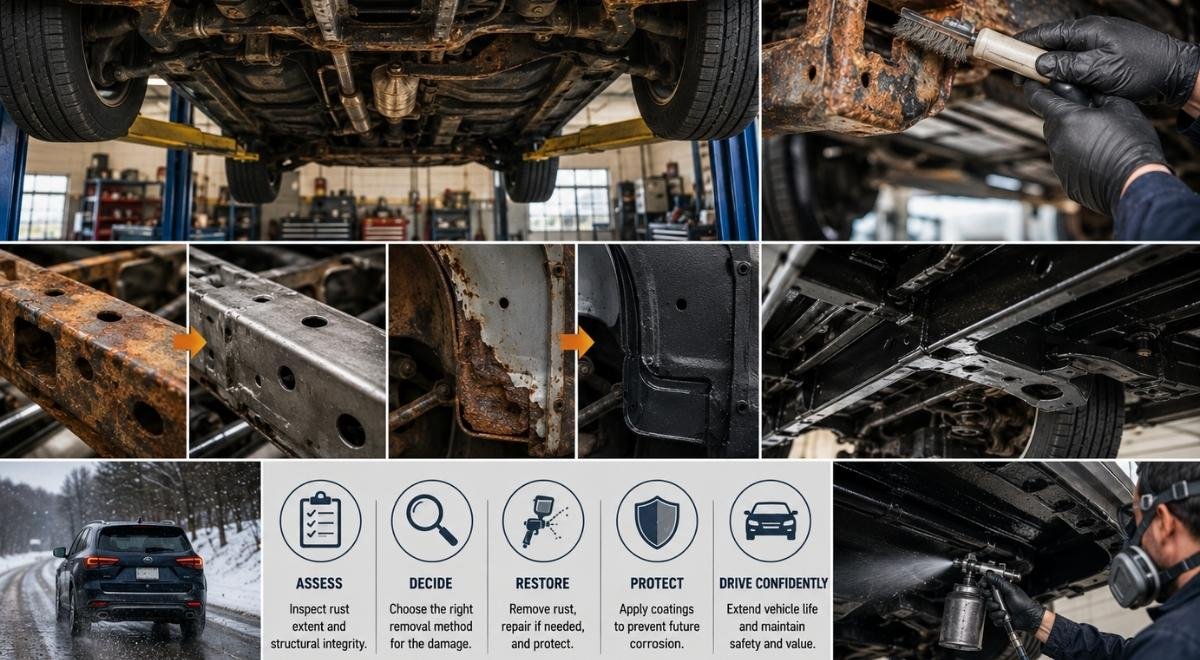
- Inspect and expose before approving hidden work. Establish a pause point after loose corrosion is removed so the remaining metal and any structural damage can be documented.
- Approve repairs with written boundaries. Confirm repair locations, fabrication or replacement decisions, change-order rules, and the inspection evidence that will be supplied.
- Apply protection only after preparation is accepted. Verify dryness, cleanup, masking, drainage, and access before authorizing undercoating or cavity treatment.
- Check function and documentation at pickup. Review reassembly, clearances, drains, photographs, product records, excluded areas, and care instructions before returning the vehicle to service.
- Schedule the next inspection. Recheck after winter salt exposure, after off-road or plow use, or according to the provider’s written maintenance recommendation. Update the vehicle record with new photographs and any repaired locations.
For Central Massachusetts owners, the practical recommendation is to treat rust removal as a staged decision: expose the condition, repair compromised metal, then protect sound and repaired surfaces with a maintainable system. Bay State Rust Prevention provides rust prevention undercoating, rust removal, frame-off sandblasting, and automotive frame repair for owners and automotive businesses across Worcester and Central Massachusetts; visit baystaterustprevention.com through baystaterustprevention.com when you are ready to discuss a documented scope.