
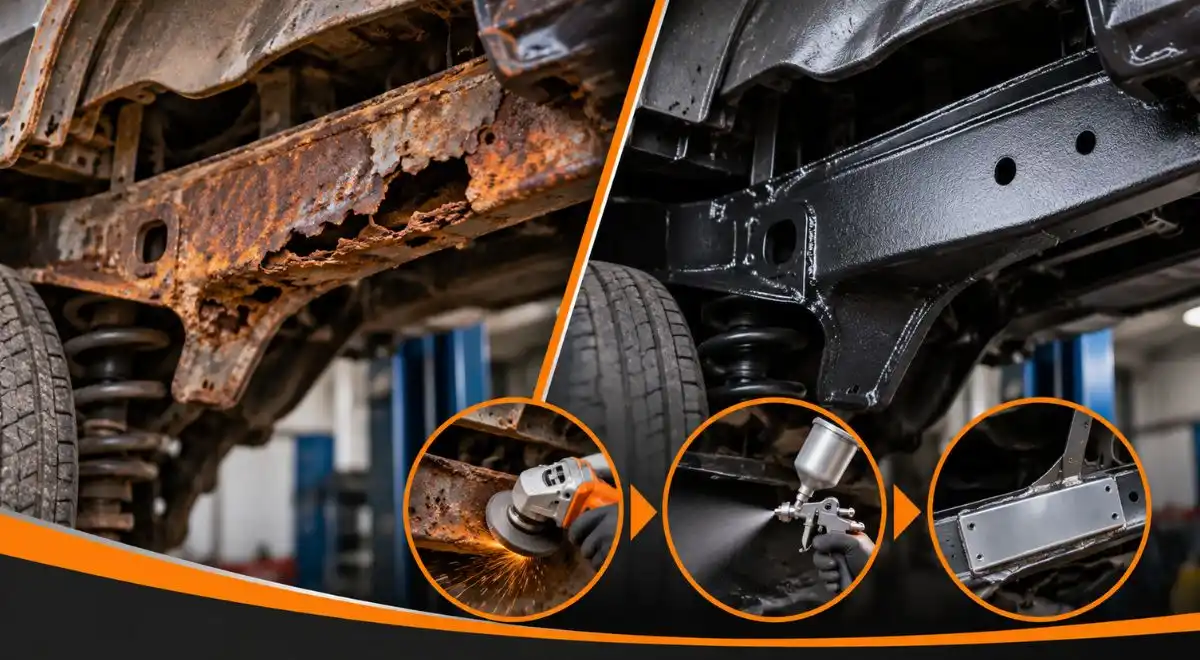
The answer to when to choose frame-off sandblasting is when separating a body from its frame will provide access needed to inspect, clean, or prepare concealed frame areas for planned repair or restoration. First confirm that the vehicle has body-on-frame construction: many modern cars and some other vehicles use unibody construction, where there is no separate body and chassis frame to remove in the conventional sense. For accessible, localized rust, a narrower inspection and treatment may be more appropriate if it can answer the repair question.
Confirm the vehicle’s construction before considering teardown
In conventional frame-off work, the vehicle’s body is separated from a distinct chassis frame. That description fits body-on-frame vehicles; it is not a general name for removing rust from every vehicle. With a unibody vehicle, structural loads are carried through the body structure rather than a separate chassis frame, so repairs and rust removal need to be planned around the affected structural sections and the manufacturer’s repair information. Do not assume a unibody can be handled by simply lifting a body off a frame.
Construction type is not always easy to identify from a photograph or a quick look underneath, particularly when coatings and attached components obscure the structure. If you are unsure, ask a repair professional to identify the vehicle’s construction and explain which parts are structural. This is especially useful for used-car buyers, who may be evaluating a questionable area before purchase, and for shops planning outsourced restoration work.
- Body-on-frame: Ask whether the body must be separated to reach the specific frame surfaces or mounts in question.
- Unibody: Ask which structural sections are affected and how they will be inspected and repaired; do not treat “frame-off” as a literal or automatic solution.
- Unclear construction or scope: Have the shop identify the structure and the access problem before approving disassembly.
The term “frame-off” also does not define a complete job. It does not, by itself, specify which components are removed, what gets blasted, how corrosion is assessed, or whether repairs and final protection are included. Treat it as a description of a possible access step—not a diagnosis or a promise that the vehicle will be restored.
Use the corrosion concern to define the access needed
Separate visible evidence from a repair finding
Rust on an exposed surface can be a reason to investigate, but appearance alone does not establish how much sound metal remains. Flaking, scale, perforation, distortion, or corrosion around a joint or mounting point are clues to examine, not proof that a frame is either repairable or beyond repair. A coating or attached part may also hide the extent of a problem.
Before authorizing major disassembly, ask what is known from the current inspection and what remains hidden. The key is whether the concealed area could change the repair decision. If an inspection in place can show the affected metal adequately, separating the body may add little. If access is blocked and the condition of a structural area matters to the planned repair, the uncertainty may justify a more extensive inspection plan.
For example, suppose corrosion is suspected near a body mount, but the mount and surrounding structure are partly obscured. The useful question is not simply whether blasting would make the area look cleaner. Ask whether the hidden metal can be assessed without removing the body, and what decision the additional access would support. By contrast, a small rusty bracket that is fully visible and accessible may not, by itself, justify a full teardown.
- Identify the specific suspected corrosion area and what currently obstructs the view.
- Ask whether the uncertainty affects safety, the proposed repair, or the restoration scope.
- Find out what further inspection would be possible without separating the body.
- Ask what findings after disassembly would change the plan or require a new approval.
These are ways to frame an inspection, not remote diagnoses. For a vehicle purchase, ask what a pre-purchase assessment can establish without dismantling the vehicle and what would remain uncertain. For a restoration, connect the proposed access to a defined structural or preparation task rather than a vague goal of making everything “like new.”
Choose frame-off when the added access serves a defined job
Frame-off work is most defensible when separating the body is needed for a specific inspection, structural repair, or restoration plan. The case is stronger when the work already requires substantial disassembly or when concealed frame surfaces must be exposed before a repair decision can be made. It is weaker when the only stated reason is that a more extensive process is automatically “better.”
Make the access-to-task link explicit
Ask the shop to name the areas that become reachable and explain what will be done with that access. Is the aim to inspect a particular mounting area, remove rust and old coating from specified frame surfaces, prepare the frame for planned metalwork, or coordinate several tasks within a restoration? A clear answer lets you judge whether the additional work addresses your vehicle’s actual condition.
Bay State Rust Prevention lists frame-off vehicle disassembly, sandblasting, bare-metal preparation, and automotive frame repair among its capabilities. Its frame-off rust removal page identifies the related rust-removal service. That information describes the business’s stated capabilities; it does not determine whether a particular vehicle needs teardown. Confirm the proposed vehicle-specific scope, including which operations are included and which decisions depend on inspection after disassembly.
Where frame repair is already planned, rust removal and preparation may be considered as part of the same project. But newly exposed metal is not automatically suitable for reuse. Cleaning, assessment, metal repair, and corrosion protection are distinct steps, and the condition revealed at each stage may affect the next one. Agree in advance how the shop will report findings and seek approval if the scope changes.
- Potential reason to consider frame-off: a concealed structural area cannot be assessed adequately in place, and its condition affects a planned repair.
- Another possible fit: a body-on-frame restoration already requires separation, and the exposed frame needs inspection or preparation as part of that defined work.
- Reason to pause: the estimate uses “frame-off” without naming the areas, tasks, or decisions that require the added access.
Consider a narrower approach when it can answer the same question
If rust is limited to a reachable area, ask whether local cleaning, inspection, and repair can address it without separating the body. The appropriate scope depends on the location and condition of the metal, nearby components, available access, and the vehicle’s intended use. The most extensive option is not automatically the most suitable one.
A narrower plan is worth discussing when a professional can inspect the affected area in place and the proposed repair does not depend on opening up other parts of the vehicle. It is not a sound shortcut if a questionable structural area remains hidden or if the repair would cover over a condition that has not been assessed. The aim is to avoid unnecessary disassembly without leaving a consequential uncertainty unresolved.
Owners of daily drivers and fleet vehicles may have different priorities from classic-car restorers. A fleet decision may focus on addressing a known defect in proportion to the vehicle’s role and repair needs. A restoration may involve wider disassembly because access to multiple components is part of the intended project. In either case, ask the shop to tie the scope to a finding or a clearly stated objective, not just to the vehicle category.
Rust removal and corrosion prevention also answer different needs. Removing rust does not, by itself, repair weakened metal; applying a protective coating does not replace necessary structural repair or preparation. If the vehicle is sound and your goal is prevention rather than frame restoration, ask about the proposed protection and how it suits the existing surface condition. Bay State Rust Prevention describes its prevention work on its rust prevention undercoating page; confirm the treatment and preparation proposed for your vehicle rather than assuming a particular coating suits every condition.
- Discuss localized work when the affected area is accessible and inspection finds no related hidden concern.
- Seek more inspection when coatings or attached parts prevent a useful assessment of suspected structural rust.
- Consider prevention when the vehicle is sound and the job is corrosion protection, not repair of damaged metal.
- Reconsider full teardown if it would expose no relevant surface or change no inspection or repair decision.
Know what blasting does—and what still needs assessment
Surface preparation cannot replace metal repair
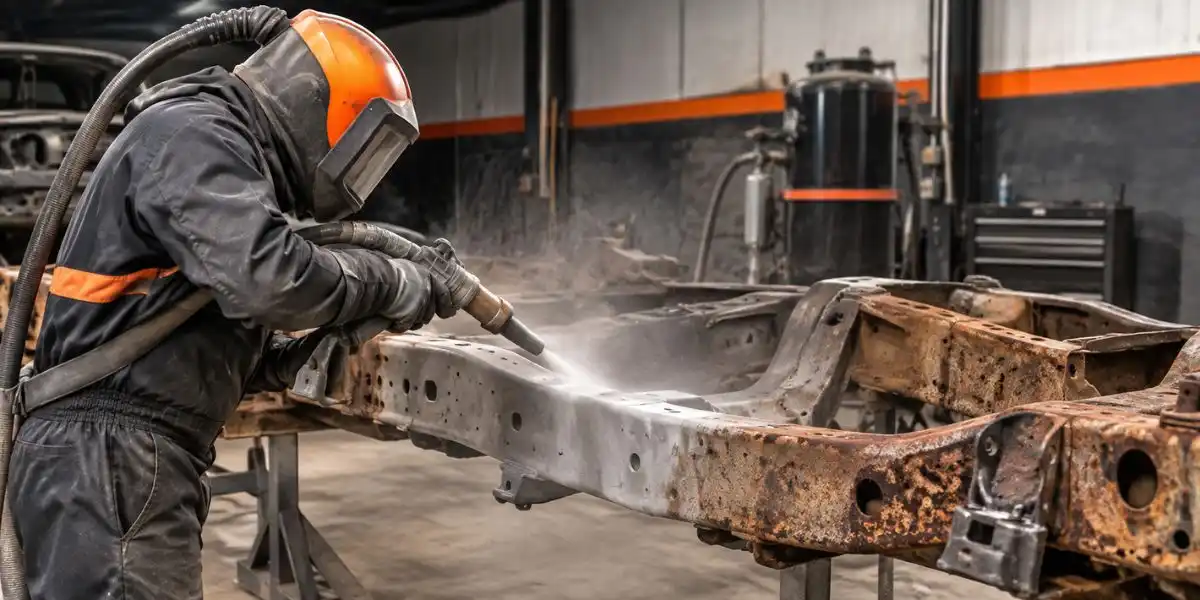
Abrasive blasting propels abrasive material at a surface to remove rust, coatings, or other contamination. The appropriate process and controls depend on the job and materials. OSHA’s abrasive-blasting standard addresses workplace measures such as ventilation and dust collection in covered operations; it underscores that blasting is a controlled work process, not simply a cosmetic cleanup (OSHA standard 1910.94).
After cleaning, the exposed metal still needs assessment. Blasting cannot put back metal lost to corrosion, and a clean appearance is not proof of structural soundness. Ask how the shop will report areas where cleaning reveals loss, perforation, or damage that affects the planned repair. Establish whether added repair work requires your approval and what happens if the initial estimate cannot account for what is concealed.
Ask how the work area and materials are managed
Blasting creates dust and debris, and nearby components or surfaces may need protection or removal. Ask which surfaces are included, what is excluded, how surrounding parts are protected, and how the shop manages the work area and debris. OSHA’s abrasive-blasting standard addresses ventilation and dust control in covered operations, but it does not specify the exact plan for your vehicle; the shop should explain what controls apply to the work being proposed (OSHA abrasive-blasting requirements).
Dust questions should also account for the abrasive and the material being removed. CDC/NIOSH describes health risks from inhaling respirable crystalline silica (CDC/NIOSH silica information). OSHA’s construction silica standard sets requirements for covered construction work, but its applicability depends on the work and setting; it should not be presented as a universal rule for every automotive shop (OSHA construction silica standard).
Old coatings may also warrant questions about the material being removed. Do not assume a particular vehicle coating contains lead—or that it does not—based only on appearance or age. If there is a specific concern, ask the shop how it identifies and manages the material. OSHA’s general-industry lead standard sets requirements for covered occupational exposures; whether it applies depends on the work and exposure conditions (OSHA lead standard).
Approve a staged scope, not just the word “frame-off”
Before authorizing disassembly, request a written sequence that separates access work, inspection, blasting, metal repair, and final protection. A staged plan matters because the condition may become clearer only after parts or coatings are removed. The initial estimate should say what is included, what is excluded, and how the shop will handle newly discovered damage or work beyond the agreed scope.
Use the estimate to test whether the process answers your original question:
- Construction and access: Does the vehicle have a separate frame, and which components will be removed to reach the named areas?
- Inspection: What will be assessed after cleaning, and how will findings about corrosion or metal loss be communicated?
- Repair decisions: What findings could lead to repair or replacement, and will additional work require approval?
- Blasting boundaries: Which surfaces are included, and what components or areas will be protected or excluded?
- Next steps: What preparation is required before repair or protection, and what work is not part of the estimate?
A proposal is difficult to assess if it treats blasting as the repair, promises a sound outcome before the metal is inspected, or leaves approval for added work unclear. A defined inspection stage and clear exclusions make uncertainty visible rather than disguising it as a fixed scope. That helps private owners, restoration shops, and fleet managers decide whether the access and repair plan are proportionate to the vehicle’s needs.
Choose frame-off sandblasting when a body-on-frame vehicle needs the access for a defined inspection, repair, or restoration task. If the vehicle is unibody, or the rust is accessible and localized, first ask whether a construction-appropriate, narrower inspection can answer the same question. Bay State Rust Prevention provides vehicle corrosion assessment, frame-off sandblasting, and automotive frame repair; see baystaterustprevention.com for its services and confirm the scope that fits your vehicle.