
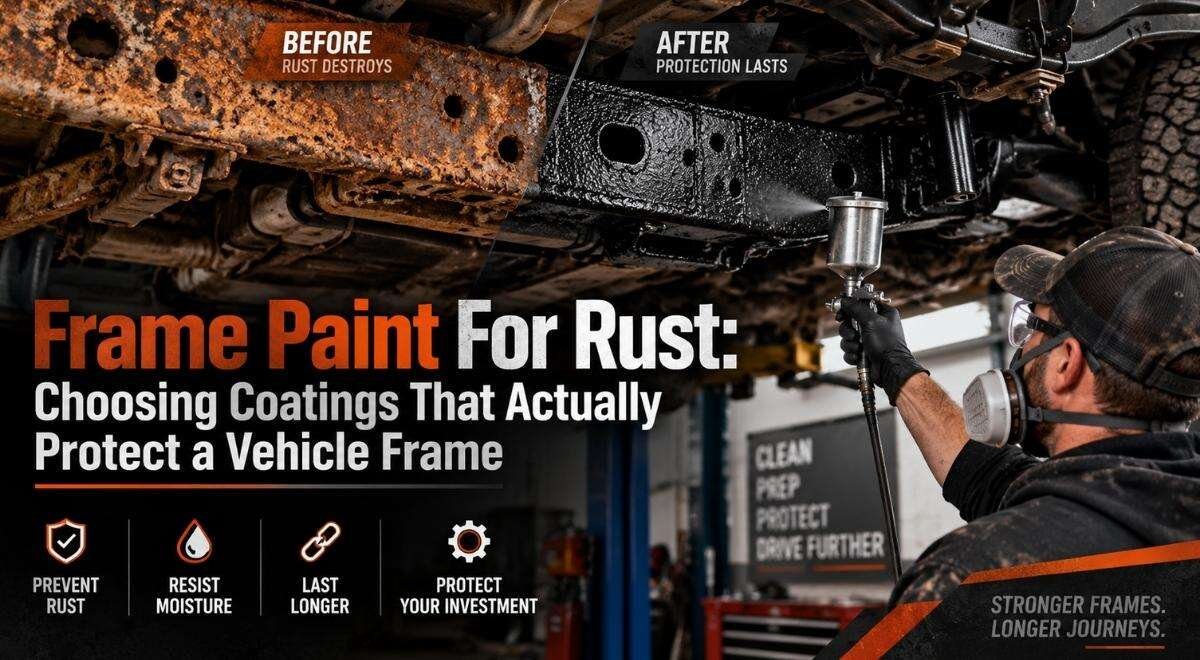
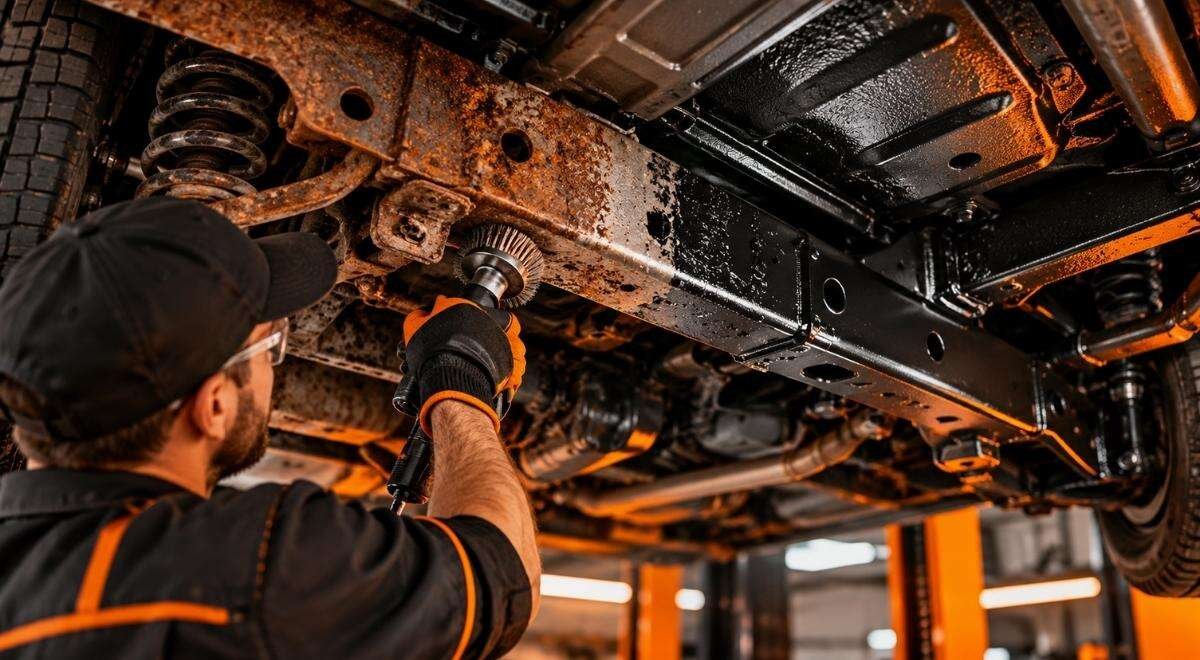
Frame paint for rust is only effective when the rust is removed or stabilized, the steel is dry and sound, and the coating matches the job. A chassis paint can protect a properly prepared frame from moisture and road salt, but it cannot restore steel that has lost structural thickness, seal damp scale, or replace a damaged section. For a Central Massachusetts truck, car, classic vehicle, or fleet unit, the correct sequence is usually inspection, cleaning or abrasive rust removal, repair where needed, primer, frame paint, and a separate cavity or underbody corrosion treatment.
What “Frame Paint For Rust” actually means
The phrase usually refers to a coating system applied to a vehicle frame, crossmember, axle housing, brackets, or other steel chassis components after corrosion has been addressed. It is not one universal product. “Frame paint” may mean an epoxy primer, a moisture-cured coating, a chassis enamel, a rust-converting coating, or a protective wax applied over a finished surface.
Paint is the barrier layer in a corrosion-control system. It separates steel from water, oxygen, salts, and contaminants. The barrier works only when it bonds to a surface that is sufficiently clean and stable. Loose flakes, oily residue, trapped moisture, and active corrosion underneath can lift the coating from the steel and allow rust to continue out of sight.
That distinction matters because a frame has different zones with different risks:
- Exterior frame rails: exposed to water, salt spray, gravel impact, and road debris.
- Overlapping seams and boxed sections: vulnerable to trapped moisture and difficult to inspect or coat.
- Mounts and brackets: subject to stress, crevice corrosion, and weld-related rust.
- Drain holes and cavities: easily blocked by heavy coatings, creating a moisture trap rather than solving one.
A product marketed for rusty metal may be suitable for a lightly rusted bracket but inappropriate for a perforated frame rail. The coating label, technical data sheet, intended film thickness, surface-preparation requirements, and recoat instructions should control the decision—not the color or the promise that it can be brushed directly over any rust.
How frame coatings differ from rust converters
A rust converter is intended to react with some iron-oxide corrosion and leave a treated surface for a compatible coating. It is not a substitute for removing thick scale or repairing weakened steel. A primer is designed to promote adhesion and provide corrosion resistance under a topcoat. A chassis topcoat adds environmental and impact resistance. A wax or fluid coating remains useful in seams and cavities because it can cover areas that paint cannot reach consistently.
Rust converter, primer, topcoat, and cavity protection are different jobs. Combining them without checking compatibility can create soft layers, poor adhesion, solvent lifting, or a surface that looks finished while corrosion remains underneath.
Why road salt makes frame coating a practical concern
Steel corrosion needs an electrolyte, and water containing dissolved salts can conduct electrical current more readily than relatively pure water. That supports the electrochemical reactions involved in corrosion. NOAA’s corrosion overview describes corrosion as an electrochemical process in which metals react with their environment; this is why persistent moisture and contamination are more important than appearance alone. NOAA explains the basic corrosion mechanism.
Road salt also changes how long contaminated moisture remains a problem. A vehicle can pick up salty spray in seams, behind brackets, inside wheel wells, and along the underside of a frame. If that residue is not rinsed away and the area does not dry, a painted surface can be attacked at chips, scratches, edges, and pinholes.
The U.S. Environmental Protection Agency identifies road salt as a source of chloride pollution and discusses how it moves with runoff into the environment. The same basic movement—water carrying dissolved salts into low spots and seams—helps explain why washing only the visible side of a frame is inadequate. See the EPA’s discussion of road salt and water quality.
For a Massachusetts owner, the useful question is not “What paint stops all rust?” It is:
- Where does salty water enter?
- Which surfaces can be cleaned and inspected?
- Where is the steel already thin or perforated?
- Which areas need a hard coating, and which need a flexible or creeping treatment?
- How will future washing and inspection be performed?
A coating reduces exposure; it does not eliminate maintenance. A vehicle that is driven through winter conditions still needs underside rinsing, drain paths kept open, and periodic visual checks for chips, swelling, new scale, or coating separation.
How a frame-paint system works
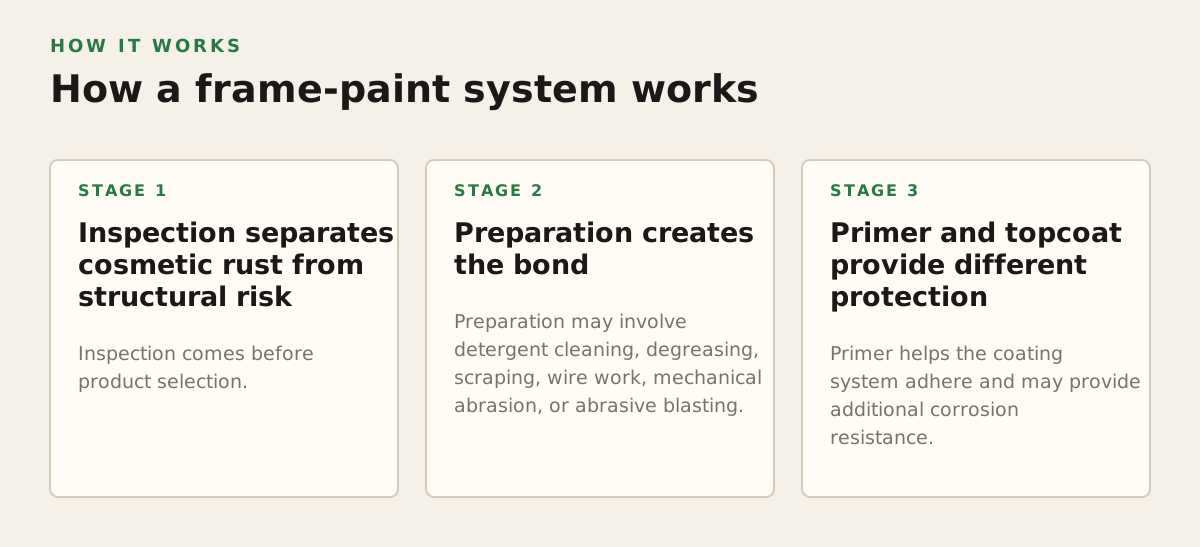
1. Inspection separates cosmetic rust from structural risk
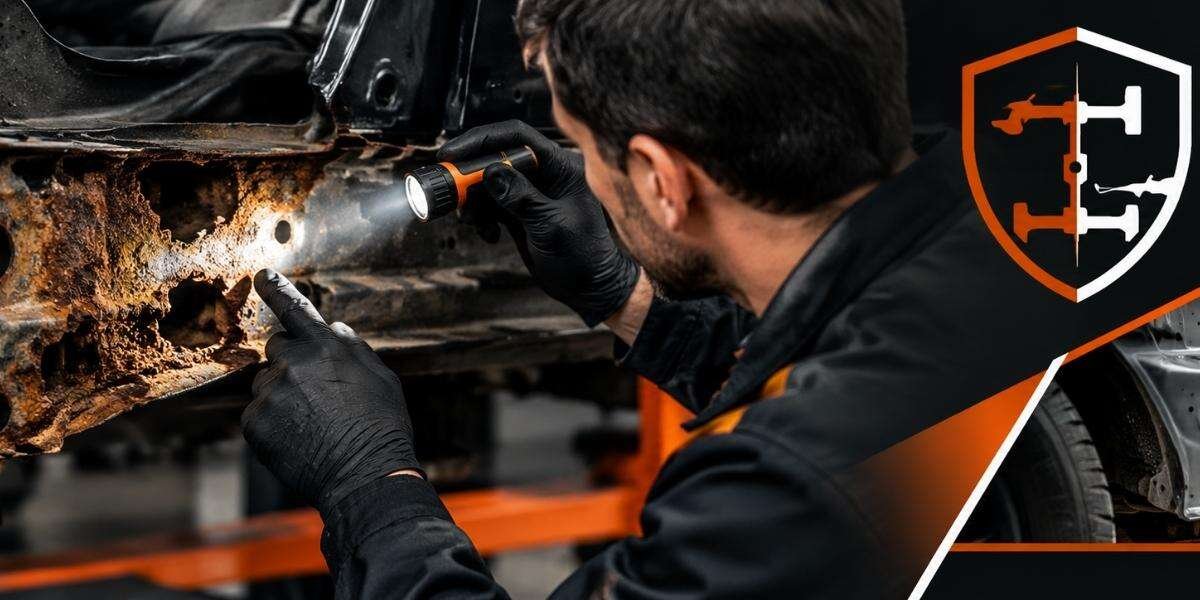
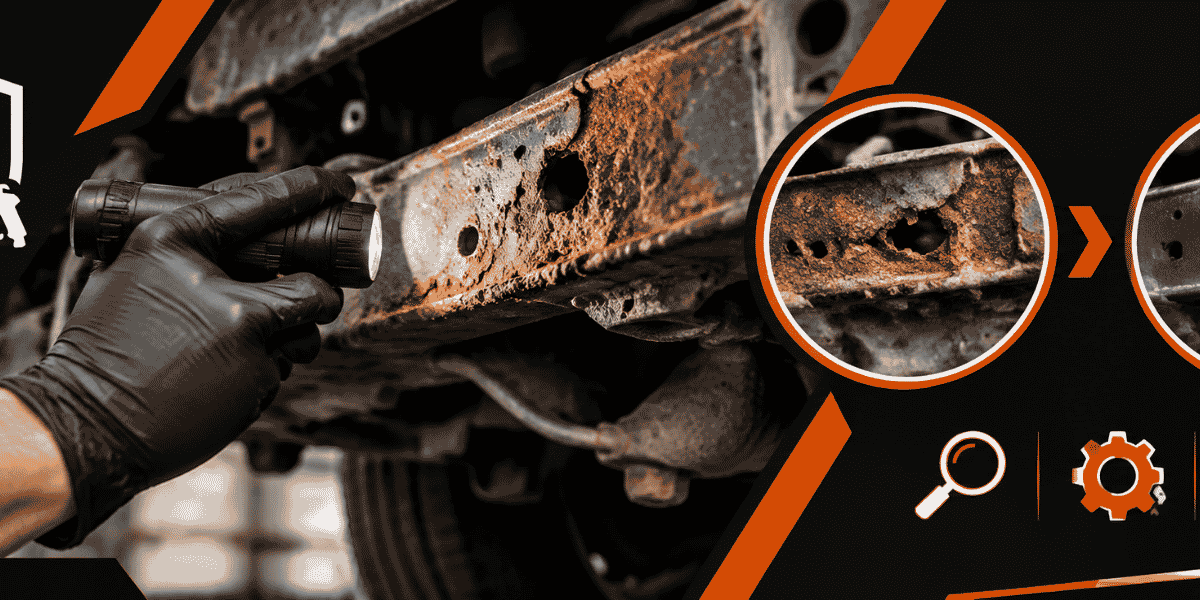
Inspection comes before product selection. Surface rust may leave the steel substantially sound, while layered scale can conceal deep pitting. Rust around a suspension, steering, body, or drivetrain mount deserves particular attention because the visible corrosion may not show the full condition of the load path.
A useful inspection records the condition of:
- frame rails and their lower flanges;
- crossmembers, brackets, and welded joints;
- spring, control-arm, steering, and body mounts;
- brake-line and fuel-line attachment areas;
- boxed sections, drain holes, and overlapping plates;
- previous patches, drilled holes, and old undercoating.
Proximity to a mount is a reason for closer examination, not proof of failure. A qualified repair professional may use visual inspection, probing where appropriate, measurements, or other methods to determine whether steel is merely scaled, materially thinned, cracked, or perforated. Paint should wait until the repair decision is clear.
2. Preparation creates the bond
Preparation may involve detergent cleaning, degreasing, scraping, wire work, mechanical abrasion, or abrasive blasting. The method depends on the vehicle’s condition and on what must be protected nearby. Heavy scale often needs to be removed mechanically; a thin orange stain may need less aggressive treatment.
Abrasive blasting can expose sound steel and reveal the true extent of pitting, but it creates dust, noise, and a risk of damaging adjacent components or forcing abrasive into bearings, seals, electrical connectors, and enclosed spaces. OSHA discusses hazards and controls associated with abrasive blasting, including respiratory protection, containment, and exposure management, in its abrasive blasting guidance.
After preparation, the surface must be compatible with the selected coating. Some systems require a particular cleanliness level, a dry surface, a defined profile, or a limited interval before priming. The manufacturer’s technical instructions are more reliable than a generic rule such as “paint over anything that feels solid.”
3. Primer and topcoat provide different protection
Primer helps the coating system adhere and may provide additional corrosion resistance. The topcoat supplies the finished barrier and may be formulated for abrasion, weather, chemicals, or chassis use. A single thick application is not automatically better: excessive film can trap solvent, sag, crack, or hide defects that should remain visible.
On a restoration project, a practitioner may use an epoxy-based primer over prepared steel, followed by a compatible chassis coating. On a working truck, the priority may be durable coverage that can be inspected and renewed without making future repairs difficult. The best coating is the one that fits the substrate, exposure, repair plan, and maintenance access.
Illustrative examples—not universal product specifications—show how the decision changes:
- Light surface oxidation: clean and abrade the sound steel, apply the specified primer and topcoat, then inspect chips after winter use.
- Heavy flaky scale: remove scale far enough to determine whether the remaining metal is sound before deciding between coating and repair.
- Perforation near a mount: stop treating it as a paint job and obtain a structural repair assessment before coating.
- Closed cavity with sound exterior metal: use a compatible internal corrosion treatment without blocking drainage or inspection access.
Where frame paint breaks down
The most common failure is coating over contamination. Oil, road film, silicone, salt residue, and dampness can prevent adhesion. The paint may look smooth when applied but later blister, flake, or peel at edges and seams.
Rust scale is not a dependable foundation. A coating can bind to the outer layer while the underlying corrosion remains active. Freeze-and-thaw movement, vibration, stone impact, and moisture entering through a chip can then separate the coating from the frame.
Other failure modes include:
- Coating a wet frame: moisture becomes trapped beneath the film.
- Sealing drain holes: water remains inside a boxed section.
- Painting over grease: the film loses adhesion at contaminated areas.
- Using incompatible layers: solvents or curing reactions damage the earlier coat.
- Hiding a repair: thick coating makes future cracking, bulging, or new rust harder to see.
- Ignoring impact damage: gravel chips expose bare steel even when the surrounding coating is intact.
Paint also cannot correct geometry, restore missing metal, or make a cracked weld safe. The Federal Highway Administration’s corrosion-resistance materials emphasize that corrosion control depends on design, detailing, materials, and maintenance rather than on one isolated finish. That broader principle applies to vehicle frames: drainage, access, joints, and repair quality affect the result. See the FHWA publication on corrosion-resistant materials and systems.
Heavy rubberized undercoating presents a special inspection concern. It can reduce direct splash in some applications, but if applied over active rust or damp debris it may conceal progression. It can also make later blasting and welding more difficult. A protective layer should not be chosen merely because it is thick.
How professionals apply Frame Paint For Rust
For newer trucks, cars, and leased vehicles
Prevention starts with access and cleanliness. A new or lightly used vehicle may need less aggressive rust removal, but its seams, crossmembers, fasteners, and cavities still require attention. The sensible approach is to inspect the underside, wash away manufacturing residue and road contamination, allow it to dry, and use products that preserve drain paths and service access.
For owners who expect to keep a vehicle through several Massachusetts winters, a properly prepared coating system can be paired with rust prevention undercoating in suitable exposed areas. Flexible protection may be more appropriate than a rigid decorative finish around some seams, while exposed frame faces may benefit from a harder paint system.
For rust-damaged frames and restoration projects
Restoration requires a different order of operations. Remove old undercoating where it conceals the metal, document the condition, and separate repairable surface corrosion from sections that need metal replacement. After welding or component replacement, remove weld spatter and contamination, prepare the surrounding steel, and apply a compatible system while access remains available.
For extensive corrosion, frame-off rust removal can make inspection and preparation more complete because components are separated and hidden surfaces become accessible. It is not automatically necessary for every vehicle; the decision depends on the extent of corrosion, the vehicle’s value, the desired restoration standard, and whether disassembly can be performed without creating new damage.
For used-car buyers, fleets, and repair shops
A buyer evaluating a used vehicle should look beyond a freshly black underside. Ask whether the coating is original or recent, whether photographs exist before application, and whether repairs were made beneath it. Look for uneven texture, lifted edges, visible patches, blocked drain holes, fresh hardware surrounded by old corrosion, and rust bleeding through seams.
Fleet managers and repair shops should treat frame coating as a maintenance record, not a one-time cosmetic event. Record the vehicle identification, areas treated, preparation method, repair locations, coating products, and areas intentionally left accessible. This helps the next technician distinguish an inspected repair from an unknown layer of undercoating.
A practical workflow is:
- define whether the goal is prevention, preservation, restoration, or sale preparation;
- clean and inspect before selecting the coating;
- remove scale and old coatings where they obstruct judgment;
- repair weakened or perforated steel before painting;
- apply primer and topcoat according to the product instructions;
- protect cavities without blocking drainage or hiding inspection points;
- document the work and schedule future visual checks after exposure to winter roads.
Choose inspection over optimism when corrosion affects a load-bearing area. For a sound frame, preparation and a compatible coating can slow contamination-driven corrosion. For a weakened frame, the correct service is repair or replacement first, followed by a coating system that protects the completed work.
Bay State Rust Prevention serves Worcester and Central Massachusetts with rust removal, frame repair, vehicle rust prevention undercoating, and restoration work using WaxOyl for corrosion protection. If the frame condition is uncertain, Bay State Rust Prevention can help determine whether the vehicle needs preparation and paint, deeper rust removal, or structural frame work before protection.